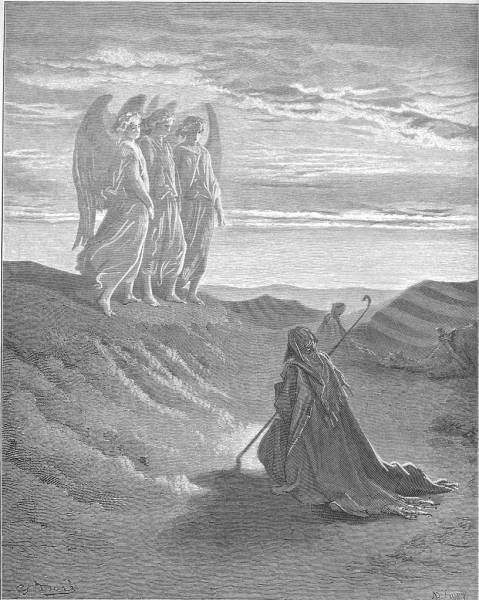
Gustave Doré
(Strasbourg, France, 1832 - 1883)
Genesis 18:1-15
Following the triumph over Jericho and Ai, the conquest of Canaan saw Joshua achieve pivotal victories that defined his leadership. Two notable wins stand out: one at Gibeon, against the alliance of tribes and kings in the southern region, and the other at the waters of Merom, against a similar coalition in the north. In both instances, Joshua employed surprise attacks, capitalizing on his attributes of integrity, faith, prayer, and innate military prowess. His resolute decisiveness, swiftness, bravery, foresight, and unwavering determination proved crucial in achieving victory. Joshua's capabilities as a military commander rivaled Moses' capacity as a legislator, showcasing the complementarity of their respective skills and callings.
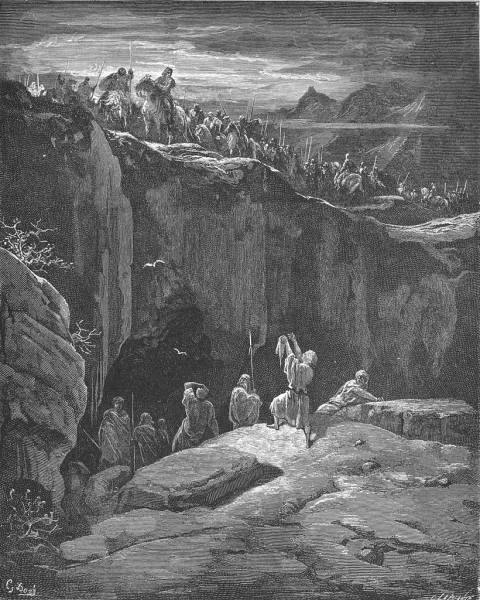
The initial battle unfolded at Gibeon, where Joshua learned of a coalition of five kings amassed against the city. In a bold night maneuver from Gilgal, he descended upon the adversary with incredible force, resulting in an instantaneous routing of the opposing forces. The overwhelming triumph was accentuated by a fierce hailstorm that inflicted even greater casualties than the victorious army's swords. However, as the pursuit extended into the approaching darkness, the prospects of an interruption in capitalizing on the victory loomed large.
Recognizing the urgency of capitalizing on their advantage, Joshua sought to secure the full benefits of triumph. This led to the remarkable event recounted in the narrative. Inspired by divine guidance, Joshua issued a command for the sun and moon to remain suspended in their positions, an order miraculously obeyed by these celestial bodies. The luminous glow persisted "until the people had avenged themselves upon their enemies." The historian aptly notes, "And there was no day like that before it or after it, that the Lord hearkened unto the voice of a man."
Despite the historical event's occasional subject to ridicule or skepticism, such reactions lack justification. The narrative does not necessitate a sudden cessation of Earth's rotational motion. The account adheres to the biblical practice of portraying events based on their observable features. The essential point to grasp is that there was a temporary optical pause of the sun—an extraordinary astronomical occurrence that supernaturally prolonged daylight. This extension facilitated Israel's completion of the enemy's defeat. For the rest of the world, the appearance of the sky remained unchanged. The feasibility of God executing this remarkable miracle is undeniable for those who believe in His existence. Considering the circumstances, the action seems fitting, likely igniting a surge of zeal among the people and significantly contributing to their ultimate success.
1 Now when Adoni-Zedek king of Jerusalem heard how Joshua had taken Ai, and had utterly destroyed it; as he had done to Jericho and her king, so he had done to Ai and her king; and how the inhabitants of Gibeon had made peace with Israel, and were among them,
2 they were very afraid, because Gibeon was a great city, as one of the royal cities, and because it was greater than Ai, and all its men were mighty.
3 Therefore Adoni-Zedek king of Jerusalem sent to Hoham king of Hebron, Piram king of Jarmuth, Japhia king of Lachish, and Debir king of Eglon, saying,
4 “Come up to me and help me. Let us strike Gibeon; for they have made peace with Joshua and with the children of Israel.”
5 Therefore the five kings of the Amorites, the king of Jerusalem, the king of Hebron, the king of Jarmuth, the king of Lachish, and the king of Eglon, gathered themselves together and went up, they and all their armies, and encamped against Gibeon, and made war against it.
6 The men of Gibeon sent to Joshua at the camp at Gilgal, saying, “Don’t abandon your servants! Come up to us quickly and save us! Help us; for all the kings of the Amorites that dwell in the hill country have gathered together against us.”
7 So Joshua went up from Gilgal, he, and the whole army with him, including all the mighty men of valor.
8 Yahweh said to Joshua, “Don’t fear them, for I have delivered them into your hands. Not a man of them will stand before you.”
9 Joshua therefore came to them suddenly. He marched from Gilgal all night.
10 Yahweh confused them before Israel. He killed them with a great slaughter at Gibeon, and chased them by the way of the ascent of Beth Horon, and struck them to Azekah and to Makkedah.
11 As they fled from before Israel, while they were at the descent of Beth Horon, Yahweh hurled down great stones from the sky on them to Azekah, and they died. There were more who died from the hailstones than those whom the children of Israel killed with the sword.
12 Then Joshua spoke to Yahweh in the day when Yahweh delivered up the Amorites before the children of Israel. He said in the sight of Israel, “Sun, stand still on Gibeon! You, moon, stop in the valley of Aijalon!”
13 The sun stood still, and the moon stayed, until the nation had avenged themselves of their enemies. Isn’t this written in the book of Jashar? The sun stayed in the middle of the sky, and didn’t hurry to go down about a whole day.
14 There was no day like that before it or after it, that Yahweh listened to the voice of a man; for Yahweh fought for Israel.
15 Joshua returned, and all Israel with him, to the camp to Gilgal.
Joshua 10:1-15 · World English Bible

1832 - 1883
Strasbourg, France
Paul Gustave Louis Christophe Doré (6 January 1832 – 23 January 1883) was a French artist, printmaker, illustrator, comics artist, caricaturist, and sculptor who worked primarily with wood-engraving.