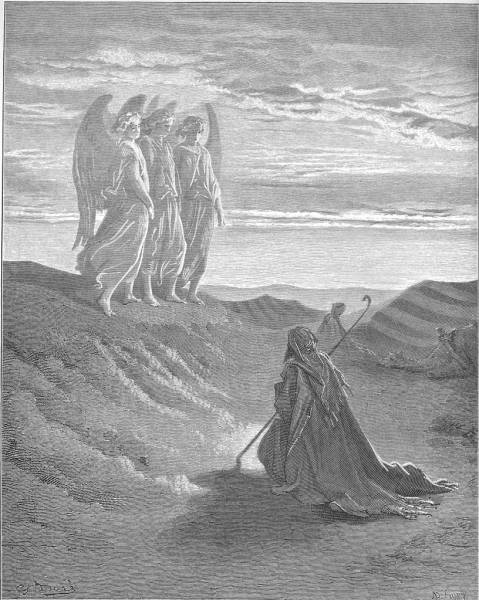
Gustave Doré
(Strasbourg, France, 1832 - 1883)
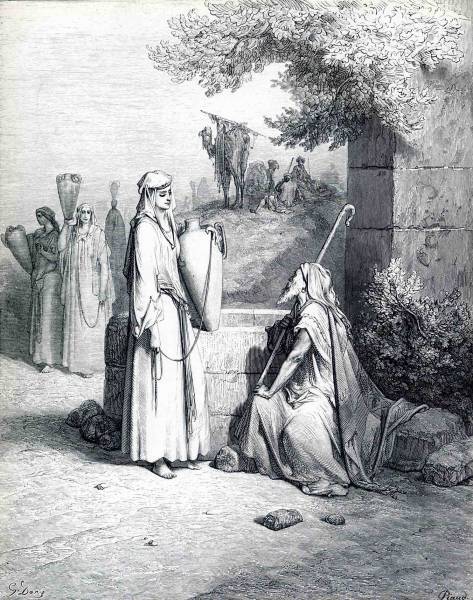
Genesis 18:1-15
David's third son, Absalom, conjures images of the handsome yet dissolute and unprincipled Alcibiades from Greek history. Despite his abundant blessings, Absalom met a disgraceful fate. His physical appearance made him the nation's pride and joy. "In all Israel there was none to be so much praised as Absalom for his beauty; from the sole of his foot even to the crown of his head there was no blemish in him." Moreover, he possessed a charming demeanor, sharp wit, and resolute will.
However, his father's strict treatment due to his own misconduct, combined with a nefarious ambition, drove him to scheme for the throne. To achieve this, he employed all the tactics of a skilled demagogue, currying favor with the people and undermining the king's authority. After years of preparation, he unfurled his standard in Hebron, securing the loyalty of David's trusted adviser, the wise Ahithophel, and amassing supporters from far and wide. When news of this formidable revolt reached the king, he hastily fled from his capital in distress, finding refuge in Mahanaim beyond the Jordan.
In the meantime, Absalom entered Jerusalem in triumph, arrogating to himself royal prerogatives, some in an offensive manner. Craftily, he was persuaded by a secret ally of David not to immediately pursue his father and decisively end the conflict but to wait until his forces were fully assembled. This respite allowed David to rally his loyalists and take a resolute stand for his throne. When Absalom finally crossed the Jordan, he encountered a sizable, well-equipped force awaiting him, led by three trusted commanders, with orders to treat Absalom gently.
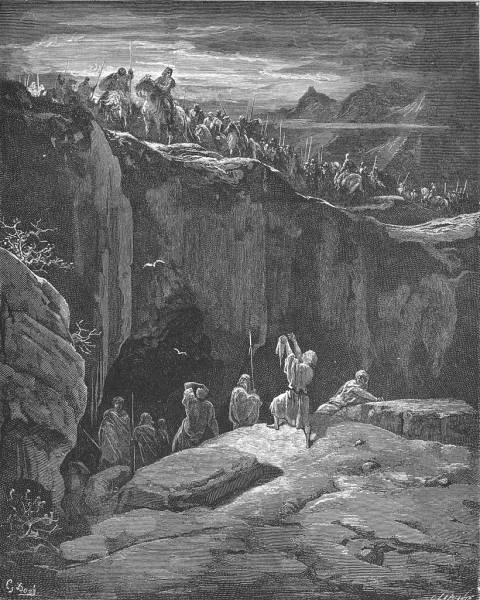
The battle unfolded in the wood of Ephraim, with David's forces emerging victorious. As Absalom sought to flee, he met a peculiar demise depicted in the illustration. Riding through the forest, his head—possibly ensnared by his flowing hair—became trapped in the branches of an overhanging tree, and his mule passed from beneath him. In this vulnerable position, Joab found him and, with his ten attendants forming a circle around the tree, struck Absalom's heart with three darts. Subsequently, his body was cast into a vast pit and covered with a mound of stones, similar to those heaped over the graves of heinous criminals. This was the inglorious end and disgraced resting place of a king's son, the most attractive and popular man of his generation. It was the fitting recompense for bitter revenge, unbridled self-will, and filial ingratitude.
Found in: 2 Samuel, 2 Samuel 18
1 David counted the people who were with him, and set captains of thousands and captains of hundreds over them.
2 David sent the people out, a third part under the hand of Joab, and a third part under the hand of Abishai the son of Zeruiah, Joab’s brother, and a third part under the hand of Ittai the Gittite. The king said to the people, “I will also surely go out with you myself.”
3 But the people said, “You shall not go out; for if we flee away, they will not care for us; neither if half of us die, will they care for us. But you are worth ten thousand of us. Therefore now it is better that you are ready to help us out of the city.”
4 The king said to them, “I will do what seems best to you.” The king stood beside the gate, and all the people went out by hundreds and by thousands.
5 The king commanded Joab and Abishai and Ittai, saying, “Deal gently for my sake with the young man, even with Absalom.” All the people heard when the king commanded all the captains concerning Absalom.
6 So the people went out into the field against Israel; and the battle was in the forest of Ephraim.
7 The people of Israel were struck there before David’s servants, and there was a great slaughter there that day of twenty thousand men.
8 For the battle was there spread over the surface of all the country, and the forest devoured more people that day than the sword devoured.
9 Absalom happened to meet David’s servants. Absalom was riding on his mule, and the mule went under the thick boughs of a great oak, and his head caught hold of the oak, and he was taken up between the sky and earth; and the mule that was under him went on.
10 A certain man saw it, and told Joab, and said, “Behold, I saw Absalom hanging in an oak.”
11 Joab said to the man who told him, “Behold, you saw it, and why didn’t you strike him there to the ground? I would have given you ten pieces of silver, and a sash.”
12 The man said to Joab, “Though I should receive a thousand pieces of silver in my hand, I still wouldn’t stretch out my hand against the king’s son; for in our hearing the king commanded you and Abishai and Ittai, saying, ‘Beware that no one touch the young man Absalom.’
13 Otherwise if I had dealt falsely against his life (and there is no matter hidden from the king), then you yourself would have set yourself against me.”
14 Then Joab said, “I’m not going to wait like this with you.” He took three darts in his hand, and thrust them through the heart of Absalom, while he was yet alive in the middle of the oak.
15 Ten young men who bore Joab’s armor surrounded and struck Absalom, and killed him.
16 Joab blew the trumpet, and the people returned from pursuing after Israel; for Joab held the people back.
17 They took Absalom and cast him into the great pit in the forest, and raised over him a very great heap of stones. Then all Israel fled, each to his own tent.
18 Now Absalom in his lifetime had taken and reared up for himself the pillar which is in the king’s valley, for he said, “I have no son to keep my name in memory.” He called the pillar after his own name. It is called Absalom’s monument, to this day.
2 Samuel 18:1-18 · World English Bible

1832 - 1883
Strasbourg, France
Paul Gustave Louis Christophe Doré (6 January 1832 – 23 January 1883) was a French artist, printmaker, illustrator, comics artist, caricaturist, and sculptor who worked primarily with wood-engraving.