The Transfiguration
(c1516)
Raphael Sanzio
(Urbino, 1483 - 1520)
Matthew 17:1-13
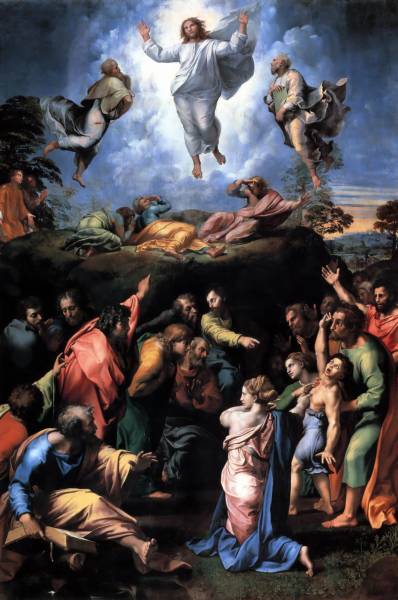
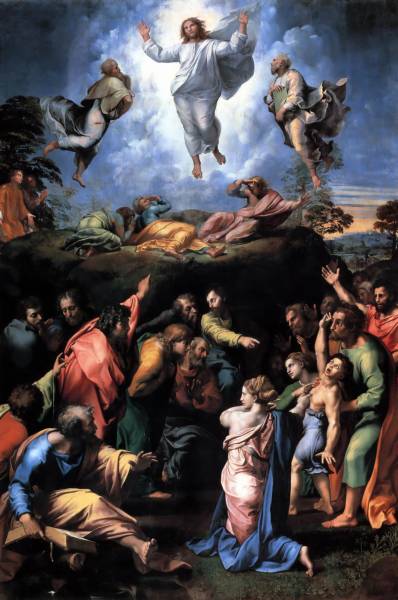
The Transfiguration is the last painting by the Italian High Renaissance master Raphael. Commissioned by Cardinal Giulio de Medici, who later became Pope Clement VII, the work was conceived as an altarpiece for Narbonne Cathedral in France. Raphael worked on it in the years preceding his death in 1520, and the painting exemplifies his development as an artist and the culmination of his career.
The composition is divided into two distinct but interconnected halves. The upper portion depicts the Transfiguration of Christ on Mount Tabor, where Jesus is shown elevated and radiant, flanked by the Old Testament prophets Moses and Elijah, who float on either side of him. Below them, the three apostles Peter, James, and John shield their eyes from the dazzling divine light.
The lower portion of the painting depicts the next episode from the Gospels: the apostles' failed attempt to heal a possessed boy. A crowd of agitated figures surrounds the afflicted youth, whose contorted body and wild expression contrast dramatically with the serene transfiguration above. The apostles gesture helplessly, unable to cure the boy without Christ's presence. This unusual combination of two biblical episodes creates a powerful theological statement linking Christ's divine nature with his healing power on earth.
From the late 16th century until the early 20th century, The Transfiguration was regarded by various commentators as the most famous oil painting in the world. After Raphael's death on 6 April 1520, the painting lay at the head of his catafalque. It was later installed in San Pietro in Montorio in Rome, before being seized by Napoleon's forces in 1797 and taken to the Louvre. After Napoleon's fall in 1815, it was returned to Rome and now resides in the Pinacoteca Vaticana in Vatican City.
Found in: Matthew, Matthew 17, 16th century
1 After six days, Jesus took with him Peter, James, and John his brother, and brought them up into a high mountain by themselves.
2 He was transfigured before them. His face shone like the sun, and his garments became as white as the light.
3 Behold, Moses and Elijah appeared to them talking with him.
4 Peter answered, and said to Jesus, “Lord, it is good for us to be here. If you want, let’s make three tents here: one for you, one for Moses, and one for Elijah.”
5 While he was still speaking, behold, a bright cloud overshadowed them. Behold, a voice came out of the cloud, saying, “This is my beloved Son, in whom I am well pleased. Listen to him.”
6 When the disciples heard it, they fell on their faces, and were very afraid.
7 Jesus came and touched them and said, “Get up, and don’t be afraid.”
8 Lifting up their eyes, they saw no one, except Jesus alone.
9 As they were coming down from the mountain, Jesus commanded them, saying, “Don’t tell anyone what you saw, until the Son of Man has risen from the dead.”
10 His disciples asked him, saying, “Then why do the scribes say that Elijah must come first?”
11 Jesus answered them, “Elijah indeed comes first, and will restore all things,
12 but I tell you that Elijah has come already, and they didn’t recognize him, but did to him whatever they wanted to. Even so the Son of Man will also suffer by them.”
13 Then the disciples understood that he spoke to them of John the Baptizer.
Matthew 17:1-13 · World English Bible
1483 - 1520
Urbino, Italy
Raffaello Sanzio da Urbino, known to the world as Raphael, stands as one of the three towering masters of the High Renaissance alongside Leonardo da Vinci and Michelangelo. Born in 1483 in the cultured city of Urbino, where his father Giovanni Santi served as court painter, Raphael was immersed in artistic excellence from childhood. After his father's death when he was eleven, Raphael likely trained under Pietro Perugino and was recognized as a master by 1500. His meteoric career unfolded…