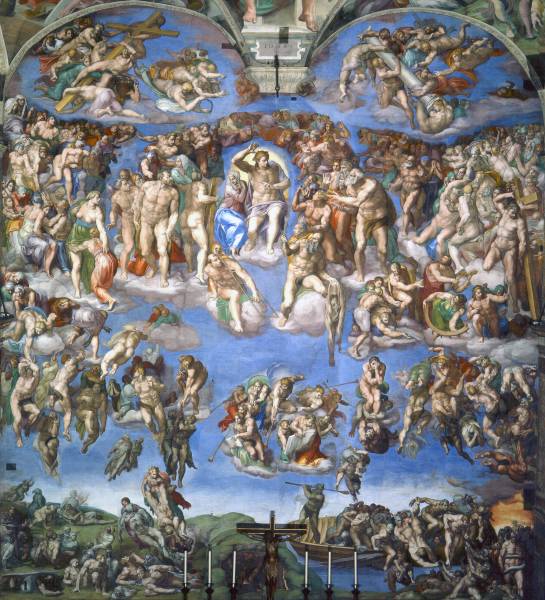
The Last Judgment
(1536)
Michelangelo
(Florence, Italy, 1475 - 1564)
Matthew 25:31-46
31 “But when the Son of Man comes in his glory, and all the holy angels with him, then he will sit on the throne of his glory.
32 Before him all the nations will be gathered, and he will separate them one from another, as a shepherd separates the sheep from the goats.
33 He will set the sheep on his right hand, but the goats on the left.
34 Then the King will tell those on his right hand, ‘Come, blessed of my Father, inherit the Kingdom prepared for you from the foundation of the world;
35 for I was hungry, and you gave me food to eat. I was thirsty, and you gave me drink. I was a stranger, and you took me in.
36 I was naked, and you clothed me. I was sick, and you visited me. I was in prison, and you came to me.’
37 “Then the righteous will answer him, saying, ‘Lord, when did we see you hungry, and feed you; or thirsty, and give you a drink?
38 When did we see you as a stranger, and take you in; or naked, and clothe you?
39 When did we see you sick, or in prison, and come to you?’
40 “The King will answer them, ‘Most certainly I tell you, because you did it to one of the least of these my brothers, you did it to me.’
41 Then he will say also to those on the left hand, ‘Depart from me, you cursed, into the eternal fire which is prepared for the devil and his angels;
42 for I was hungry, and you didn’t give me food to eat; I was thirsty, and you gave me no drink;
43 I was a stranger, and you didn’t take me in; naked, and you didn’t clothe me; sick, and in prison, and you didn’t visit me.’
44 “Then they will also answer, saying, ‘Lord, when did we see you hungry, or thirsty, or a stranger, or naked, or sick, or in prison, and didn’t help you?’
45 “Then he will answer them, saying, ‘Most certainly I tell you, because you didn’t do it to one of the least of these, you didn’t do it to me.’
46 These will go away into eternal punishment, but the righteous into eternal life.”
Matthew 25:31-46 · World English Bible