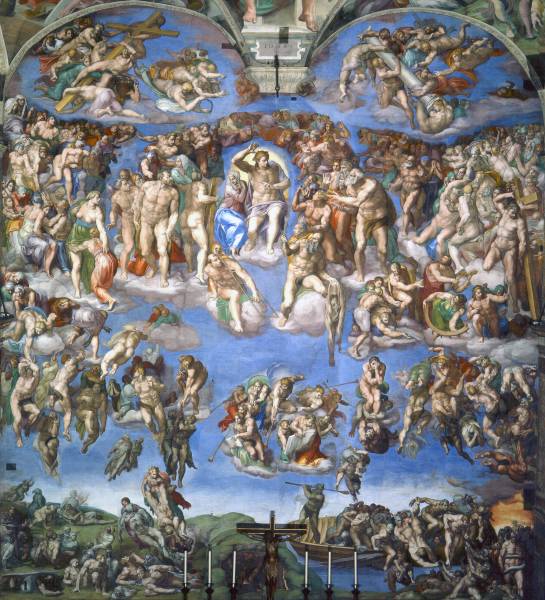
The Last Judgment
(1536)
Michelangelo
(Florence, Italy, 1475 - 1564)
Matthew 25:31-46
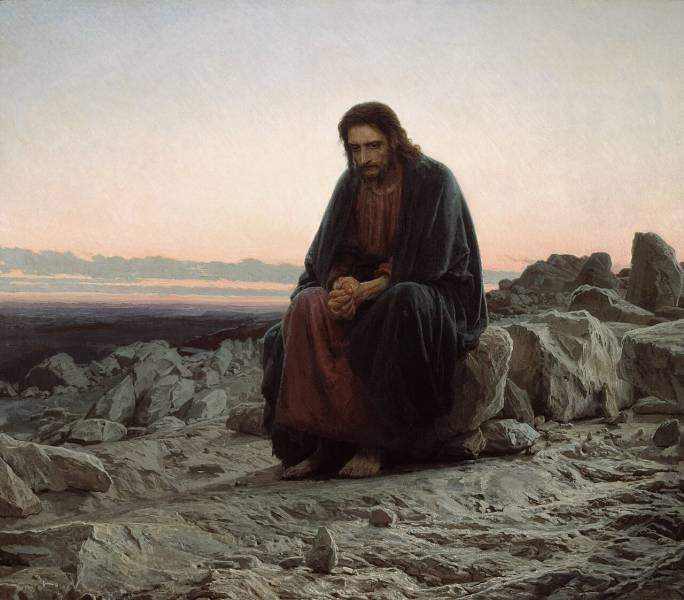
Ivan Kramskoi's "Christ in the Wilderness" is a poignant depiction of a pivotal moment in the life of Jesus Christ, as described in Matthew 4:1-11. The painting captures the scene where Jesus, after being baptised by John the Baptist, is led into the wilderness by the Holy Spirit to be tempted by the devil. For forty days and nights, Jesus fasts and prays, preparing himself for his ministry and the trials that lie ahead. Kramskoi's masterpiece conveys the intensity of Jesus' spiritual struggle, inviting the viewer to contemplate the profound humanity and inner turmoil of the Son of God.
The composition of "Christ in the Wilderness" is characterized by a harmonious balance of colours and forms, with the figure of Jesus dominating the painting space. Set against the stark, rocky desert landscape, Jesus is depicted in a dark wrap and red tunic, his thoughtful face a picture of introspection and resolve. The use of cold colours, such as the pale blue and grey hues of the dawn sky, creates a sense of chill and desolation, underscoring the harsh conditions of the wilderness. The horizon, dividing the canvas almost in half, serves to emphasize Jesus' solitude and his connection to the vast, empty landscape.
The painting is rich in symbolism, with Jesus' pose and expression conveying his inner struggle to resist the temptations of the devil. The artist's decision to depict Jesus in a moment of quiet contemplation, rather than in a more dramatic or action-packed scene, serves to emphasize the human aspect of Christ's nature. This focus on Jesus' humanity is a hallmark of Kramskoi's approach, and it lends the painting a sense of intimacy and emotional depth. By portraying Jesus in this way, Kramskoi invites the viewer to reflect on the profound implications of Christ's temptation and his ultimate triumph over the forces of darkness.
"Christ in the Wilderness" is a significant work in the oeuvre of Ivan Kramskoi, and its importance extends beyond its masterful composition and emotional resonance. The painting has been widely acclaimed for its thought-provoking and deeply human portrayal of Jesus Christ, and it continues to inspire and move audiences to this day. As a work of biblical art, it offers a powerful meditation on the nature of faith, sacrifice, and the human condition, and it remains a testament to the enduring power of art to capture the deepest truths of the human experience.
Found in: Matthew, Matthew 4, 19th century
1 Then Jesus was led up by the Spirit into the wilderness to be tempted by the devil.
2 When he had fasted forty days and forty nights, he was hungry afterward.
3 The tempter came and said to him, “If you are the Son of God, command that these stones become bread.”
4 But he answered, “It is written, ‘Man shall not live by bread alone, but by every word that proceeds out of the mouth of God.’”
5 Then the devil took him into the holy city. He set him on the pinnacle of the temple,
6 and said to him, “If you are the Son of God, throw yourself down, for it is written, ‘He will put his angels in charge of you.’ and, ‘On their hands they will bear you up, so that you don’t dash your foot against a stone.’”
7 Jesus said to him, “Again, it is written, ‘You shall not test the Lord, your God.’”
8 Again, the devil took him to an exceedingly high mountain, and showed him all the kingdoms of the world, and their glory.
9 He said to him, “I will give you all of these things, if you will fall down and worship me.”
10 Then Jesus said to him, “Get behind me, Satan! For it is written, ‘You shall worship the Lord your God, and you shall serve him only.’”
11 Then the devil left him, and behold, angels came and served him.
Matthew 4:1-11 · World English Bible
1837 - 1887
Ostrog, Russia
Ivan Nikolayevich Kramskoy was a prominent Russian Realist painter and art critic, renowned for his contributions to the development of realist art and aesthetics in Russia during the 19th century. Born on June 8, 1837, Kramskoy came from a humble background, but his talent and dedication led him to study at the St. Petersburg Academy of Arts from 1857 to 1863. However, he soon became disillusioned with the academic art style and was one of the initiators of the "Revolt…