Gustave Doré
(Strasbourg, France, 1832 - 1883)
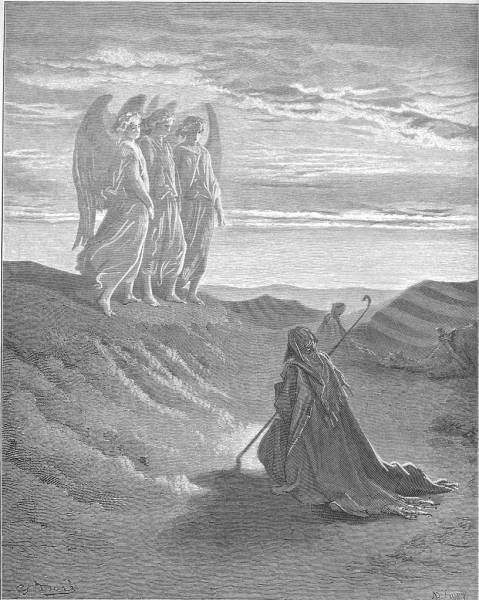
Genesis 18:1-15
The incident recounted in Genesis chapter twenty-one revolves around the weaning of Isaac, marked by a celebratory feast. However, the joyous occasion takes a bitter turn when Ishmael, the son of Hagar and now a fifteen-year-old boy, mocks the infant heir of the promise, Isaac. Sarah, Isaac's mother, is deeply distressed by this ridicule and demands that both Hagar and her son be cast out of their household.
Initially, Abraham hesitates to comply with Sarah's request, but he eventually relents when commanded by a divine message. With a heavy heart, he bids farewell to Hagar and her son, sending them away into the wilderness. The artist portrays this sorrowful separation with great spirit and effectiveness. It is worth noting that while the picture shows Hagar receiving water in an earthen jar, it is more likely that she received it in a kid-skin, as is customary in the East.
At first glance, this action of sending Hagar and Ishmael away might seem harsh and unjustifiable. However, it is essential to understand that the wilderness they were sent to was not a barren desert but a region suitable for pasture. Although not suitable for cultivation, it provided a means for survival. Moreover, Abraham was assured by a divine promise that no harm would befall Ishmael, for he, too, would become the father of a great nation.
In truth, this separation was necessary for the well-being and harmony of the household. It served as a living illustration of the fundamental incompatibility between the spirit of bondage and the spirit of liberty, a theme later expounded in the history of the Christian Church (Galatians 4:22-31). Hagar, representing a servile and legalistic view of religious life, is contrasted with the freewoman, symbolizing the boundless grace and liberty of the Gospel. The mockery of Ishmael foreshadows the opposition faced by those who embrace the Gospel's promise, as opposed to those who adhere rigidly to the letter of the law.
While the act of casting out Hagar and Ishmael may appear severe, it signifies the transition from a legalistic and task-oriented religious perspective to one of joyous and filial spirit that naturally arises from the grace of God. This little incident from patriarchal times foreshadows the workings of God's providence on a grander scale in the unfolding history of the Christian Church.
Found in: Genesis, Genesis 21
8 The child grew, and was weaned. Abraham made a great feast on the day that Isaac was weaned.
9 Sarah saw the son of Hagar the Egyptian, whom she had borne to Abraham, mocking.
10 Therefore she said to Abraham, “Cast out this servant and her son! For the son of this servant will not be heir with my son, Isaac.”
11 The thing was very grievous in Abraham’s sight on account of his son.
12 God said to Abraham, “Don’t let it be grievous in your sight because of the boy, and because of your servant. In all that Sarah says to you, listen to her voice. For your offspring will be named through Isaac.
13 I will also make a nation of the son of the servant, because he is your child.”
14 Abraham rose up early in the morning, and took bread and a bottle of water, and gave it to Hagar, putting it on her shoulder; and gave her the child, and sent her away. She departed, and wandered in the wilderness of Beersheba.
15 The water in the bottle was spent, and she put the child under one of the shrubs.
16 She went and sat down opposite him, a good way off, about a bow shot away. For she said, “Don’t let me see the death of the child.” She sat over against him, and lifted up her voice, and wept.
17 God heard the voice of the boy. The angel of God called to Hagar out of the sky, and said to her, “What ails you, Hagar? Don’t be afraid. For God has heard the voice of the boy where he is.
18 Get up, lift up the boy, and hold him in your hand. For I will make him a great nation.”
19 God opened her eyes, and she saw a well of water. She went, filled the bottle with water, and gave the boy drink.
20 God was with the boy, and he grew. He lived in the wilderness, and became, as he grew up, an archer.
21 He lived in the wilderness of Paran. His mother took a wife for him out of the land of Egypt.
Genesis 21:8-21 · World English Bible

1832 - 1883
Strasbourg, France
Paul Gustave Louis Christophe Doré (6 January 1832 – 23 January 1883) was a French artist, printmaker, illustrator, comics artist, caricaturist, and sculptor who worked primarily with wood-engraving.