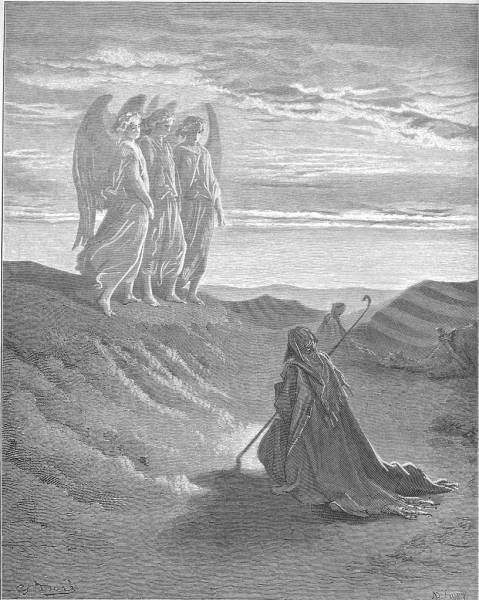
Gustave Doré
(Strasbourg, France, 1832 - 1883)
Genesis 18:1-15
The little book of Ruth is often likened to a bed of untamed wildflowers, rich in their exquisite beauty and a varied array of colors, much like those found scattered across the landscapes of Palestine. It serves as a captivating contrast to the preceding book of Judges in our Canon. Transitioning from one to the other feels akin to moving from the somber and harrowing scenes of an Aeschylus tragedy to the vibrant and picturesque settings of a pastoral idyll penned by Theocritus. Every verse of Ruth resonates with an aura of tranquility and love, painting a vivid testament to the humane and broad-minded principles underpinning the Mosaic laws. Israel was indeed a people set apart, secluded from the rest of the world to preserve the purity of the chosen lineage until the time came for a universal dispensation. Yet, throughout both word and deed, there are continual hints of hope for the nations beyond. Within the pages of Ruth, we find a narrative that unveils the journey of a daughter of the uncircumcised Moabites, welcomed into the fellowship of God's people, ultimately becoming a member of the lineage from which the most illustrious of Israel's kings would emerge.
The story unfolds as Elimelech, driven by famine, leads his family, including his wife and two sons, on an emigration from Bethlehem to the fields of Moab. There, his sons marry local women. Tragedy befalls the household as Elimelech passes away, followed by the untimely deaths of both sons. A decade later, Naomi is left with her two daughters-in-law. Learning that the famine has lifted in her homeland, she decides to return, with her younger companions initially accompanying her. On the journey, Naomi, while acknowledging their kindness and devotion to the deceased, urges them to turn back, for she has little to offer them. Orpah heeds this advice and, weeping, returns home. However, Ruth adamantly refuses and clings to Naomi. This poignant scene is vividly captured in the picture: Orpah turning away, hands covering her face, while Ruth, brimming with deep affection, remains steadfastly attached to her husband's mother. When Naomi suggests that Ruth should follow her sister-in-law's example, Ruth responds with words that have become timeless in their expression of profound and sacred affection: "Urge me not to leave thee, or to return from following thee: for whither thou goest, I will go; and where thou lodgest, I will lodge: thy people shall be my people, and thy God my God: where thou diest, I will die, and there will I be buried: the Lord do so to me, and more also, if aught but death part thee and me." The love depicted here is undeniably intense, yet it is wholly moral and spiritual in its essence, untouched by self-interest, hope, or vanity.
6 Then she arose with her daughters-in-law, that she might return from the country of Moab; for she had heard in the country of Moab how Yahweh had visited his people in giving them bread.
7 She went out of the place where she was, and her two daughters-in-law with her. They went on the way to return to the land of Judah.
8 Naomi said to her two daughters-in-law, “Go, return each of you to her mother’s house. May Yahweh deal kindly with you, as you have dealt with the dead, and with me.
9 May Yahweh grant you that you may find rest, each of you in the house of her husband.” Then she kissed them, and they lifted up their voices, and wept.
10 They said to her, “No, but we will return with you to your people.”
11 Naomi said, “Go back, my daughters. Why do you want to go with me? Do I still have sons in my womb, that they may be your husbands?
12 Go back, my daughters, go your way; for I am too old to have a husband. If I should say, ‘I have hope,’ if I should even have a husband tonight, and should also bear sons;
13 would you then wait until they were grown? Would you then refrain from having husbands? No, my daughters, for it grieves me seriously for your sakes, for Yahweh’s hand has gone out against me.”
14 They lifted up their voices, and wept again; then Orpah kissed her mother-in-law, but Ruth joined with her.
15 She said, “Behold, your sister-in-law has gone back to her people, and to her god. Follow your sister-in-law.”
16 Ruth said, “Don’t urge me to leave you, and to return from following you, for where you go, I will go; and where you stay, I will stay. Your people will be my people, and your God my God.
17 Where you die, I will die, and there I will be buried. May Yahweh do so to me, and more also, if anything but death parts you and me.”
18 When she saw that she was determined to go with her, she stopped urging her.
19 So they both went until they came to Bethlehem. When they had come to Bethlehem, all the city was excited about them, and they asked, “Is this Naomi?”
20 She said to them, “Don’t call me Naomi. Call me Mara; for the Almighty has dealt very bitterly with me.
21 I went out full, and Yahweh has brought me home again empty. Why do you call me Naomi, since Yahweh has testified against me, and the Almighty has afflicted me?”
22 So Naomi returned, and Ruth the Moabitess, her daughter-in-law, with her, who returned out of the country of Moab. They came to Bethlehem in the beginning of barley harvest.
Ruth 1:6-22 · World English Bible

1832 - 1883
Strasbourg, France
Paul Gustave Louis Christophe Doré (6 January 1832 – 23 January 1883) was a French artist, printmaker, illustrator, comics artist, caricaturist, and sculptor who worked primarily with wood-engraving.