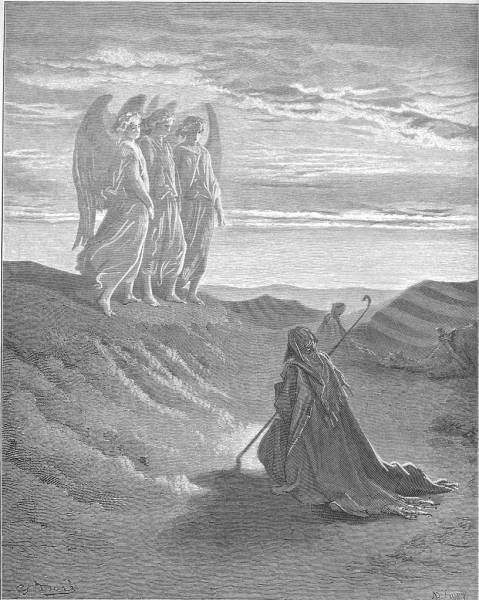
Gustave Doré
(Strasbourg, France, 1832 - 1883)
Genesis 18:1-15
Nothing is more striking in the unfolding of divine providence than the way human wickedness ultimately defeats itself. A remarkable example of this can be found in the story of Joseph, and another is vividly illustrated in the following account. Pharaoh, fearing the rapid increase of the Israelites, issued a cruel decree to kill every male child at birth. Little did he know that this very decree would lead to the training and preparation of the man who would later lead Israel out of Egypt in triumph. A pious couple from the house of Levi gave birth to an extraordinarily beautiful child, described as "exceeding fair" in Acts vii. 20, meaning fair to God, indicating divine approval and a special purpose for him. The mother, recognizing the significance of this child, hid him for three months. When she could no longer conceal him, she devised a plan that offered some hope of deliverance. She crafted a small chest of papyrus, once common in Egypt but now extinct, and made it water-tight with slime and pitch from the Dead Sea. Placing the child in this makeshift ark, she carefully set it among the reeds on the bank of the Nile, strategically near the spot where Pharaoh's daughter bathed, following an ancient custom known from monuments.
The scene depicted in the picture unfolds as the royal lady discovers the child and is moved by his tears. Despite recognizing that he was one of the Hebrews' children, she couldn't resist the child's charm and decided to raise him, defying the king's decree. The mother's services were enlisted to nurse the child for the princess, and thus Moses began a journey that led to marvelous outcomes. Born a slave and destined for death, he was spared and raised in a palace as the adopted son of the princess. As Stephen states in Acts vii. 22, Moses received an education in all the wisdom of the Egyptians, renowned throughout the ancient world. This preparation was essential for his extraordinary mission, and it is evident in the life of Moses, the most illustrious figure in Hebrew history. His mother's ingenious plan facilitated this exceptional preparation, paving the way for the remarkable events that followed.
1 The heavens, the earth, and all their vast array were finished.
2 On the seventh day God finished his work which he had done; and he rested on the seventh day from all his work which he had done.
3 God blessed the seventh day, and made it holy, because he rested in it from all his work of creation which he had done.
4 This is the history of the generations of the heavens and of the earth when they were created, in the day that Yahweh God made the earth and the heavens.
5 No plant of the field was yet in the earth, and no herb of the field had yet sprung up; for Yahweh God had not caused it to rain on the earth. There was not a man to till the ground,
6 but a mist went up from the earth, and watered the whole surface of the ground.
7 Yahweh God formed man from the dust of the ground, and breathed into his nostrils the breath of life; and man became a living soul.
8 Yahweh God planted a garden eastward, in Eden, and there he put the man whom he had formed.
9 Out of the ground Yahweh God made every tree to grow that is pleasant to the sight, and good for food, including the tree of life in the middle of the garden and the tree of the knowledge of good and evil.
10 A river went out of Eden to water the garden; and from there it was parted, and became the source of four rivers.
Genesis 2:1-10 · World English Bible

1832 - 1883
Strasbourg, France
Paul Gustave Louis Christophe Doré (6 January 1832 – 23 January 1883) was a French artist, printmaker, illustrator, comics artist, caricaturist, and sculptor who worked primarily with wood-engraving.