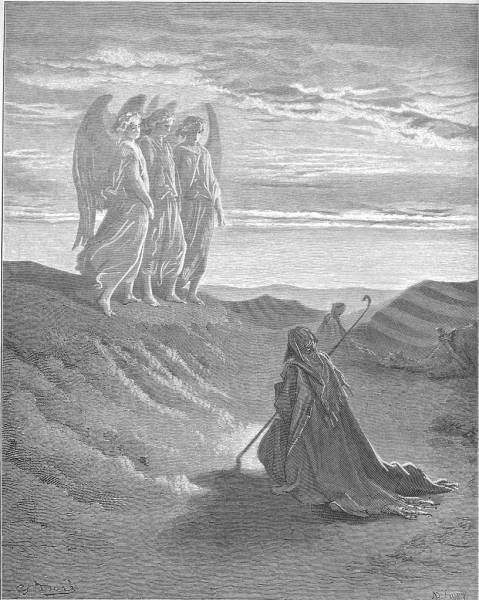
Gustave Doré
(Strasbourg, France, 1832 - 1883)
Genesis 18:1-15
This compelling and expressive depiction portrays a sorrowful image of human depravity. The youngest son of Jacob becomes the victim of his brothers' envy, leading to a heart-wrenching sequence of events. They betray him, selling him as a slave and condemning him to a life of exile, bondage, and endless toil in Egypt. What makes this act of cruelty even more unsettling is that these brothers were not heathens or Canaanites but descendants of Abraham, nurtured under the pious traditions of three generations.
The root of this heinous act lies in one simple phrase: "And his brethren envied him" (Gen. xxxvii. 11). Envy, an emotion purely evil, crept into their hearts and took hold, overshadowing any sense of goodness. While other negative emotions may at times appear justifiable, envy offers no such excuse. It is like the poison of the serpent, thriving on the prosperity and goodness of others, lamenting their success, and begrudging them their happiness. King Solomon aptly described envy as "Rottenness in the bones."
The consequence of this envy was hatred, and hatred, as history has shown, often leads to actions akin to murder. The ten brothers stained their own name, perpetrated a terrible injustice upon the young and innocent Joseph, and inflicted deep pain upon their venerable father for many years.
However, amid this dark tapestry of envy, malice, and cruelty, there exists a glimmer of hope. These sinister events were, in fact, part of a greater plan orchestrated by the One who is wise in counsel and powerful in action. God intended to separate His people from the corrupt nations of Canaan during their formative years, transforming them from a family into a nation. Egypt was the chosen place for this transformation to occur, and the events leading to Joseph's journey to Egypt were the initial steps in bringing about this divine design.
Although God's hand guided the circumstances, it's essential to recognize that the brothers' wickedness was entirely their own. God did not influence them to commit the crime; they acted out of their own volition, as they later acknowledged. The sequence of events, such as their time in Dothan, Joseph's mission, spotting him from afar, the idea of throwing him into the pit, the timely arrival of the Midianitish traders, Reuben's absence, and Judah's suggestion, were all elements that played a role in the outcome.
Joseph himself best encapsulates both sides of the transaction in his words: "As for you, you thought evil against me, but God meant it unto good, to bring it to pass as it is this day, to save much people alive" (Gen. 50:20). This complex interplay of human actions and divine providence led to a greater purpose, ultimately saving many lives in the future. Nonetheless, it does not diminish the heinous wrongdoing of the brothers, who were responsible for their choices throughout the tragic event.
Found in: Genesis, Genesis 37
12 His brothers went to feed their father’s flock in Shechem.
13 Israel said to Joseph, “Aren’t your brothers feeding the flock in Shechem? Come, and I will send you to them.” He said to him, “Here I am.”
14 He said to him, “Go now, see whether it is well with your brothers, and well with the flock; and bring me word again.” So he sent him out of the valley of Hebron, and he came to Shechem.
15 A certain man found him, and behold, he was wandering in the field. The man asked him, “What are you looking for?”
16 He said, “I am looking for my brothers. Tell me, please, where they are feeding the flock.”
17 The man said, “They have left here, for I heard them say, ‘Let us go to Dothan.’” Joseph went after his brothers, and found them in Dothan.
18 They saw him afar off, and before he came near to them, they conspired against him to kill him.
19 They said to one another, “Behold, this dreamer comes.
20 Come now therefore, and let’s kill him, and cast him into one of the pits, and we will say, ‘An evil animal has devoured him.’ We will see what will become of his dreams.”
21 Reuben heard it, and delivered him out of their hand, and said, “Let’s not take his life.”
22 Reuben said to them, “Shed no blood. Throw him into this pit that is in the wilderness, but lay no hand on him”—that he might deliver him out of their hand, to restore him to his father.
23 When Joseph came to his brothers, they stripped Joseph of his coat, the coat of many colors that was on him;
24 and they took him, and threw him into the pit. The pit was empty. There was no water in it.
25 They sat down to eat bread, and they lifted up their eyes and looked, and saw a caravan of Ishmaelites was coming from Gilead, with their camels bearing spices and balm and myrrh, going to carry it down to Egypt.
26 Judah said to his brothers, “What profit is it if we kill our brother and conceal his blood?
27 Come, and let’s sell him to the Ishmaelites, and not let our hand be on him; for he is our brother, our flesh.” His brothers listened to him.
28 Midianites who were merchants passed by, and they drew and lifted up Joseph out of the pit, and sold Joseph to the Ishmaelites for twenty pieces of silver. They brought Joseph into Egypt.
29 Reuben returned to the pit; and saw that Joseph wasn’t in the pit; and he tore his clothes.
30 He returned to his brothers, and said, “The child is no more; and I, where will I go?”
31 They took Joseph’s coat, and killed a male goat, and dipped the coat in the blood.
32 They took the coat of many colors, and they brought it to their father, and said, “We have found this. Examine it, now, whether it is your son’s coat or not.”
33 He recognized it, and said, “It is my son’s coat. An evil animal has devoured him. Joseph is without doubt torn in pieces.”
34 Jacob tore his clothes, and put sackcloth on his waist, and mourned for his son many days.
35 All his sons and all his daughters rose up to comfort him, but he refused to be comforted. He said, “For I will go down to Sheol to my son mourning.” His father wept for him.
36 The Midianites sold him into Egypt to Potiphar, an officer of Pharaoh’s, the captain of the guard.
Genesis 37:12-36 · World English Bible

1832 - 1883
Strasbourg, France
Paul Gustave Louis Christophe Doré (6 January 1832 – 23 January 1883) was a French artist, printmaker, illustrator, comics artist, caricaturist, and sculptor who worked primarily with wood-engraving.