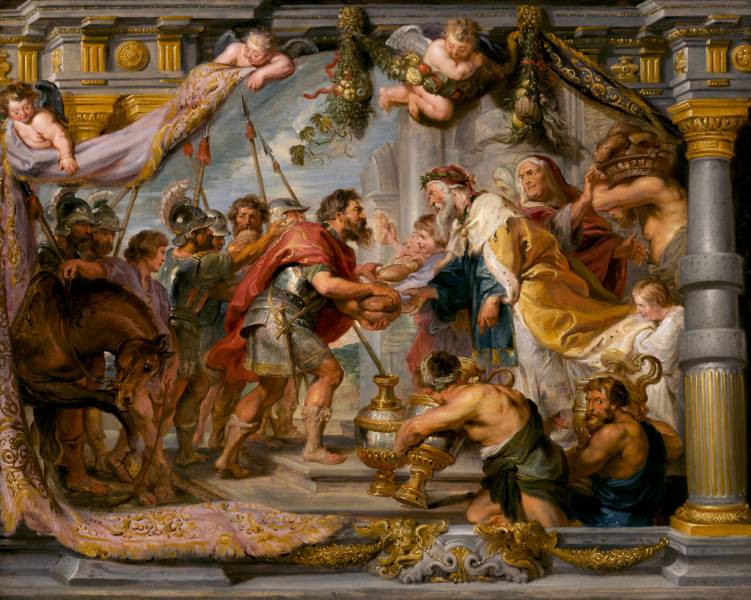
Abraham Meets Melchizedek
(c1625)
Peter Paul Rubens
(Siegen, 1577 - 1640)
Genesis 14
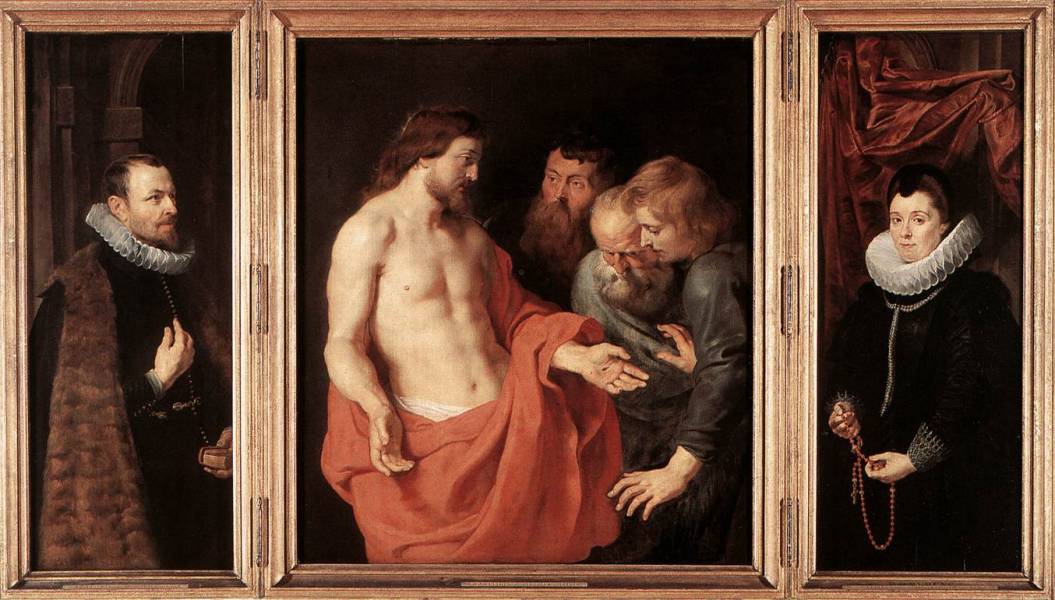
This vibrant triptych, one of the few to have come from Peter Paul Rubens' considerable career, was completed in 1611-1612 and contains all of the elements that made this artist one of the finest members of the Baroque art movement.
To take each of the three panels separately, the central piece, that is always the main focus of any triptych, concentrates on the subject title - namely the risen Jesus appearing from the tomb. That is, after all, the Resurrection itself. As the artist captures him in traditionally dramatic and animated Baroque style, complete with flashes of light to contrast him with the rest of the scene, the other figures cower in surprise and fear.
On the left hand panel is John the Baptist, whilst on the opposing wing of this triptych is Martina of Rome. Invariably, a painting put together with three panels like this will depict related scenes on each one, and then place the most significant element in the middle. Some triptychs will have hinges on each of the wings so that the piece can be closed, revealing a further artwork on the outside. That is not the case in this Rubens work.
The city of Antwerp played an important role in the Northern Renaissance and much of the art produced there during that time is still on display here. For example, the Resurrection of Christ triptych can now be found at the Cathedral of Our Lady, a fitting institution for such a breaktaking panel painting. This Cathedral was finished in 1521 after several stages of development that took nearly two centuries to complete. This was the norm for large scale buildings at that time right across Europe.
Found in: John, John 21, 17th century, Resurrection
1 After these things, Jesus revealed himself again to the disciples at the sea of Tiberias. He revealed himself this way.
2 Simon Peter, Thomas called Didymus, Nathanael of Cana in Galilee, and the sons of Zebedee, and two others of his disciples were together.
3 Simon Peter said to them, “I’m going fishing.” They told him, “We are also coming with you.” They immediately went out, and entered into the boat. That night, they caught nothing.
4 But when day had already come, Jesus stood on the beach, yet the disciples didn’t know that it was Jesus.
5 Jesus therefore said to them, “Children, have you anything to eat?” They answered him, “No.”
6 He said to them, “Cast the net on the right side of the boat, and you will find some.” They cast it therefore, and now they weren’t able to draw it in for the multitude of fish.
7 That disciple therefore whom Jesus loved said to Peter, “It’s the Lord!” So when Simon Peter heard that it was the Lord, he wrapped his coat around him (for he was naked), and threw himself into the sea.
8 But the other disciples came in the little boat (for they were not far from the land, but about two hundred cubits away), dragging the net full of fish.
9 So when they got out on the land, they saw a fire of coals there, and fish laid on it, and bread.
10 Jesus said to them, “Bring some of the fish which you have just caught.”
11 Simon Peter went up, and drew the net to land, full of great fish, one hundred fifty-three; and even though there were so many, the net wasn’t torn.
12 Jesus said to them, “Come and eat breakfast.” None of the disciples dared inquire of him, “Who are you?” knowing that it was the Lord.
13 Then Jesus came and took the bread, gave it to them, and the fish likewise.
14 This is now the third time that Jesus was revealed to his disciples, after he had risen from the dead.
John 21:1-14 · World English Bible

1577 - 1640
Siegen, Germany
Peter Paul Rubens was a Flemish artist. He is considered the most influential artist of Flemish Baroque tradition. Rubens's highly charged compositions reference erudite aspects of classical and Christian history. His unique and immensely popular Baroque style emphasized movement, colour, and sensuality, which followed the immediate, dramatic artistic style promoted in the Counter-Reformation. Rubens specialized in making altarpieces, portraits, landscapes, and history paintings of mythological and allegorical subjects.