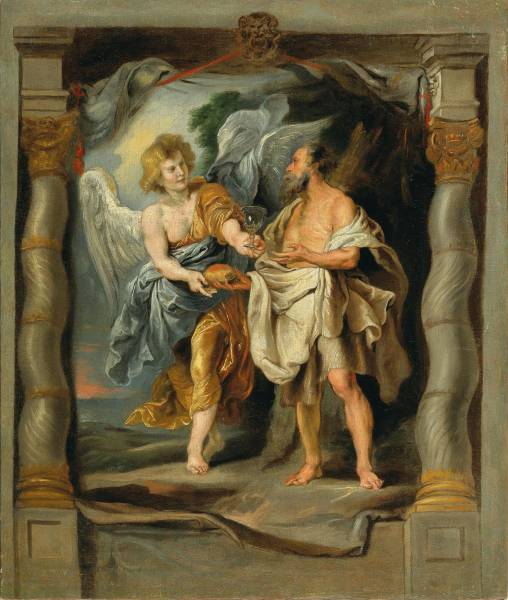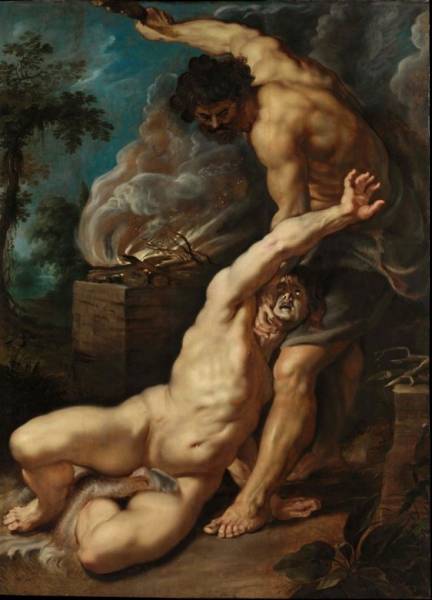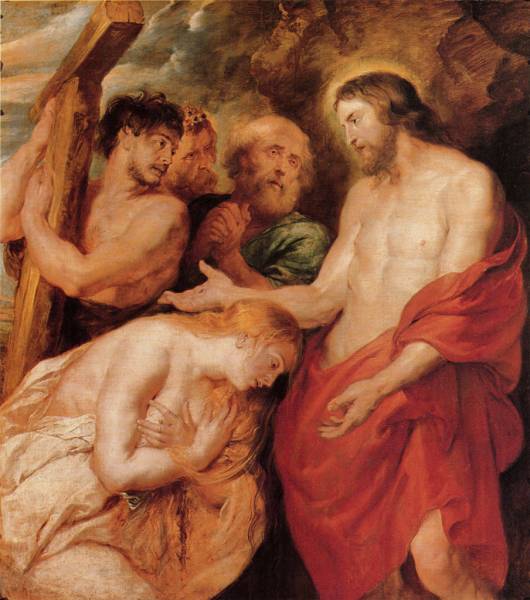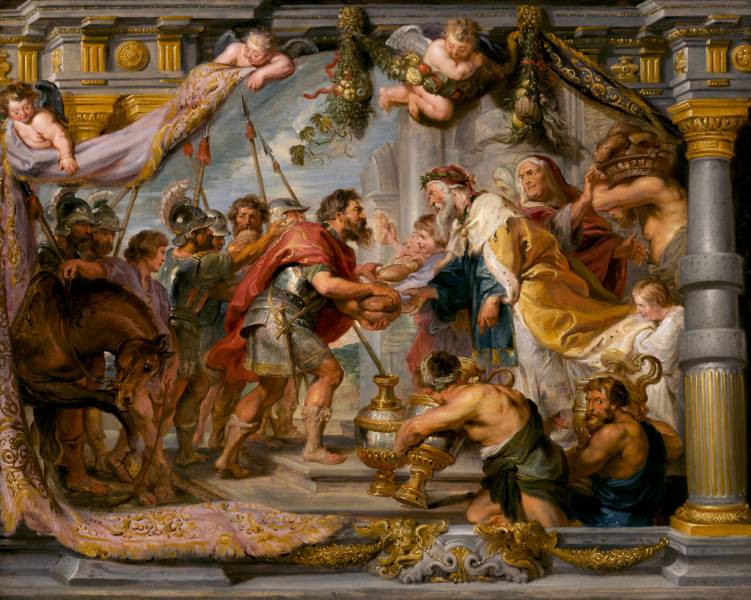
Abraham Meets Melchizedek
(c1625)
Peter Paul Rubens
(Siegen, 1577 - 1640)
Genesis 14
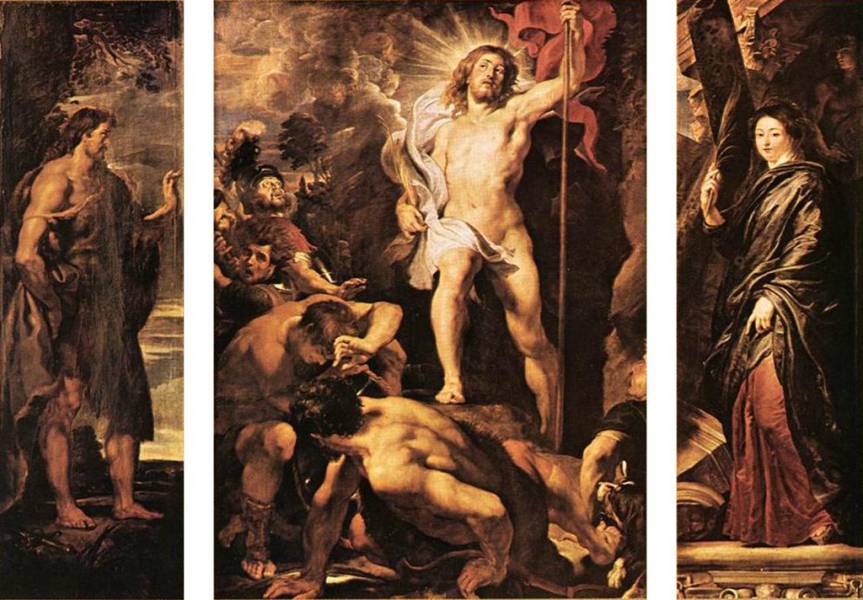
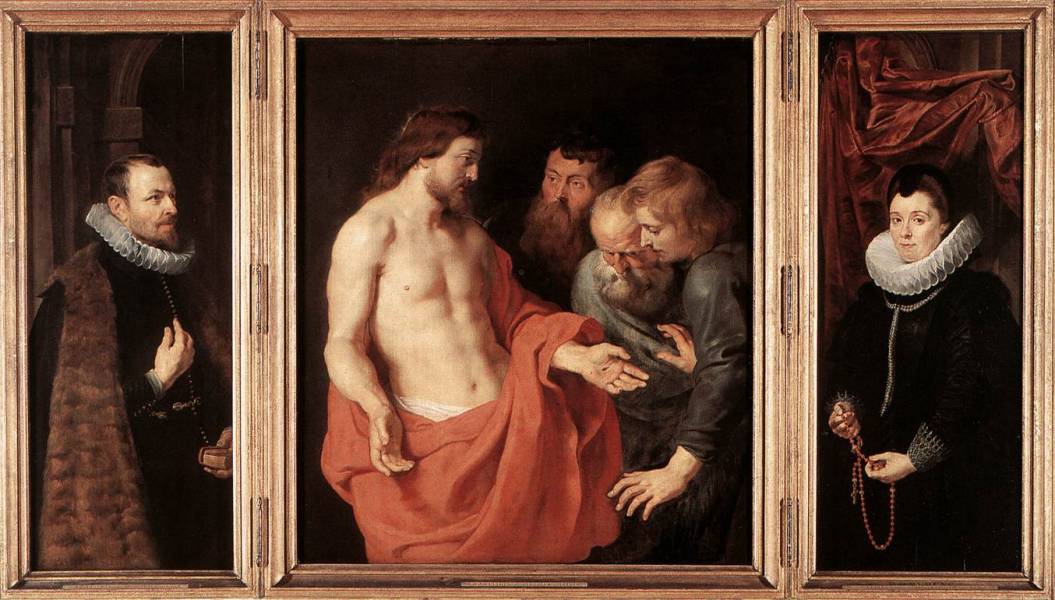
Although essentially Baroque, the oil on panel piece is rooted in the Venetian tradition, and likely influenced by the work of Daniele da Volterra, Federico Barocci and Cigoli, amongst others. In its composition and use of light, the triptych recalls Caravaggio's Roman period.
Theophile Silvestre wrote, in his "On Rubens' Descent from the Cross – 1868":
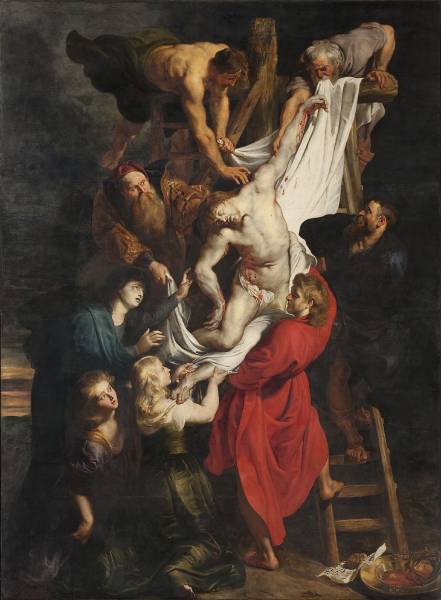
“The principal subject is composed of nine figures: at the top of two ladders, workers are lowering the body of Christ with the aid of a shroud which one of them holds in his teeth, the other in the left hand. Bracing themselves firmly against the arms of the cross, each bends forward to guide the Christ with the hand that is left free while St. John, with one foot on the ladder and his back arched, supports him most energetically. One of Savior’s feet comes to rest on the beautiful shoulder of the Magdalene, grazing her golden hair. Joseph of Arimathea and Nicodemus, placed midway on ladders so as to face each other, form, together with the two workmen in the upper part of the picture, a square of vigorous but plebeian figures. The Virgin, standing at the foot of the sacrificial tree, extends her arms towards her Son; Salome (properly, Mary Cleophas), kneeling, gathers up her robe. On the ground are seen the superscription and a copper basin where the crown of thorns and the nails of the Crucifixion lie in the congealed blood. The crowd, always elated by the spectacle of torture, has departed from Golgotha as daylight fades. After the sacrifice of Calvary, as it is called in Scripture, the sad, dark sky is crossed by a light that illumines the shoulders of the workmen, whose bold posture recalls the composition by Daniele da Volterra".
In 1794, Napoleon removed this painting and The Elevation of the Cross and sent them to the Louvre. After his defeat, they were returned to the cathedral in 1815.
Found in: John, John 19, 17th century, Deposition
38 After these things, Joseph of Arimathaea, being a disciple of Jesus, but secretly for fear of the Jews, asked of Pilate that he might take away Jesus’ body. Pilate gave him permission. He came therefore and took away his body.
39 Nicodemus, who at first came to Jesus by night, also came bringing a mixture of myrrh and aloes, about a hundred Roman pounds.
40 So they took Jesus’ body, and bound it in linen cloths with the spices, as the custom of the Jews is to bury.
41 Now in the place where he was crucified there was a garden. In the garden was a new tomb in which no man had ever yet been laid.
42 Then because of the Jews’ Preparation Day (for the tomb was near at hand) they laid Jesus there.
John 19:38-42 · World English Bible

1577 - 1640
Siegen, Germany
Peter Paul Rubens was a Flemish artist. He is considered the most influential artist of Flemish Baroque tradition. Rubens's highly charged compositions reference erudite aspects of classical and Christian history. His unique and immensely popular Baroque style emphasized movement, colour, and sensuality, which followed the immediate, dramatic artistic style promoted in the Counter-Reformation. Rubens specialized in making altarpieces, portraits, landscapes, and history paintings of mythological and allegorical subjects.