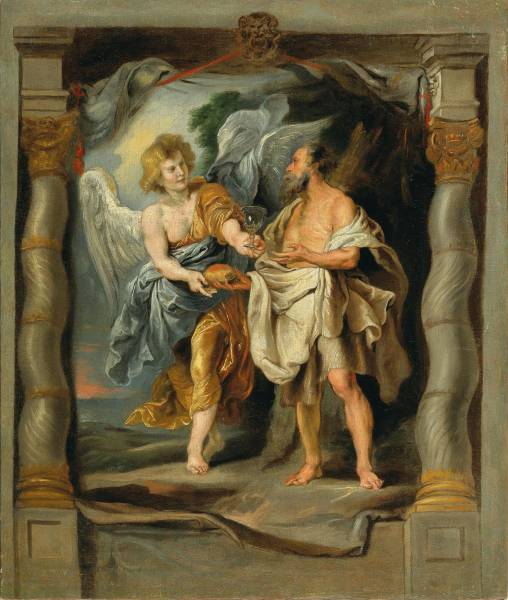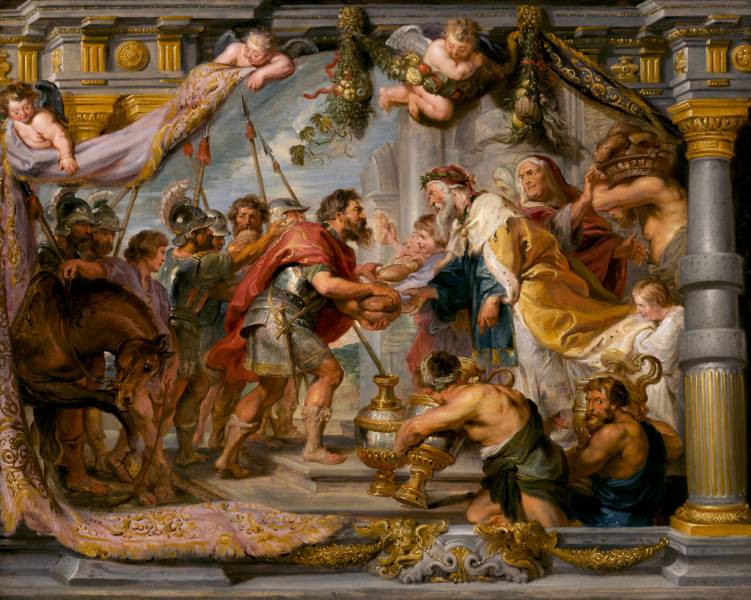
Abraham Meets Melchizedek
(c1625)
Peter Paul Rubens
(Siegen, 1577 - 1640)
Genesis 14
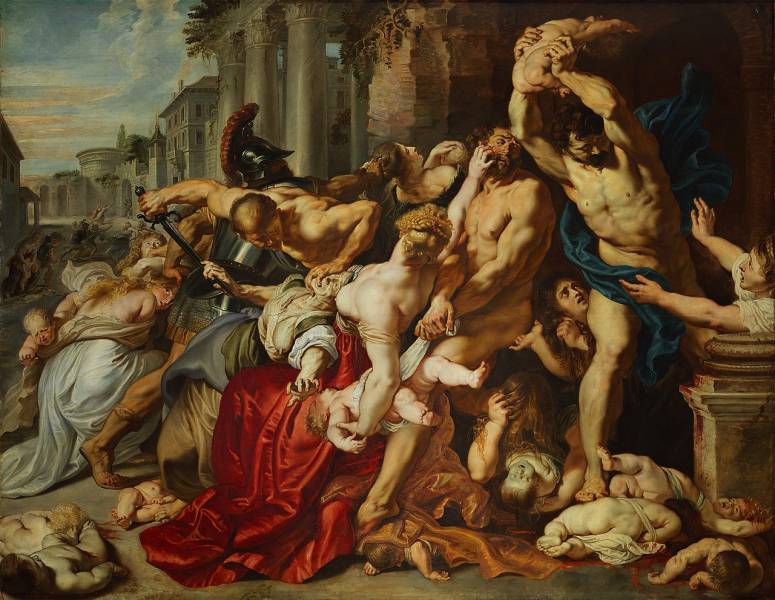
The Massacre of the Innocents is the subject of two paintings by Peter Paul Rubens depicting the episode of the biblical Massacre of the Innocents of Bethlehem, as related in the Gospel of Matthew (2:13-18). The first, measuring 142 x 182 cm, was painted after his return to his native Antwerp in 1608, following eight years spent in Italy.
Found in: Matthew, Matthew 2, 17th century, Massacre of the Innocents
13 Now when they had departed, behold, an angel of the Lord appeared to Joseph in a dream, saying, “Arise and take the young child and his mother, and flee into Egypt, and stay there until I tell you, for Herod will seek the young child to destroy him.”
14 He arose and took the young child and his mother by night, and departed into Egypt,
15 and was there until the death of Herod; that it might be fulfilled which was spoken by the Lord through the prophet, saying, “Out of Egypt I called my son.”
16 Then Herod, when he saw that he was mocked by the wise men, was exceedingly angry, and sent out, and killed all the male children who were in Bethlehem and in all the surrounding countryside, from two years old and under, according to the exact time which he had learned from the wise men.
17 Then that which was spoken by Jeremiah the prophet was fulfilled, saying,
18 “A voice was heard in Ramah, lamentation, weeping and great mourning, Rachel weeping for her children; she wouldn’t be comforted, because they are no more.”
Matthew 2:13-18 · World English Bible

1577 - 1640
Siegen, Germany
Peter Paul Rubens was a Flemish artist. He is considered the most influential artist of Flemish Baroque tradition. Rubens's highly charged compositions reference erudite aspects of classical and Christian history. His unique and immensely popular Baroque style emphasized movement, colour, and sensuality, which followed the immediate, dramatic artistic style promoted in the Counter-Reformation. Rubens specialized in making altarpieces, portraits, landscapes, and history paintings of mythological and allegorical subjects.