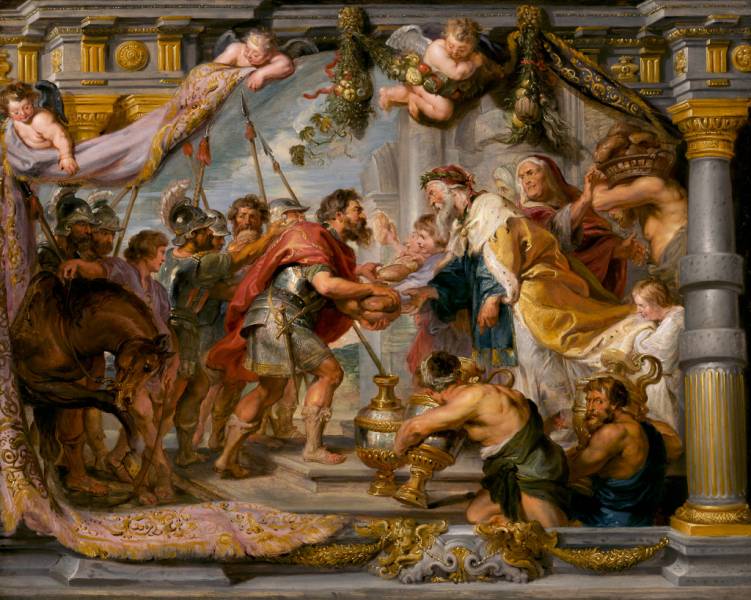
Abraham Meets Melchizedek
(c1625)
Peter Paul Rubens
(Siegen, 1577 - 1640)
Genesis 14
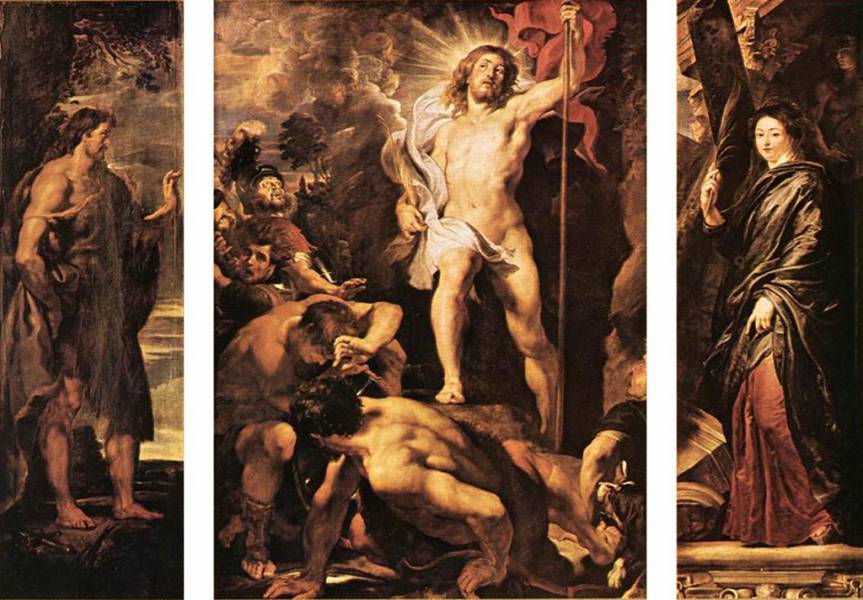
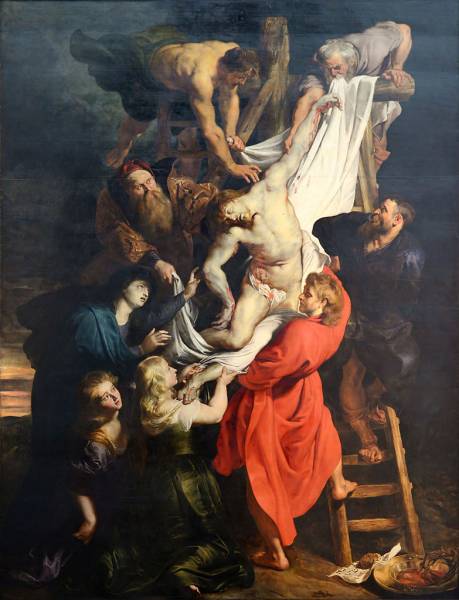
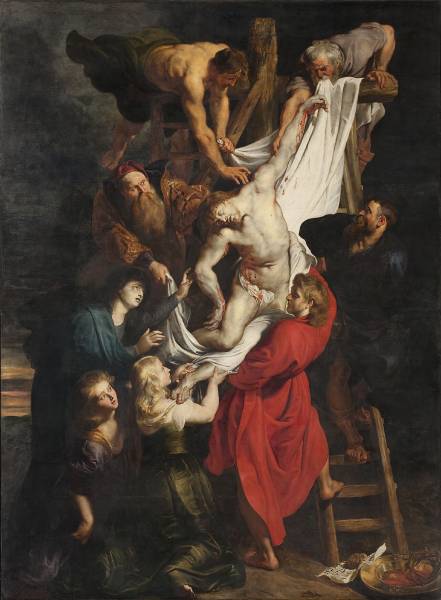
Shortly after the successful completion of his painting of the Raising of the Cross, in Antwerp’s Cathedral of Our Lady, Peter Paul Rubens was asked by the city’s Guild of Harquebusiers to create a complementary triptych altarpiece in the same cathedral. The subject was to be the descent of Christ’s body from ‘the Cross that carried the Lamb of the World’. Rubens, by his own account, expanded the theme to include the patron of the Guild, St Christopher, who in legend had also carried Christ, as well as other ‘carriers’ of the Saviour.
The central scene of the triptych is the Descent from the Cross. When the hinged shutters or 'wings' are open they show the Visitation and the Presentation in the Temple. When they are closed they show St Christopher on one wing and his hermit mentor on the other.
The ‘carriers’ of Christ thus include the cross itself; those who removed his body from it; Mary his mother, bearing him in the womb at the Visitation; the sage Simeon, at the Presentation; and St Christopher, whose name means ‘Christ-bearer’.
In the Presentation scene, Mary has just presented the child to the aged Simeon. Her arms are still raised in the gesture of offering. Their position forms a counterpart to her raised arms in the central panel. (Though uniquely entrusted with the carrying of Christ, Mary must let him go at the end of his life as well as at the beginning—as Simeon foretold.)
Simeon holds the baby in his arms and raises his eyes to heaven. His robes are meant to evoke those of a Jewish priest, but they could equally be those of a bishop, and he wears on his head a camauro, a fur-trimmed red hat that by Rubens’s day was worn only by the Pope.
Joseph kneels at the feet of Simeon, carrying the two birds that would be sacrificed as a vicarious offering for Jesus as a first-born son (Leviticus 12:8; 5:11). The allusion to Jesus’s sacrifice on the cross, which replaces the Temple sacrifice, is apparent.
This privileged circle of Christ-carriers is not a closed one. By implication, it extends to all Christians, who bear Christ in their hearts (Ephesians 3:17; Romans 8:10) and who—foreshadowed by Solomon’s prototype—are now the living Temple of the Holy Spirit (1 Corinthians 3:16).
Found in: Luke, Luke 2, 17th century, Presentation in the Temple
22 When the days of their purification according to the law of Moses were fulfilled, they brought him up to Jerusalem, to present him to the Lord
23 (as it is written in the law of the Lord, “Every male who opens the womb shall be called holy to the Lord”),
24 and to offer a sacrifice according to that which is said in the law of the Lord, “A pair of turtledoves, or two young pigeons.”
25 Behold, there was a man in Jerusalem whose name was Simeon. This man was righteous and devout, looking for the consolation of Israel, and the Holy Spirit was on him.
26 It had been revealed to him by the Holy Spirit that he should not see death before he had seen the Lord’s Christ.
27 He came in the Spirit into the temple. When the parents brought in the child, Jesus, that they might do concerning him according to the custom of the law,
28 then he received him into his arms, and blessed God, and said,
29 “Now you are releasing your servant, Master, according to your word, in peace;
30 for my eyes have seen your salvation,
31 which you have prepared before the face of all peoples;
32 a light for revelation to the nations, and the glory of your people Israel.”
33 Joseph and his mother were marveling at the things which were spoken concerning him,
34 and Simeon blessed them, and said to Mary, his mother, “Behold, this child is set for the falling and the rising of many in Israel, and for a sign which is spoken against.
35 Yes, a sword will pierce through your own soul, that the thoughts of many hearts may be revealed.”
36 There was one Anna, a prophetess, the daughter of Phanuel, of the tribe of Asher (she was of a great age, having lived with a husband seven years from her virginity,
37 and she had been a widow for about eighty-four years), who didn’t depart from the temple, worshiping with fastings and petitions night and day.
38 Coming up at that very hour, she gave thanks to the Lord, and spoke of him to all those who were looking for redemption in Jerusalem.
39 When they had accomplished all things that were according to the law of the Lord, they returned into Galilee, to their own city, Nazareth.
40 The child was growing, and was becoming strong in spirit, being filled with wisdom, and the grace of God was upon him.
Luke 2:22-40 · World English Bible

1577 - 1640
Siegen, Germany
Peter Paul Rubens was a Flemish artist. He is considered the most influential artist of Flemish Baroque tradition. Rubens's highly charged compositions reference erudite aspects of classical and Christian history. His unique and immensely popular Baroque style emphasized movement, colour, and sensuality, which followed the immediate, dramatic artistic style promoted in the Counter-Reformation. Rubens specialized in making altarpieces, portraits, landscapes, and history paintings of mythological and allegorical subjects.