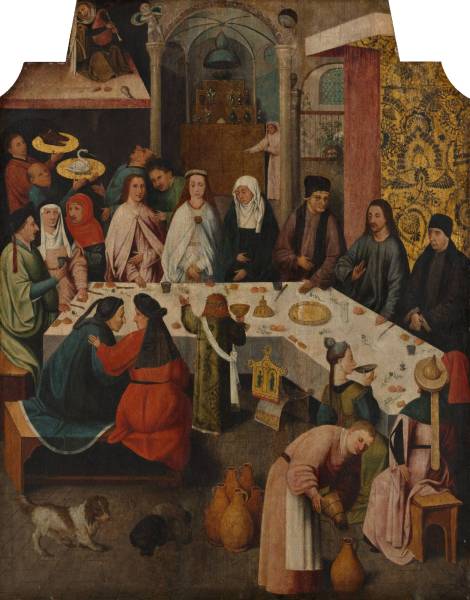
Marriage at Cana
(c1530)
Jan Vermeyen
(Brussels, 1559 - 1606)
John 2:1-12
This attractive triptych comes from the chapel of the Holy Sacrament in St Michael's Cathedral in Brussels, where Charles V's collector-general, Jean Micault and his wife Livine Cats van Welle were buried. The altarpiece was probably commissioned by their second son Nicholas in their memory. This is why they appear with their children on the wings, he wearing the mantle of the treasurer of the Order of the Golden Fleece, with his armour perhaps alluding to his having been knighted, she dressed in a black robe and a fur. Both carry little crosses in their hands, which shows that they have died, as do the adolescent boy to the far left and the girl in the plumed hat on the right-hand wing.
The central panel illustrates the greatest of Christ's miracles, the resurrection of Lazarus, the brother of Martha and Mary, after lying dead for four days. Apostles but also Jews, recognisable by their turbans, press round the tomb. Certain of them hold their noses or their throats, reminding us of Martha's words: "Lord, by this time he stinketh" (John 11,39). Martha, helped by Mary, is relieving Lazarus, sitting on the edge of his tomb, of the winding cloth in which he had been buried. At the bottom of the tomb lies his brownish corpse. Lazarus is looking at Christ with stupor. The strongly silhouetted figures standing round exude a certain coldness appropriate to an epitaph. It is the background landscapes, however, that provide the exceptional feature in this triptych, with their unusual oriental décor, albeit particularly appropriate for a biblical subject. From left to right, we recognise the bay of Tunis, the arena and aqueduct of Carthage, a Tunisian mosque, an antique-looking temple and obelisk, the aqueduct of Segovia, a primitive basilica, a domed tomb and a curious sarcophagus-shaped building.
In fact Vermeyen had joined Charles V in Spain in 1533/34. From there he followed him to Tunis, where he was commissioned to immortalise the Emperor's battle there. The many sketches he made on this voyage served in particular for an unequalled series of twelve tapestries, ordered by Mary of Hungary a few years before the triptych. By selecting a context referring to the imperial expeditions for this painting, Vermeyen probably wanted to emphasise the close connections between the Micault family and the Habsburgs.
Found in: John, John 11, 16th century, Raising of Lazarus
14 So Jesus said to them plainly then, “Lazarus is dead.
15 I am glad for your sakes that I was not there, so that you may believe. Nevertheless, let’s go to him.”
16 Thomas therefore, who is called Didymus, said to his fellow disciples, “Let’s go also, that we may die with him.”
17 So when Jesus came, he found that he had been in the tomb four days already.
18 Now Bethany was near Jerusalem, about fifteen stadia away.
19 Many of the Jews had joined the women around Martha and Mary, to console them concerning their brother.
20 Then when Martha heard that Jesus was coming, she went and met him, but Mary stayed in the house.
21 Therefore Martha said to Jesus, “Lord, if you would have been here, my brother wouldn’t have died.
22 Even now I know that, whatever you ask of God, God will give you.”
23 Jesus said to her, “Your brother will rise again.”
24 Martha said to him, “I know that he will rise again in the resurrection at the last day.”
25 Jesus said to her, “I am the resurrection and the life. He who believes in me will still live, even if he dies.
26 Whoever lives and believes in me will never die. Do you believe this?”
27 She said to him, “Yes, Lord. I have come to believe that you are the Christ, God’s Son, he who comes into the world.”
28 When she had said this, she went away, and called Mary, her sister, secretly, saying, “The Teacher is here, and is calling you.”
29 When she heard this, she arose quickly, and went to him.
30 Now Jesus had not yet come into the village, but was in the place where Martha met him.
31 Then the Jews who were with her in the house, and were consoling her, when they saw Mary, that she rose up quickly and went out, followed her, saying, “She is going to the tomb to weep there.”
32 Therefore when Mary came to where Jesus was, and saw him, she fell down at his feet, saying to him, “Lord, if you would have been here, my brother wouldn’t have died.”
33 When Jesus therefore saw her weeping, and the Jews weeping who came with her, he groaned in the spirit, and was troubled,
34 and said, “Where have you laid him?” They told him, “Lord, come and see.”
35 Jesus wept.
36 The Jews therefore said, “See how much affection he had for him!”
37 Some of them said, “Couldn’t this man, who opened the eyes of him who was blind, have also kept this man from dying?”
38 Jesus therefore, again groaning in himself, came to the tomb. Now it was a cave, and a stone lay against it.
39 Jesus said, “Take away the stone.” Martha, the sister of him who was dead, said to him, “Lord, by this time there is a stench, for he has been dead four days.”
40 Jesus said to her, “Didn’t I tell you that if you believed, you would see God’s glory?”
41 So they took away the stone from the place where the dead man was lying. Jesus lifted up his eyes, and said, “Father, I thank you that you listened to me.
42 I know that you always listen to me, but because of the multitude standing around I said this, that they may believe that you sent me.”
43 When he had said this, he cried with a loud voice, “Lazarus, come out!”
44 He who was dead came out, bound hand and foot with wrappings, and his face was wrapped around with a cloth. Jesus said to them, “Free him, and let him go.”
45 Therefore many of the Jews, who came to Mary and saw what Jesus did, believed in him.
John 11:14-45 · World English Bible
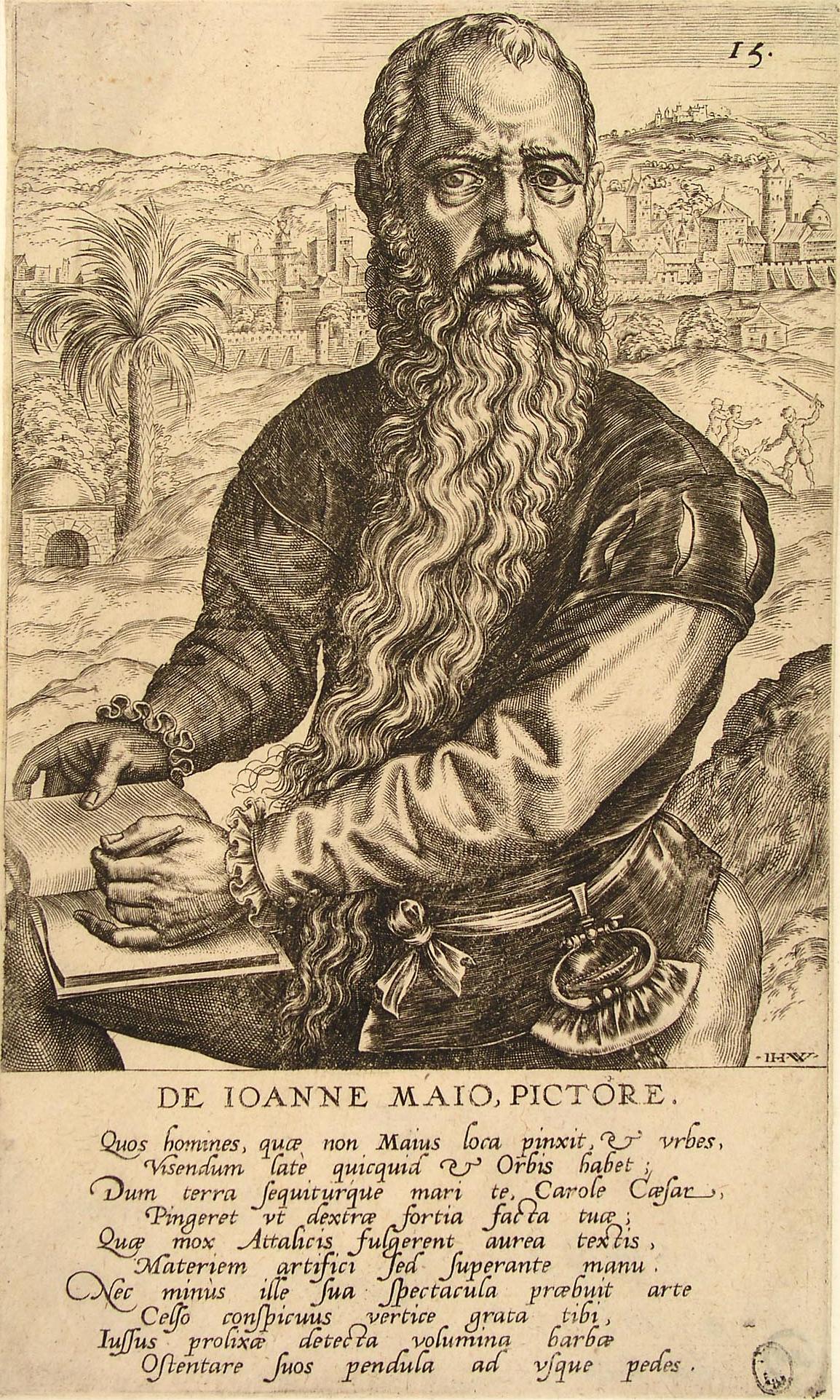
1559 - 1606
Brussels, Belgium
Jan Vermeyen (before 1559 – 1606) was a goldsmith of the Renaissance Mannerism.