The Good Samaritan
(c1562)
Jacopo Bassano
(Venice, 1510 - 1592)
Luke 10:25-37
Jacopo Bassano’s painting of Christ on the way to Calvary shows the moment at which the legendary St Veronica offers him her veil to wipe his face, leaving his portrait imprinted on the cloth. This came to be known as ‘the Veronica’ and was considered an authentic image of Christ. Here we see, not the portrait, but Christ himself and, perhaps even more arrestingly, Veronica taking on his likeness.
On her knees in the road, her posture reflects Christ’s, and her bare head (the other women are discreetly veiled, with downcast eyes) shows her crown of plaits, echoing Christ’s crown of thorns. Her mirroring of Christ is further revealed by her clothing. The sections of her white petticoat are loosely stitched, leaving almond-shaped openings which prefigure the shape of Christ’s side wound, while the vertical stitch marks bring to mind the flagellation marks hidden beneath Christ’s robe. As Christ is led by a rope, like a ‘sheep to be slaughtered’ (Romans 8:36) Veronica is alongside him in ‘tribulation’, ‘distress’, ‘persecution’, and ‘peril’ (v.35), and her hair and garments manifest this.
In part, this is a picture about picture-making, and the legendary origins of a foundational image of the adult Christ. It is also about a particular incidence of what one might now call ‘Christian witness’ or, perhaps, since she is in a sense an image-maker, ‘artist witness’. Veronica’s offering of her veil here is as much an offering of herself in conformity to Christ. And if she is not yet bodily redeemed (v.23), she is about to be blessed with the imprint on the veil, which cannot yet be seen but will become a source of hope and consolation to many (vv.24–25).
Found in: Luke, Luke 23, 16th century
26 When they led him away, they grabbed one Simon of Cyrene, coming from the country, and laid on him the cross, to carry it after Jesus.
27 A great multitude of the people followed him, including women who also mourned and lamented him.
28 But Jesus, turning to them, said, “Daughters of Jerusalem, don’t weep for me, but weep for yourselves and for your children.
29 For behold, the days are coming in which they will say, ‘Blessed are the barren, the wombs that never bore, and the breasts that never nursed.’
30 Then they will begin to tell the mountains, ‘Fall on us!’ and tell the hills, ‘Cover us.’
31 For if they do these things in the green tree, what will be done in the dry?”
32 There were also others, two criminals, led with him to be put to death.
33 When they came to the place that is called The Skull, they crucified him there with the criminals, one on the right and the other on the left.
34 Jesus said, “Father, forgive them, for they don’t know what they are doing.” Dividing his garments among them, they cast lots.
35 The people stood watching. The rulers with them also scoffed at him, saying, “He saved others. Let him save himself, if this is the Christ of God, his chosen one!”
36 The soldiers also mocked him, coming to him and offering him vinegar,
37 and saying, “If you are the King of the Jews, save yourself!”
38 An inscription was also written over him in letters of Greek, Latin, and Hebrew: “THIS IS THE KING OF THE JEWS.”
39 One of the criminals who was hanged insulted him, saying, “If you are the Christ, save yourself and us!”
40 But the other answered, and rebuking him said, “Don’t you even fear God, seeing you are under the same condemnation?
41 And we indeed justly, for we receive the due reward for our deeds, but this man has done nothing wrong.”
42 He said to Jesus, “Lord, remember me when you come into your Kingdom.”
43 Jesus said to him, “Assuredly I tell you, today you will be with me in Paradise.”
Luke 23:26-43 · World English Bible
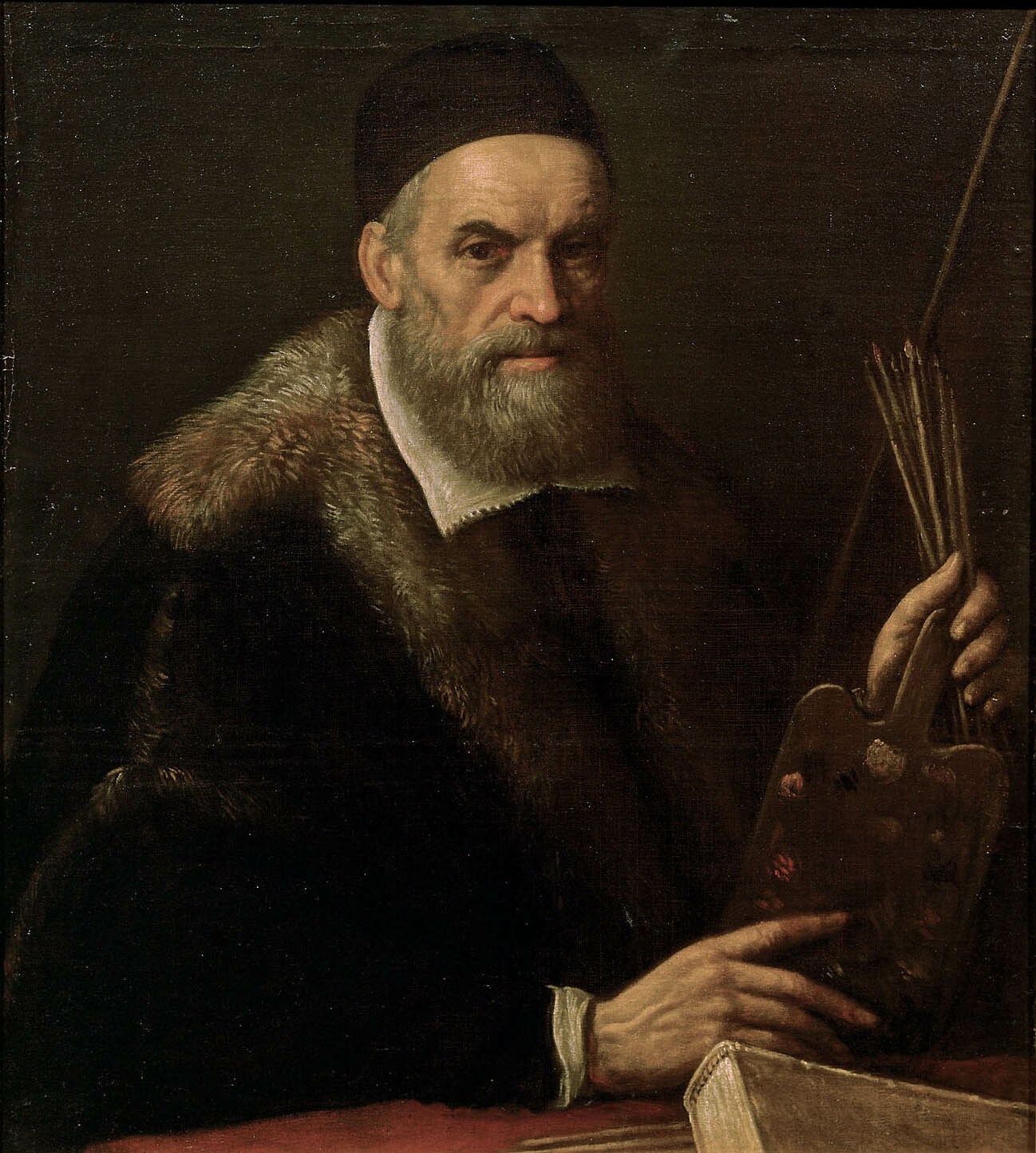
1510 - 1592
Venice, Italy
Jacopo Bassano (c. 1510 – 14 February 1592), known also as Jacopo dal Ponte, was an Italian painter who was born and died in Bassano del Grappa near Venice, and took the village as his surname. Trained in the workshop of his father, Francesco the Elder, and studying under Bonifazio Veronese in Venice, he painted mostly religious paintings including landscape and genre scenes.[3] He often treated biblical themes in the manner of rural genre scenes, portraying people who look like…