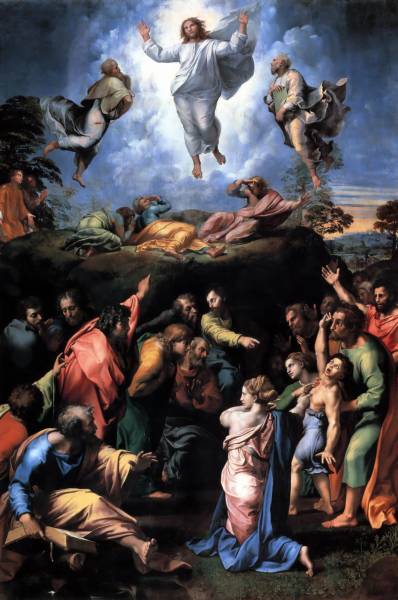
The Transfiguration
(1516)
Raphael Sanzio
(Urbino, 1483 - 1520)
Matthew 17:1-13
1 After six days, Jesus took with him Peter, James, and John his brother, and brought them up into a high mountain by themselves.
2 He was transfigured before them. His face shone like the sun, and his garments became as white as the light.
3 Behold, Moses and Elijah appeared to them talking with him.
4 Peter answered, and said to Jesus, “Lord, it is good for us to be here. If you want, let’s make three tents here: one for you, one for Moses, and one for Elijah.”
5 While he was still speaking, behold, a bright cloud overshadowed them. Behold, a voice came out of the cloud, saying, “This is my beloved Son, in whom I am well pleased. Listen to him.”
6 When the disciples heard it, they fell on their faces, and were very afraid.
7 Jesus came and touched them and said, “Get up, and don’t be afraid.”
8 Lifting up their eyes, they saw no one, except Jesus alone.
9 As they were coming down from the mountain, Jesus commanded them, saying, “Don’t tell anyone what you saw, until the Son of Man has risen from the dead.”
10 His disciples asked him, saying, “Then why do the scribes say that Elijah must come first?”
11 Jesus answered them, “Elijah indeed comes first, and will restore all things,
12 but I tell you that Elijah has come already, and they didn’t recognize him, but did to him whatever they wanted to. Even so the Son of Man will also suffer by them.”
13 Then the disciples understood that he spoke to them of John the Baptizer.
Matthew 17:1-13 · World English Bible