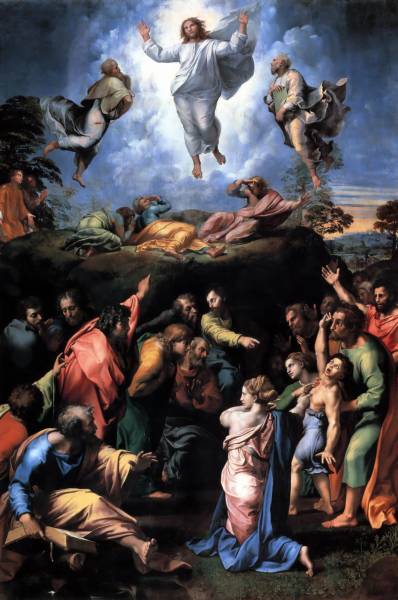
The Transfiguration
(c1516)
Raphael Sanzio
(Urbino, 1483 - 1520)
Matthew 17:1-13
1483 - 1520
Urbino, Italy
Raffaello Sanzio da Urbino, known to the world as Raphael, stands as one of the three towering masters of the High Renaissance alongside Leonardo da Vinci and Michelangelo. Born in 1483 in the cultured city of Urbino, where his father Giovanni Santi served as court painter, Raphael was immersed in artistic excellence from childhood. After his father's death when he was eleven, Raphael likely trained under Pietro Perugino and was recognized as a master by 1500. His meteoric career unfolded across three distinct phases: his formative years in Umbria, a transformative period in Florence (1504-1508) where he absorbed the innovations of his contemporaries, and finally his triumphant twelve years in Rome beginning in 1508.
Raphael's artistic genius manifested in his unparalleled ability to synthesize beauty, harmony, and divine grace in his religious works. His biblical and sacred paintings demonstrate a masterful command of composition, clarity of form, and an almost ethereal quality that embodies the Neoplatonic ideals of his era. Among his most celebrated religious works are the sublime Sistine Madonna, with its iconic cherubs, and numerous depictions of the Madonna and Child that showcase his tender humanity and spiritual depth. His Vatican commissions included magnificent biblical frescoes, though his secular masterpiece The School of Athens in the Raphael Rooms remains his most famous work.
Working under the patronage of Pope Julius II and later Leo X, Raphael transformed religious art through his innovative approach to sacred subjects, imbuing them with both monumental grandeur and intimate devotion. His workshop was extraordinarily productive, though works executed primarily by assistants in his later years sometimes lacked the master's direct touch. Despite his untimely death at just 37 in 1520, Raphael left an indelible mark on Western art, particularly in his portrayal of biblical themes that continue to inspire reverence and wonder centuries later.
Raphael's legacy in religious art endures as a testament to the perfect marriage of technical mastery and spiritual expression. His influence waned temporarily under Michelangelo's shadow but resurged powerfully in the 18th and 19th centuries, when his serene harmonies and graceful compositions were once again recognized as pinnacles of artistic achievement. His biblical works remain cornerstones of Christian artistic tradition, embodying an ideal of divine beauty that continues to move viewers across cultures and centuries.
2 artworks found