Adoration of the Shepherds
(1622)
Gerard Van Honthorst
(Utrecht, 1592 - 1656)
Luke 2:1-21
"The Beheading of St. John the Baptist" by Gerard van Honthorst, a monumental oil-on-canvas painting created in 1618, brings to life a dramatic and tragic scene from the Christian Bible. The canvas measures an impressive 210cm ✕ 350cm, showcasing Honthorst's mastery in capturing large-scale compositions with emotional depth.
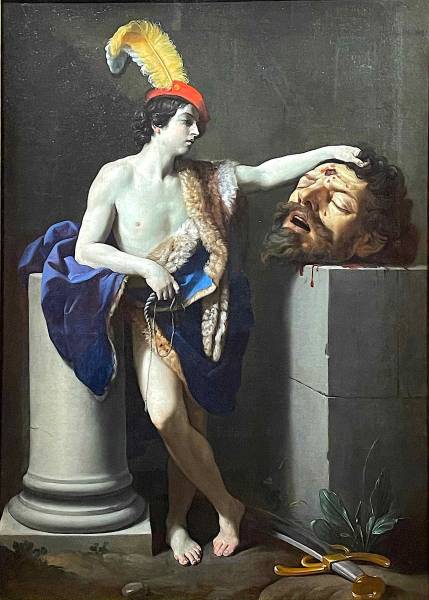
The painting depicts the fateful moment of St. John the Baptist's execution, as Tiberias and Salome look on, witnessing the gruesome spectacle. Tiberias, the ruler of Galilee, had ordered the beheading of John as a result of a promise he made to Salome, the daughter of Herodias, who had danced for him and pleased him. Upon her mother's urging, Salome requested John's head on a platter, and despite his reservations, Tiberias fulfilled her macabre wish.
At the top of the canvas, an angel descends with a crown of martyrdom, symbolizing the spiritual triumph of St. John even in his martyrdom. This celestial figure's presence adds a poignant and transcendent element to the scene, highlighting the saint's ultimate victory in his faith and devotion to his beliefs.
Honthorst's expert use of lighting and shadow plays a pivotal role in creating an intense and emotionally charged atmosphere. The contrast of light and darkness enhances the dramatic impact of the scene, emphasizing the gravity of the moment and the characters' conflicting emotions. Salome's youthful face betrays a mix of curiosity and remorse, while Tiberias appears burdened by the weight of his decision. The saint himself, serene and composed, stands as a symbol of unwavering faith and martyrdom.
The composition's scale and the detailed rendering of the figures draw the viewer into the scene, allowing them to experience the tension and tragedy of the event. Honthorst's meticulous attention to the figures' expressions and body language infuses the painting with a profound sense of realism and human emotion.
"The Beheading of St. John the Baptist" stands as a testament to Honthorst's artistic skill in narrating poignant and powerful biblical narratives. Through this painting, the artist delves into themes of religious devotion, political intrigue, and the complexities of human nature. The artwork serves not only as a poignant remembrance of a biblical event but also as a reflection on the enduring struggles between faith and worldly desires.
In conclusion, "The Beheading of St. John the Baptist" by Gerard van Honthorst is a powerful and emotionally charged masterpiece that brings to life a tragic scene from the Christian Bible. Through his expert use of lighting, composition, and detailed rendering of characters, Honthorst creates a compelling and immersive tableau that captivates viewers with its profound storytelling and exploration of human emotions. The painting continues to be an important work in the realm of religious art, inviting contemplation on themes of faith, martyrdom, and the complexities of human choices.
Found in: Mark, Mark 6, 17th century, Death of the Baptist
14 King Herod heard this, for his name had become known, and he said, “John the Baptizer has risen from the dead, and therefore these powers are at work in him.”
15 But others said, “He is Elijah.” Others said, “He is a prophet, or like one of the prophets.”
16 But Herod, when he heard this, said, “This is John, whom I beheaded. He has risen from the dead.”
17 For Herod himself had sent out and arrested John, and bound him in prison for the sake of Herodias, his brother Philip’s wife, for he had married her.
18 For John said to Herod, “It is not lawful for you to have your brother’s wife.”
19 Herodias set herself against him, and desired to kill him, but she couldn’t,
20 for Herod feared John, knowing that he was a righteous and holy man, and kept him safe. When he heard him, he did many things, and he heard him gladly.
21 Then a convenient day came, that Herod on his birthday made a supper for his nobles, the high officers, and the chief men of Galilee.
22 When the daughter of Herodias herself came in and danced, she pleased Herod and those sitting with him. The king said to the young lady, “Ask me whatever you want, and I will give it to you.”
23 He swore to her, “Whatever you shall ask of me, I will give you, up to half of my kingdom.”
24 She went out, and said to her mother, “What shall I ask?” She said, “The head of John the Baptizer.”
25 She came in immediately with haste to the king, and asked, “I want you to give me right now the head of John the Baptizer on a platter.”
26 The king was exceedingly sorry, but for the sake of his oaths, and of his dinner guests, he didn’t wish to refuse her.
27 Immediately the king sent out a soldier of his guard, and commanded to bring John’s head, and he went and beheaded him in the prison,
28 and brought his head on a platter, and gave it to the young lady; and the young lady gave it to her mother.
29 When his disciples heard this, they came and took up his corpse, and laid it in a tomb.
Mark 6:14-29 · World English Bible

1592 - 1656
Utrecht, Netherland
Gerard van Honthorst (Gerrit van Honthorst) (4 November 1592 – 27 April 1656) was a Dutch Golden Age painter who became especially noted for his depiction of artificially lit scenes, eventually receiving the nickname Gherardo delle Notti ("Gerard of the nights"). Early in his career he visited Rome, where he had great success painting in a style influenced by Caravaggio. Following his return to the Netherlands he became a leading portrait painter. Van Honthorst was born in Utrecht, the son…