Gerard Van Honthorst
(Utrecht, 1592 - 1656)
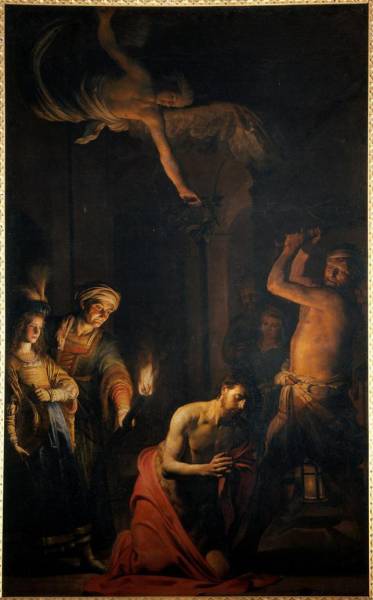
Mark 6:14-29
The Adoration of the Shepherds by Gerrit van Honthorst is one of the biggest crowd-pleasers in the Wallraf-Richartz-Museum – and not only at Christmas time. The Dutch master’s intimate view of the Nativity is unique, making it one of the most fascinating adoration scenes in art history.
Thanks to an extensive restoration supported by the state of North Rhine-Westphalia, and the provision of a new oak wood frame based on historical models, the painting now shines forth in new glory: brighter, more colorful and even bigger! Surprisingly, the work of the restorers revealed that after an initial completion Honthorst subsequently enlarged the canvas in the upper part, providing the scene with more air; this had remained hidden as a result of the added strip being folded back in the 1940s. The re-creation of the original format was not an easy task because the blue-striped canvas had been relined and, in order to align the canvas strip on the reverse of the top edge with the rest of the image, the painting had first to be detached from its stretcher. Gradually it was flattened out, partly by using clamping plates to tauten the canvas. The holes made by the nails that were hammered through the canvas and paint layer when the canvas was folded were repaired with tiny patches on the reverse.
Found in: Luke, Luke 2, 17th century, Adoration of the Shepherds
1 Now in those days, a decree went out from Caesar Augustus that all the world should be enrolled.
2 This was the first enrollment made when Quirinius was governor of Syria.
3 All went to enroll themselves, everyone to his own city.
4 Joseph also went up from Galilee, out of the city of Nazareth, into Judea, to David’s city, which is called Bethlehem, because he was of the house and family of David;
5 to enroll himself with Mary, who was pledged to be married to him as wife, being pregnant.
6 While they were there, the day had come for her to give birth.
7 She gave birth to her firstborn son. She wrapped him in bands of cloth, and laid him in a feeding trough, because there was no room for them in the inn.
8 There were shepherds in the same country staying in the field, and keeping watch by night over their flock.
9 Behold, an angel of the Lord stood by them, and the glory of the Lord shone around them, and they were terrified.
10 The angel said to them, “Don’t be afraid, for behold, I bring you good news of great joy which will be to all the people.
11 For there is born to you today, in David’s city, a Savior, who is Christ the Lord.
12 This is the sign to you: you will find a baby wrapped in strips of cloth, lying in a feeding trough.”
13 Suddenly, there was with the angel a multitude of the heavenly army praising God, and saying,
14 “Glory to God in the highest, on earth peace, good will toward men.”
15 When the angels went away from them into the sky, the shepherds said to one another, “Let’s go to Bethlehem, now, and see this thing that has happened, which the Lord has made known to us.”
16 They came with haste, and found both Mary and Joseph, and the baby was lying in the feeding trough.
17 When they saw it, they publicized widely the saying which was spoken to them about this child.
18 All who heard it wondered at the things which were spoken to them by the shepherds.
19 But Mary kept all these sayings, pondering them in her heart.
20 The shepherds returned, glorifying and praising God for all the things that they had heard and seen, just as it was told them.
21 When eight days were fulfilled for the circumcision of the child, his name was called Jesus, which was given by the angel before he was conceived in the womb.
Luke 2:1-21 · World English Bible

1592 - 1656
Utrecht, Netherland
Gerard van Honthorst (Gerrit van Honthorst) (4 November 1592 – 27 April 1656) was a Dutch Golden Age painter who became especially noted for his depiction of artificially lit scenes, eventually receiving the nickname Gherardo delle Notti ("Gerard of the nights"). Early in his career he visited Rome, where he had great success painting in a style influenced by Caravaggio. Following his return to the Netherlands he became a leading portrait painter. Van Honthorst was born in Utrecht, the son…