Duccio di Buoninsegna
(Siena, 1255 - 1260)
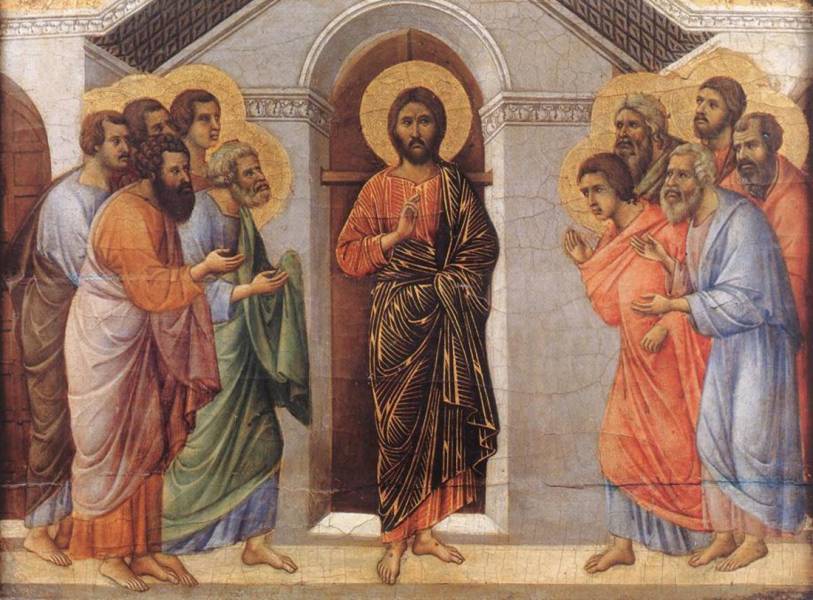
John 20:19-23
Duccio di Buoninsegna's "The Raising of Lazarus" is a captivating depiction of a pivotal scene from the Gospel of John, where Jesus restores life to his friend Lazarus, who has been entombed for four days. The narrative, as recorded in John 11:1-44, is one of faith, hope, and the miraculous power of Jesus. The scene is set in Bethany, where Jesus, surrounded by his disciples and the grieving sisters of Lazarus, Martha and Mary, summons the deceased from his tomb. As Lazarus emerges, bound in his burial clothes, the gathering witnesses a moment of profound awe and reverence.
Artistically, "The Raising of Lazarus" showcases Duccio's mastery of composition and his innovative approach to visual storytelling. The painting's spatial organization is deliberate and purposeful, guiding the viewer's eye through the dramatic sequence of events. The use of gold backgrounds and delicate details, characteristic of Duccio's style, adds a sense of warmth and intimacy to the scene. The figures, with their softly modeled features and three-dimensional forms, exude a sense of humanity and emotional depth. The overall effect is one of tender devotion and profound spiritual resonance.
The painting's symbolism is equally noteworthy, as Duccio weaves together multiple layers of meaning to convey the richness of the biblical narrative. The raising of Lazarus is often seen as a prefiguration of Jesus' own resurrection, and the scene is replete with allusions to this miraculous event. The bound figure of Lazarus, emerging from the darkness of the tomb into the light of new life, serves as a powerful metaphor for spiritual rebirth and the triumph of faith over mortality. Through his masterful handling of light, color, and composition, Duccio invites the viewer to contemplate the profound significance of this moment, and to participate in the awe and wonder of the witnesses who beheld the miracle.
As a work of art, "The Raising of Lazarus" holds significant importance in the history of Italian painting, marking a pivotal moment in the development of the Sienese school and the Trecento Gothic style. Duccio's innovative approach to tempera painting, his use of gold leaf, and his delicate modeling of figures all contributed to a new era of artistic expression, one that would influence generations of painters to come. As a testament to the enduring power of faith and the human spirit, "The Raising of Lazarus" remains a deeply moving and thought-provoking work, one that continues to inspire and uplift all who behold it.
Found in: John, John 11, 14th century
1 Now a certain man was sick, Lazarus from Bethany, of the village of Mary and her sister, Martha.
2 It was that Mary who had anointed the Lord with ointment, and wiped his feet with her hair, whose brother, Lazarus, was sick.
3 The sisters therefore sent to him, saying, “Lord, behold, he for whom you have great affection is sick.”
4 But when Jesus heard it, he said, “This sickness is not to death, but for the glory of God, that God’s Son may be glorified by it.”
5 Now Jesus loved Martha, and her sister, and Lazarus.
6 When therefore he heard that he was sick, he stayed two days in the place where he was.
7 Then after this he said to the disciples, “Let’s go into Judea again.”
8 The disciples told him, “Rabbi, the Jews were just trying to stone you, and are you going there again?”
9 Jesus answered, “Aren’t there twelve hours of daylight? If a man walks in the day, he doesn’t stumble, because he sees the light of this world.
10 But if a man walks in the night, he stumbles, because the light isn’t in him.”
11 He said these things, and after that, he said to them, “Our friend, Lazarus, has fallen asleep, but I am going so that I may awake him out of sleep.”
12 The disciples therefore said, “Lord, if he has fallen asleep, he will recover.”
13 Now Jesus had spoken of his death, but they thought that he spoke of taking rest in sleep.
14 So Jesus said to them plainly then, “Lazarus is dead.
15 I am glad for your sakes that I was not there, so that you may believe. Nevertheless, let’s go to him.”
16 Thomas therefore, who is called Didymus, said to his fellow disciples, “Let’s go also, that we may die with him.”
17 So when Jesus came, he found that he had been in the tomb four days already.
18 Now Bethany was near Jerusalem, about fifteen stadia away.
19 Many of the Jews had joined the women around Martha and Mary, to console them concerning their brother.
20 Then when Martha heard that Jesus was coming, she went and met him, but Mary stayed in the house.
21 Therefore Martha said to Jesus, “Lord, if you would have been here, my brother wouldn’t have died.
22 Even now I know that, whatever you ask of God, God will give you.”
23 Jesus said to her, “Your brother will rise again.”
24 Martha said to him, “I know that he will rise again in the resurrection at the last day.”
25 Jesus said to her, “I am the resurrection and the life. He who believes in me will still live, even if he dies.
26 Whoever lives and believes in me will never die. Do you believe this?”
27 She said to him, “Yes, Lord. I have come to believe that you are the Christ, God’s Son, he who comes into the world.”
28 When she had said this, she went away, and called Mary, her sister, secretly, saying, “The Teacher is here, and is calling you.”
29 When she heard this, she arose quickly, and went to him.
30 Now Jesus had not yet come into the village, but was in the place where Martha met him.
31 Then the Jews who were with her in the house, and were consoling her, when they saw Mary, that she rose up quickly and went out, followed her, saying, “She is going to the tomb to weep there.”
32 Therefore when Mary came to where Jesus was, and saw him, she fell down at his feet, saying to him, “Lord, if you would have been here, my brother wouldn’t have died.”
33 When Jesus therefore saw her weeping, and the Jews weeping who came with her, he groaned in the spirit, and was troubled,
34 and said, “Where have you laid him?” They told him, “Lord, come and see.”
35 Jesus wept.
36 The Jews therefore said, “See how much affection he had for him!”
37 Some of them said, “Couldn’t this man, who opened the eyes of him who was blind, have also kept this man from dying?”
38 Jesus therefore, again groaning in himself, came to the tomb. Now it was a cave, and a stone lay against it.
39 Jesus said, “Take away the stone.” Martha, the sister of him who was dead, said to him, “Lord, by this time there is a stench, for he has been dead four days.”
40 Jesus said to her, “Didn’t I tell you that if you believed, you would see God’s glory?”
41 So they took away the stone from the place where the dead man was lying. Jesus lifted up his eyes, and said, “Father, I thank you that you listened to me.
42 I know that you always listen to me, but because of the multitude standing around I said this, that they may believe that you sent me.”
43 When he had said this, he cried with a loud voice, “Lazarus, come out!”
44 He who was dead came out, bound hand and foot with wrappings, and his face was wrapped around with a cloth. Jesus said to them, “Free him, and let him go.”
John 11:1-44 · World English Bible
1255 - 1260
Siena, Italy
Duccio di Buoninsegna (c. 1255–1260 – c. 1318–1319) was an Italian painter active in Siena, Tuscany, in the late 13th and early 14th century. He was hired throughout his life to complete many important works in government and religious buildings around Italy. Duccio is credited with creating the painting styles of Trecento and the Sienese school, and also contributed significantly to the Sienese Gothic style.