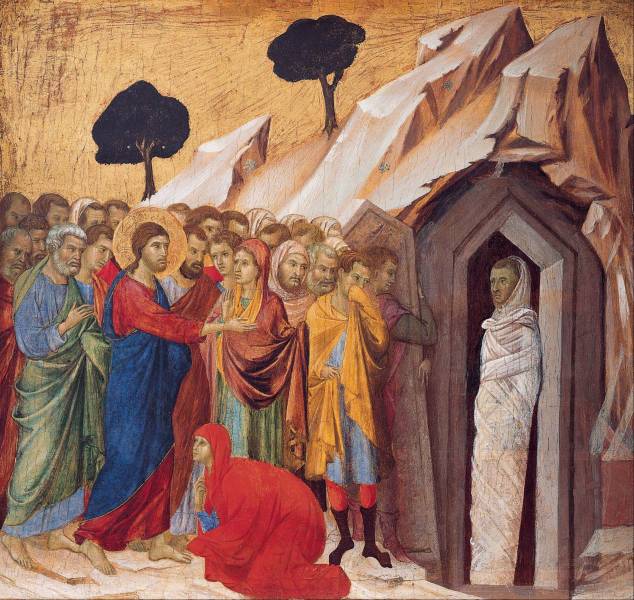
The Raising of Lazarus
(c1310)
Duccio di Buoninsegna
(Siena, 1255 - 1260)
John 11:1-44
This scene is on one of the back crowning panels of the Maestà.
The episodes Appearance Behind Locked Doors and Doubting St Thomas take place in the same surroundings, the house where the apostles took refuge for fear of the Jews. The door in the centre, firmly shut with a horizontal bar (a detail which emphasizes the miraculous nature of the event), frames and shows up the dominant figure of Christ, towards whom the two groups of apostles are converging.
Found in: John, John 20, 14th century, Maesta (Duccio), Resurrection
19 When therefore it was evening, on that day, the first day of the week, and when the doors were locked where the disciples were assembled, for fear of the Jews, Jesus came and stood in the middle, and said to them, “Peace be to you.”
20 When he had said this, he showed them his hands and his side. The disciples therefore were glad when they saw the Lord.
21 Jesus therefore said to them again, “Peace be to you. As the Father has sent me, even so I send you.”
22 When he had said this, he breathed on them, and said to them, “Receive the Holy Spirit!
23 If you forgive anyone’s sins, they have been forgiven them. If you retain anyone’s sins, they have been retained.”
John 20:19-23 · World English Bible
1255 - 1260
Siena, Italy
Duccio di Buoninsegna (c. 1255–1260 – c. 1318–1319) was an Italian painter active in Siena, Tuscany, in the late 13th and early 14th century. He was hired throughout his life to complete many important works in government and religious buildings around Italy. Duccio is credited with creating the painting styles of Trecento and the Sienese school, and also contributed significantly to the Sienese Gothic style.