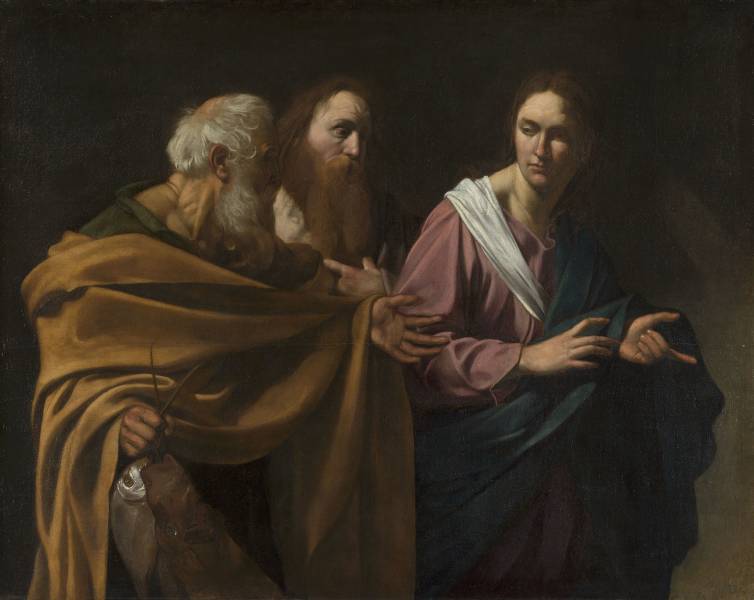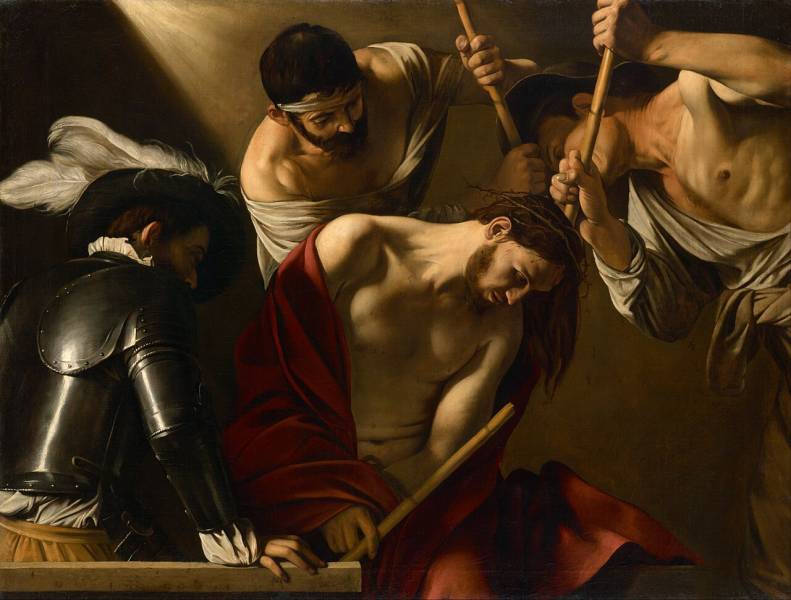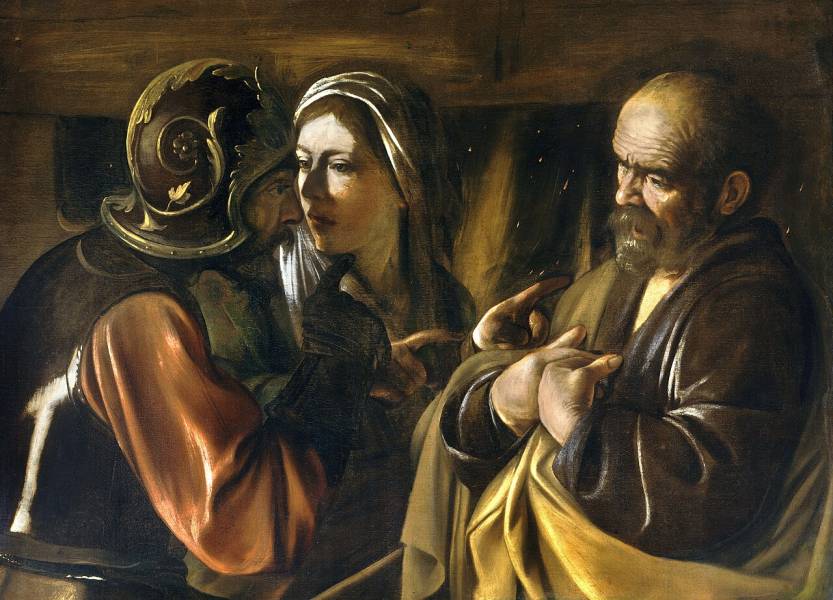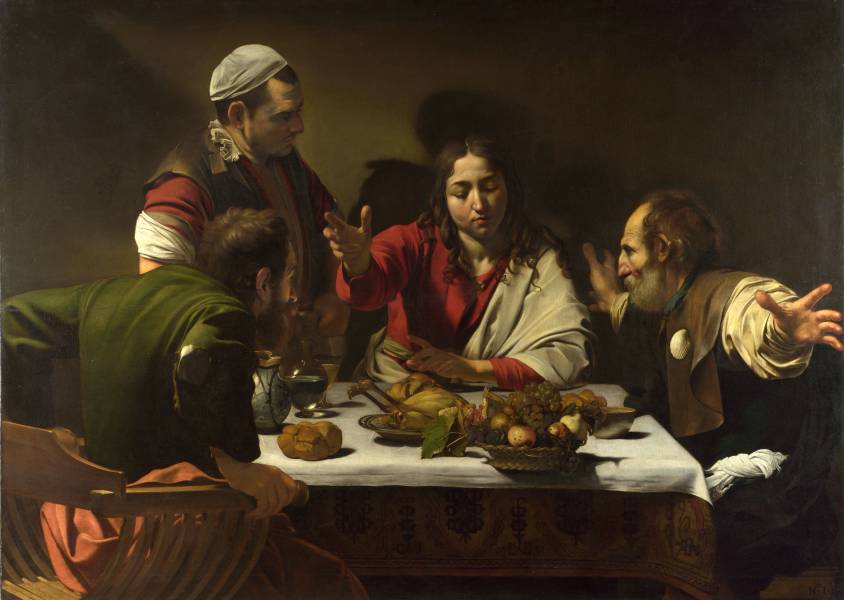
Caravaggio
(Milan, 1571 - 1610)
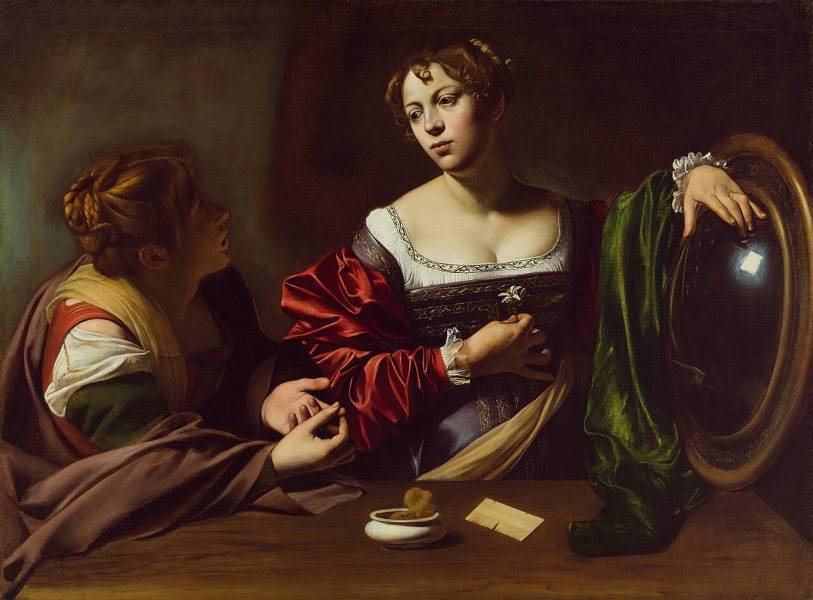
Luke 10:38-42
Caravaggio's "The Resurrection of Lazarus" masterfully depicts the dramatic scene from John 11:1-44, where Jesus Christ resurrects Lazarus, a close friend who had been dead for four days. The painting captures the moment when Jesus calls out to Lazarus, saying "Lazarus, come forth," and the miraculous event unfolds. The scene is set in a dimly lit tomb, with the figures of Jesus, Lazarus, and the onlookers arranged in a powerful composition that conveys the emotional intensity of the moment.
The artistic composition of "The Resurrection of Lazarus" showcases Caravaggio's innovative use of chiaroscuro, a technique that emphasizes the contrast between light and dark to create a sense of drama and tension. The painting's use of tenebrism, a style characterized by intense shadows and highlights, adds to the emotional impact of the scene. The figures are arranged in a diagonal line, with Jesus at the center, his arm outstretched as he calls out to Lazarus. The onlookers are depicted in various states of astonishment and devotion, adding to the sense of drama and wonder. The use of light and shadow creates a sense of depth and volume, drawing the viewer's eye to the central figure of Jesus and emphasizing his role as the catalyst for the miracle.
The painting is also rich in symbolism, with the figures and their actions conveying the deeper meaning of the biblical narrative. Lazarus, still wrapped in his grave clothes, emerges from the tomb, symbolizing the triumph of life over death and the promise of eternal salvation through Jesus Christ. The onlookers, who are depicted in various states of emotion, represent the range of human responses to the miracle, from awe and wonder to skepticism and doubt. The painting's use of symbolism and its powerful composition make it a masterpiece of Baroque art, showcasing Caravaggio's innovative style and his ability to convey complex emotions and ideas through his work.
"The Resurrection of Lazarus" is a significant work in Caravaggio's oeuvre, demonstrating his ability to balance dramatic intensity with emotional depth and psychological complexity. The painting's influence can be seen in the work of later artists, who were inspired by Caravaggio's innovative use of light and shadow and his ability to convey complex emotions and ideas through his compositions. Today, "The Resurrection of Lazarus" is considered one of the greatest paintings of the Baroque period, a testament to Caravaggio's innovative style and his enduring influence on the development of Western art.
Found in: John, John 11, 17th century
1 Now a certain man was sick, Lazarus from Bethany, of the village of Mary and her sister, Martha.
2 It was that Mary who had anointed the Lord with ointment, and wiped his feet with her hair, whose brother, Lazarus, was sick.
3 The sisters therefore sent to him, saying, “Lord, behold, he for whom you have great affection is sick.”
4 But when Jesus heard it, he said, “This sickness is not to death, but for the glory of God, that God’s Son may be glorified by it.”
5 Now Jesus loved Martha, and her sister, and Lazarus.
6 When therefore he heard that he was sick, he stayed two days in the place where he was.
7 Then after this he said to the disciples, “Let’s go into Judea again.”
8 The disciples told him, “Rabbi, the Jews were just trying to stone you, and are you going there again?”
9 Jesus answered, “Aren’t there twelve hours of daylight? If a man walks in the day, he doesn’t stumble, because he sees the light of this world.
10 But if a man walks in the night, he stumbles, because the light isn’t in him.”
11 He said these things, and after that, he said to them, “Our friend, Lazarus, has fallen asleep, but I am going so that I may awake him out of sleep.”
12 The disciples therefore said, “Lord, if he has fallen asleep, he will recover.”
13 Now Jesus had spoken of his death, but they thought that he spoke of taking rest in sleep.
14 So Jesus said to them plainly then, “Lazarus is dead.
15 I am glad for your sakes that I was not there, so that you may believe. Nevertheless, let’s go to him.”
16 Thomas therefore, who is called Didymus, said to his fellow disciples, “Let’s go also, that we may die with him.”
17 So when Jesus came, he found that he had been in the tomb four days already.
18 Now Bethany was near Jerusalem, about fifteen stadia away.
19 Many of the Jews had joined the women around Martha and Mary, to console them concerning their brother.
20 Then when Martha heard that Jesus was coming, she went and met him, but Mary stayed in the house.
21 Therefore Martha said to Jesus, “Lord, if you would have been here, my brother wouldn’t have died.
22 Even now I know that, whatever you ask of God, God will give you.”
23 Jesus said to her, “Your brother will rise again.”
24 Martha said to him, “I know that he will rise again in the resurrection at the last day.”
25 Jesus said to her, “I am the resurrection and the life. He who believes in me will still live, even if he dies.
26 Whoever lives and believes in me will never die. Do you believe this?”
27 She said to him, “Yes, Lord. I have come to believe that you are the Christ, God’s Son, he who comes into the world.”
28 When she had said this, she went away, and called Mary, her sister, secretly, saying, “The Teacher is here, and is calling you.”
29 When she heard this, she arose quickly, and went to him.
30 Now Jesus had not yet come into the village, but was in the place where Martha met him.
31 Then the Jews who were with her in the house, and were consoling her, when they saw Mary, that she rose up quickly and went out, followed her, saying, “She is going to the tomb to weep there.”
32 Therefore when Mary came to where Jesus was, and saw him, she fell down at his feet, saying to him, “Lord, if you would have been here, my brother wouldn’t have died.”
33 When Jesus therefore saw her weeping, and the Jews weeping who came with her, he groaned in the spirit, and was troubled,
34 and said, “Where have you laid him?” They told him, “Lord, come and see.”
35 Jesus wept.
36 The Jews therefore said, “See how much affection he had for him!”
37 Some of them said, “Couldn’t this man, who opened the eyes of him who was blind, have also kept this man from dying?”
38 Jesus therefore, again groaning in himself, came to the tomb. Now it was a cave, and a stone lay against it.
39 Jesus said, “Take away the stone.” Martha, the sister of him who was dead, said to him, “Lord, by this time there is a stench, for he has been dead four days.”
40 Jesus said to her, “Didn’t I tell you that if you believed, you would see God’s glory?”
41 So they took away the stone from the place where the dead man was lying. Jesus lifted up his eyes, and said, “Father, I thank you that you listened to me.
42 I know that you always listen to me, but because of the multitude standing around I said this, that they may believe that you sent me.”
43 When he had said this, he cried with a loud voice, “Lazarus, come out!”
44 He who was dead came out, bound hand and foot with wrappings, and his face was wrapped around with a cloth. Jesus said to them, “Free him, and let him go.”
John 11:1-44 · World English Bible
1571 - 1610
Milan, Italy
Michelangelo Merisi da Caravaggio (1571-1610) stands as one of history's most revolutionary and influential painters, whose dramatic innovations forever transformed religious art. Born in Milan, he moved to Rome in his twenties where he developed his extraordinary artistic vision, combining intense psychological realism with revolutionary lighting techniques. Despite his relatively short career, cut tragically short by his death at age 38, Caravaggio created some of the most powerful and emotionally compelling biblical paintings ever conceived.