Caravaggio
(Milan, 1571 - 1610)
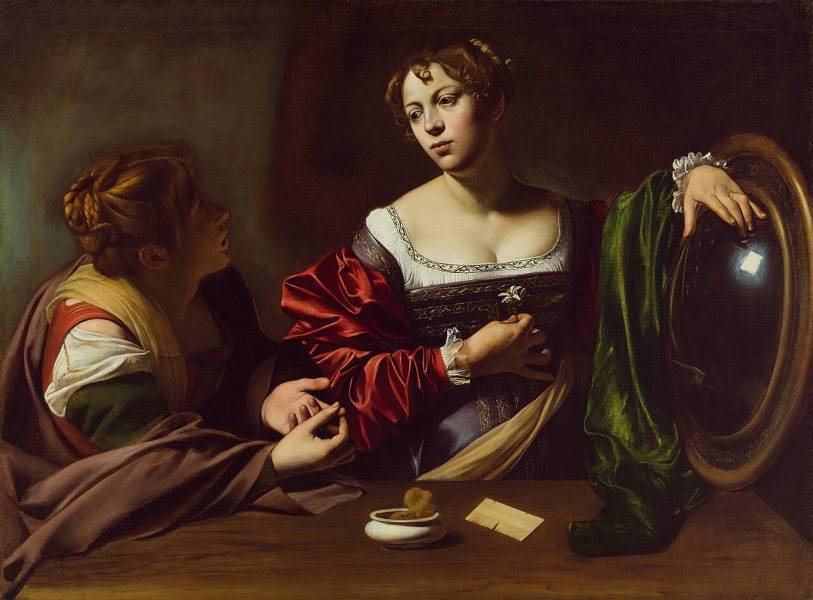
Luke 10:38-42
Caravaggio's "The Denial of Saint Peter" depicts one of the most psychologically charged moments in the Passion narrative from Matthew 26:69-75, when the apostle Peter, warming himself by a fire in the courtyard of the high priest's house, three times denies knowing Jesus after his arrest. A servant girl points accusingly at Peter, who recoils with open hands in a gesture of denial, his weathered face conveying both fear and anguish. The intimate composition captures Peter in his moment of greatest weakness, fulfilling Christ's prophecy that he would deny him before the cock crowed.
Painted around 1610 in Naples during the final months of Caravaggio's turbulent life, this work exemplifies the artist's mastery of chiaroscuro, with dramatic lighting that seems to emerge from the fire itself. The nocturnal scene is illuminated by flickering flames that cast deep shadows across the figures' faces, creating an atmosphere of tension and secrecy. The composition is tightly focused, with Peter's defensive posture contrasting sharply with the servant girl's confident accusation, while other figures warming themselves by the fire create witnesses to this pivotal moment of betrayal.
This painting represents one of Caravaggio's last masterworks and demonstrates his continued innovation in religious storytelling through psychological realism. Rather than presenting Peter as a noble saint, Caravaggio reveals him as a frightened, all-too-human figure caught between loyalty and self-preservation. The work's influence extended to contemporary artists including José de Ribera and Lionello Spada, who created their own interpretations of the scene. Now housed in the Metropolitan Museum of Art, this profound meditation on human frailty and divine forgiveness stands as testament to Caravaggio's ability to transform biblical narrative into deeply personal, universal drama.
Found in: Matthew, Matthew 26, 17th century
69 Now Peter was sitting outside in the court, and a maid came to him, saying, “You were also with Jesus, the Galilean!”
70 But he denied it before them all, saying, “I don’t know what you are talking about.”
71 When he had gone out onto the porch, someone else saw him, and said to those who were there, “This man also was with Jesus of Nazareth.”
72 Again he denied it with an oath, “I don’t know the man.”
73 After a little while those who stood by came and said to Peter, “Surely you are also one of them, for your speech makes you known.”
74 Then he began to curse and to swear, “I don’t know the man!” Immediately the rooster crowed.
75 Peter remembered the word which Jesus had said to him, “Before the rooster crows, you will deny me three times.” He went out and wept bitterly.
Matthew 26:69-75 · World English Bible
1571 - 1610
Milan, Italy
Michelangelo Merisi da Caravaggio (1571-1610) stands as one of history's most revolutionary and influential painters, whose dramatic innovations forever transformed religious art. Born in Milan, he moved to Rome in his twenties where he developed his extraordinary artistic vision, combining intense psychological realism with revolutionary lighting techniques. Despite his relatively short career, cut tragically short by his death at age 38, Caravaggio created some of the most powerful and emotionally compelling biblical paintings ever conceived.