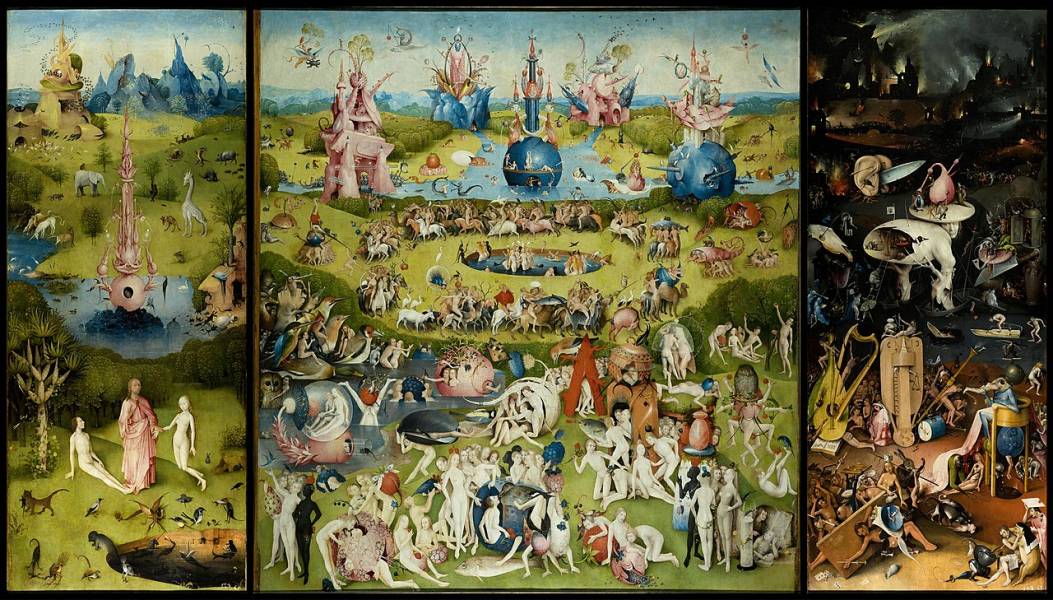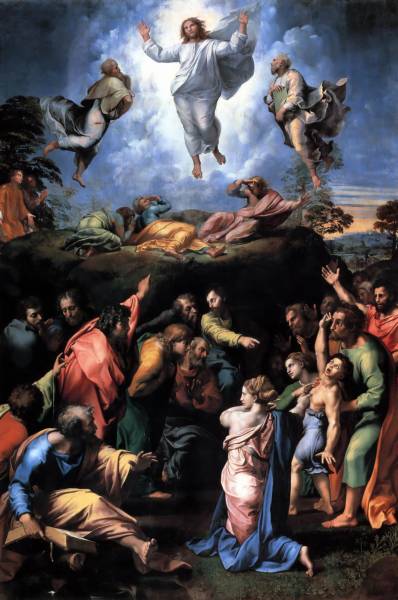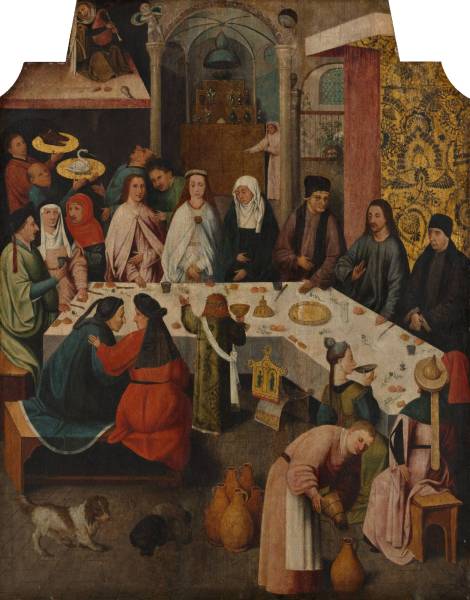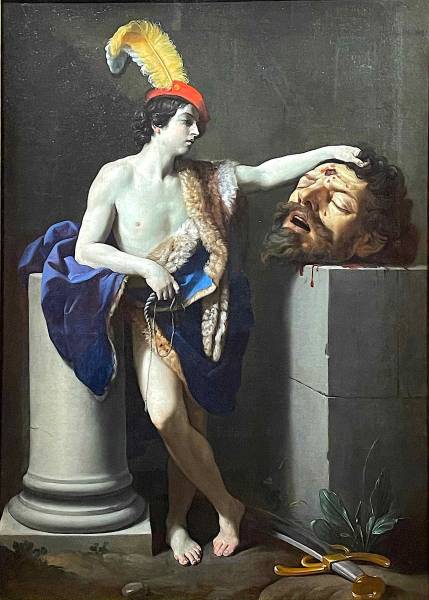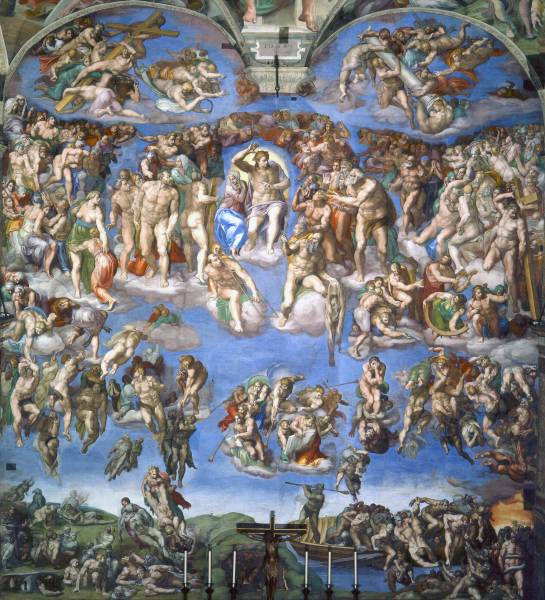
The Last Judgment
(1536)
Michelangelo
(Florence, Italy, 1475 - 1564)
Matthew 25:31-46
"Christ and the Samaritan Woman at the Well" by Angelika Kauffmann is a masterpiece that transcends time and space, inviting us to witness a profound biblical encounter through the eyes of a gifted artist. This exquisite painting, created in 1796, stands as a testament to the enduring power of art to breathe life into sacred narratives.
The portrayal of the scene, based on John 4:1-26, is a true visual feast. Kauffmann's meticulous attention to detail and her masterful use of oil on canvas shine through every brushstroke. The dimensions of the work, measuring 158.5cm by 123.5cm, provide a substantial canvas for the artist to work her magic.
The central focus of the painting is, of course, the encounter between Jesus and the Samaritan woman at the well, a pivotal moment of dialogue and revelation. Kauffmann masterfully captures the tension and curiosity in their expressions, the play of light and shadow enhancing their features. It's as if the artist has frozen time, allowing us to eavesdrop on this transformative conversation.
The color palette is nothing short of exquisite, with a harmonious interplay of warm and cool tones. The well, placed centrally, is bathed in sunlight, a symbol of spiritual illumination. The surrounding landscape, with its lush greenery and ancient architecture, evokes a sense of place and history.
One can't help but marvel at the intricate details in the characters' attire and the well itself. Kauffmann's commitment to historical accuracy is evident in every fold of fabric and every chiseled stone.
But it's not just the technical brilliance that makes this painting remarkable; it's the emotional depth and storytelling prowess. Through her artistry, Kauffmann invites us to ponder the universal themes of acceptance, redemption, and the transformative power of faith.
"Christ and the Samaritan Woman at the Well" is a visual hymn that not only enriches our understanding of the biblical narrative but also celebrates the enduring capacity of art to touch our souls. Angelika Kauffmann's brushstrokes are, in essence, a bridge between the divine and the human, a connection that continues to resonate more than two centuries after this masterpiece's creation.
Found in: John, John 4, 18th century
1 Therefore when the Lord knew that the Pharisees had heard that Jesus was making and baptizing more disciples than John
2 (although Jesus himself didn’t baptize, but his disciples),
3 he left Judea, and departed into Galilee.
4 He needed to pass through Samaria.
5 So he came to a city of Samaria, called Sychar, near the parcel of ground that Jacob gave to his son, Joseph.
6 Jacob’s well was there. Jesus therefore, being tired from his journey, sat down by the well. It was about the sixth hour.
7 A woman of Samaria came to draw water. Jesus said to her, “Give me a drink.”
8 For his disciples had gone away into the city to buy food.
9 The Samaritan woman therefore said to him, “How is it that you, being a Jew, ask for a drink from me, a Samaritan woman?” (For Jews have no dealings with Samaritans.)
10 Jesus answered her, “If you knew the gift of God, and who it is who says to you, ‘Give me a drink,’ you would have asked him, and he would have given you living water.”
11 The woman said to him, “Sir, you have nothing to draw with, and the well is deep. So where do you get that living water?
12 Are you greater than our father, Jacob, who gave us the well, and drank of it himself, as did his children, and his livestock?”
13 Jesus answered her, “Everyone who drinks of this water will thirst again,
14 but whoever drinks of the water that I will give him will never thirst again; but the water that I will give him will become in him a well of water springing up to eternal life.”
15 The woman said to him, “Sir, give me this water, so that I don’t get thirsty, neither come all the way here to draw.”
16 Jesus said to her, “Go, call your husband, and come here.”
17 The woman answered, “I have no husband.” Jesus said to her, “You said well, ‘I have no husband,’
18 for you have had five husbands; and he whom you now have is not your husband. This you have said truly.”
19 The woman said to him, “Sir, I perceive that you are a prophet.
20 Our fathers worshiped in this mountain, and you Jews say that in Jerusalem is the place where people ought to worship.”
21 Jesus said to her, “Woman, believe me, the hour comes, when neither in this mountain, nor in Jerusalem, will you worship the Father.
22 You worship that which you don’t know. We worship that which we know; for salvation is from the Jews.
23 But the hour comes, and now is, when the true worshipers will worship the Father in spirit and truth, for the Father seeks such to be his worshipers.
24 God is spirit, and those who worship him must worship in spirit and truth.”
25 The woman said to him, “I know that Messiah comes, he who is called Christ. When he has come, he will declare to us all things.”
26 Jesus said to her, “I am he, the one who speaks to you.”
John 4:1-26 · World English Bible
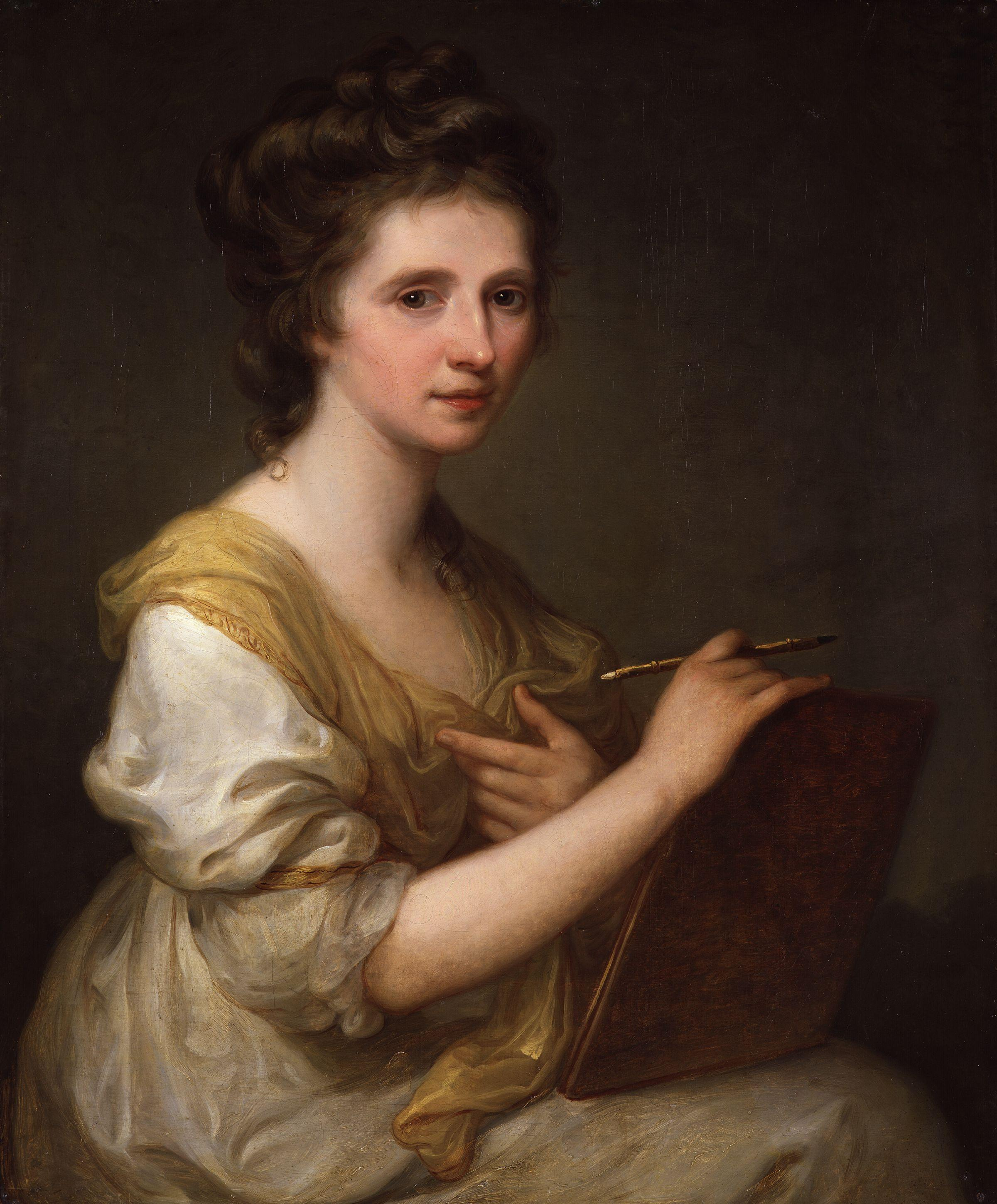
1741 - 1807
Chur, Switzerland
Angelica Kauffman's extraordinary journey through art and culture began in Chur, Switzerland. Born into a family of modest means, she exhibited exceptional talent from an early age. The Kauffmanns relocated several times, first to Morbegno in 1742, then to Como, Lombardy, under Austrian rule, in 1752. In 1757, Angelica joined her father in Schwarzenberg, Vorarlberg, where he worked as a muralist for the local bishop. Her father, Joseph Johann Kauffmann, was a skilled artist who frequently traveled for his commissions.…