Andrea Mantegna
(Isola di Carturo, 1431 - 1506)
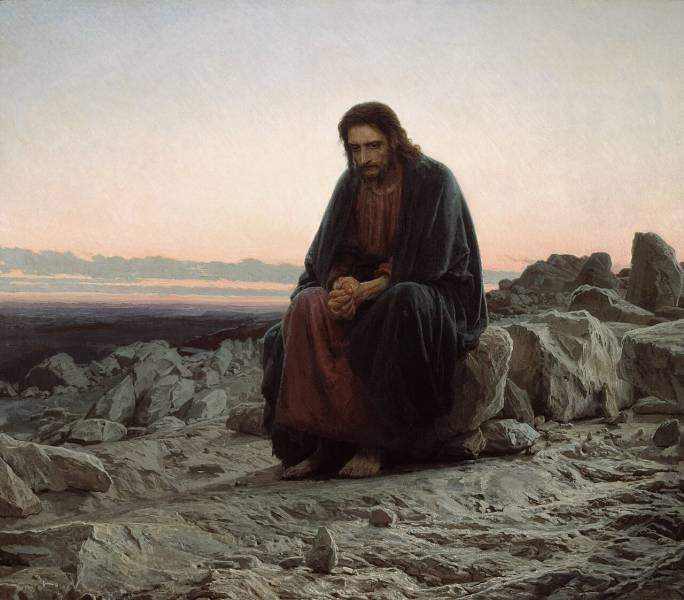
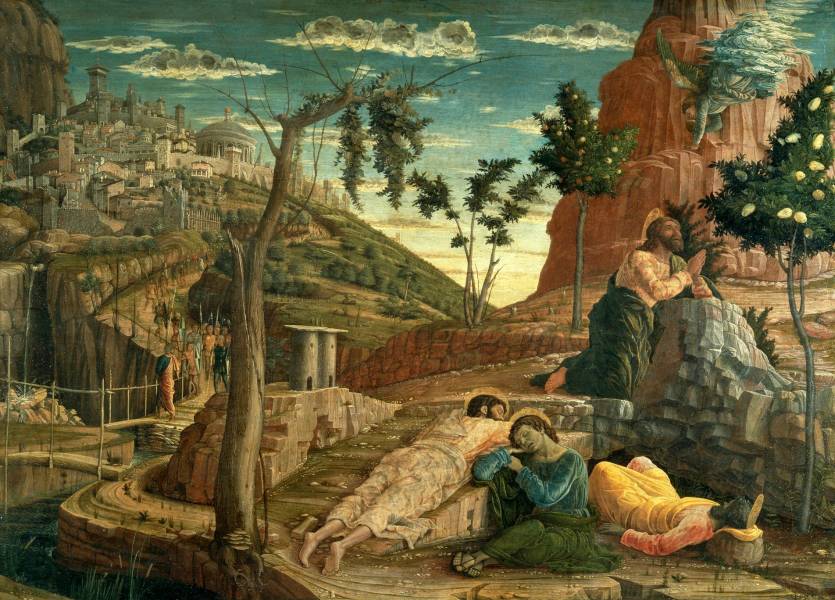
Matthew 26:36-45
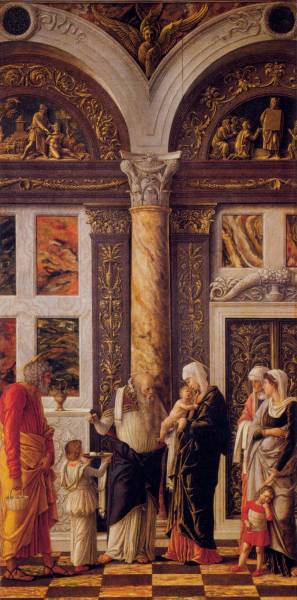
The Presentation at the Temple is a painting by the Italian Renaissance artist Andrea Mantegna. Dating to c. 1455, it is housed in the Gemäldegalerie, Berlin, Germany.
The date of the painting is unknown, but it belongs to the painter's youth in Padua. Date ranges from 1453, when Mantegna married Nicolosia Bellini, daughter Jacapo Bellini painter and the sister of Giovanni and Gentile, both painters as their father, and 1460 when he left for Mantua. Bellini's Presentation at the Temple, explicitly inspired by Mantegna's, dates to around the latter year.
The scene is set within a marble frame. The cushion on which the Child lies stands on it and partially juts out.
The Virgin Mary, in the foreground, is holding the Child while a bearded priest is near her. At the center, in penumbra, is Joseph with an aureola. Also in the background, at the sides, two spectators without aureola have been identified as possibly Mantegna's self-portrait and a portrait of his wife.
Found in: Luke, Luke 2, 15th century, Presentation in the Temple
22 When the days of their purification according to the law of Moses were fulfilled, they brought him up to Jerusalem, to present him to the Lord
23 (as it is written in the law of the Lord, “Every male who opens the womb shall be called holy to the Lord”),
24 and to offer a sacrifice according to that which is said in the law of the Lord, “A pair of turtledoves, or two young pigeons.”
25 Behold, there was a man in Jerusalem whose name was Simeon. This man was righteous and devout, looking for the consolation of Israel, and the Holy Spirit was on him.
26 It had been revealed to him by the Holy Spirit that he should not see death before he had seen the Lord’s Christ.
27 He came in the Spirit into the temple. When the parents brought in the child, Jesus, that they might do concerning him according to the custom of the law,
28 then he received him into his arms, and blessed God, and said,
29 “Now you are releasing your servant, Master, according to your word, in peace;
30 for my eyes have seen your salvation,
31 which you have prepared before the face of all peoples;
32 a light for revelation to the nations, and the glory of your people Israel.”
33 Joseph and his mother were marveling at the things which were spoken concerning him,
34 and Simeon blessed them, and said to Mary, his mother, “Behold, this child is set for the falling and the rising of many in Israel, and for a sign which is spoken against.
35 Yes, a sword will pierce through your own soul, that the thoughts of many hearts may be revealed.”
36 There was one Anna, a prophetess, the daughter of Phanuel, of the tribe of Asher (she was of a great age, having lived with a husband seven years from her virginity,
37 and she had been a widow for about eighty-four years), who didn’t depart from the temple, worshiping with fastings and petitions night and day.
38 Coming up at that very hour, she gave thanks to the Lord, and spoke of him to all those who were looking for redemption in Jerusalem.
39 When they had accomplished all things that were according to the law of the Lord, they returned into Galilee, to their own city, Nazareth.
40 The child was growing, and was becoming strong in spirit, being filled with wisdom, and the grace of God was upon him.
Luke 2:22-40 · World English Bible

1431 - 1506
Isola di Carturo, Italy
Andrea Mantegna (c. 1431 – September 13, 1506) was an Italian painter, a student of Roman archeology, and son-in-law of Jacopo Bellini. Like other artists of the time, Mantegna experimented with perspective, e.g. by lowering the horizon in order to create a sense of greater monumentality. His flinty, metallic landscapes and somewhat stony figures give evidence of a fundamentally sculptural approach to painting. He also led a workshop that was the leading producer of prints in Venice before 1500.