Andrea Mantegna
(Isola di Carturo, 1431 - 1506)
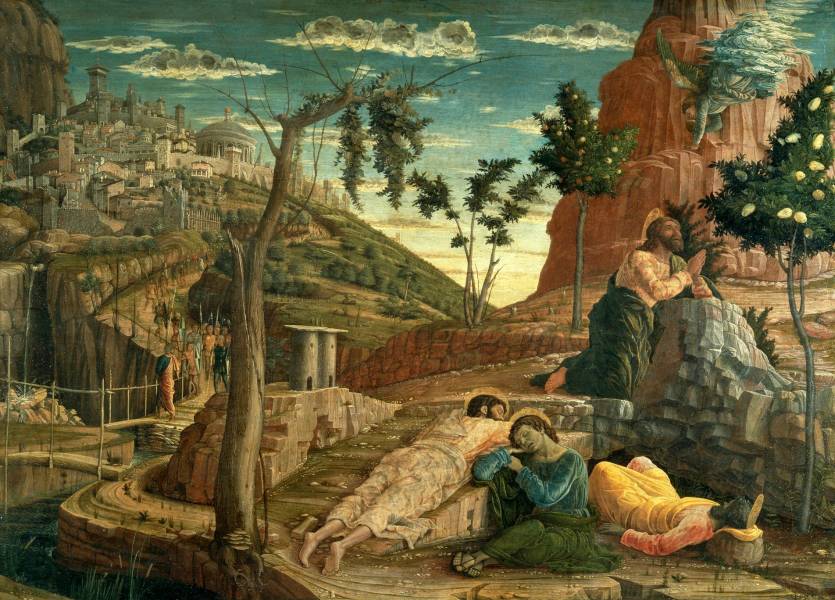
Matthew 26:36-45
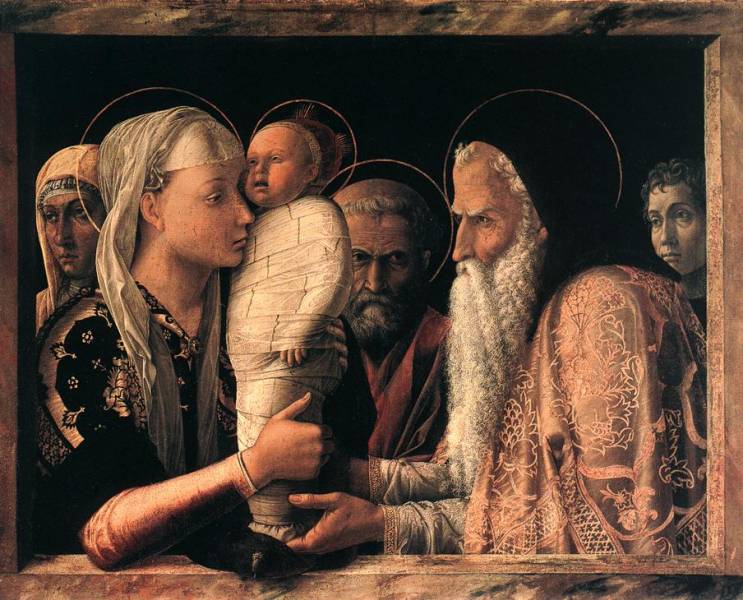
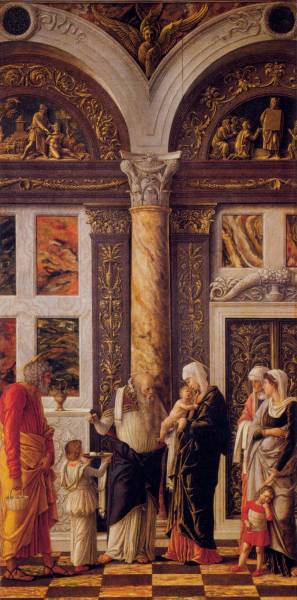
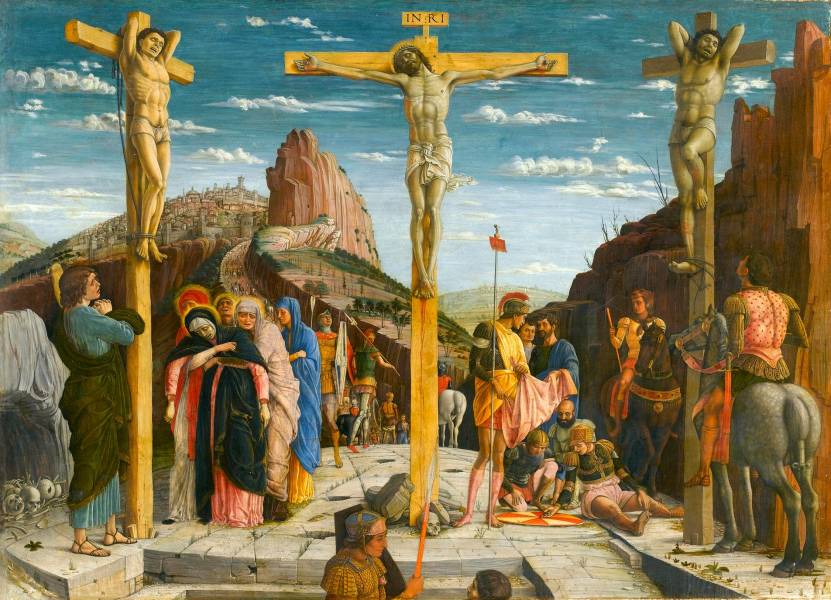
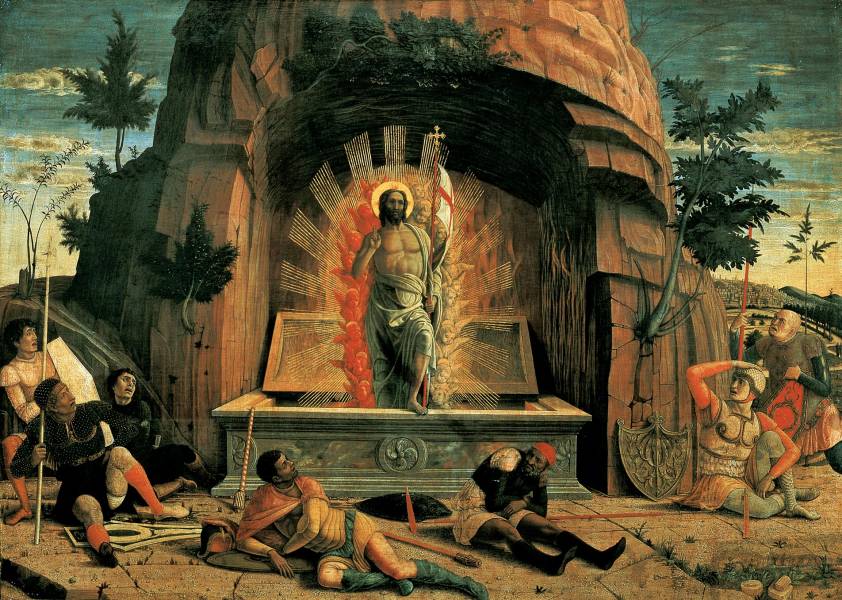
Mantegna's first important commission from Ludovico Gonzaga was the decoration of the chapel in Castello di San Giorgio, executed in the first half of the 1460s. It is unfortunately impossible to reconstruct the whole of Mantegna's original intentions there with any confidence, although some panels almost certainly traceable to the chapel still survive. They include three paintings in the Uffizi: The Ascension of Christ, The Circumcision and The Adoration of the Magi. Today they are mounted as a triptych in the Uffizi with The Adoration of the Magi in the centre. They were given this format in 1827, but the inconsistencies in both composition and iconography indicate that these are individual works rather than parts of a uniformly planned altarpiece. Nevertheless, they were created for the same chapel.
In the Ascension panel, above the saints, who gaze upwards, Christ floats somewhat stiffly, surrounded by a mandorla of angels. Immediately below Him stands Mary, occupying a special place in the lower section, the only figure facing forwards and slightly raised on a ledge of rock.
Found in: Acts, Acts 1, 15th century, Ascension
1 The first book I wrote, Theophilus, concerned all that Jesus began both to do and to teach,
2 until the day in which he was received up, after he had given commandment through the Holy Spirit to the apostles whom he had chosen.
3 To these he also showed himself alive after he suffered, by many proofs, appearing to them over a period of forty days, and speaking about God’s Kingdom.
4 Being assembled together with them, he commanded them, “Don’t depart from Jerusalem, but wait for the promise of the Father, which you heard from me.
5 For John indeed baptized in water, but you will be baptized in the Holy Spirit not many days from now.”
6 Therefore when they had come together, they asked him, “Lord, are you now restoring the kingdom to Israel?”
7 He said to them, “It isn’t for you to know times or seasons which the Father has set within his own authority.
8 But you will receive power when the Holy Spirit has come upon you. You will be witnesses to me in Jerusalem, in all Judea and Samaria, and to the uttermost parts of the earth.”
9 When he had said these things, as they were looking, he was taken up, and a cloud received him out of their sight.
10 While they were looking steadfastly into the sky as he went, behold, two men stood by them in white clothing,
Acts 1:1-10 · World English Bible

1431 - 1506
Isola di Carturo, Italy
Andrea Mantegna (c. 1431 – September 13, 1506) was an Italian painter, a student of Roman archeology, and son-in-law of Jacopo Bellini. Like other artists of the time, Mantegna experimented with perspective, e.g. by lowering the horizon in order to create a sense of greater monumentality. His flinty, metallic landscapes and somewhat stony figures give evidence of a fundamentally sculptural approach to painting. He also led a workshop that was the leading producer of prints in Venice before 1500.