Albert Edelfelt
(Porvoo, 1854 - 1905)
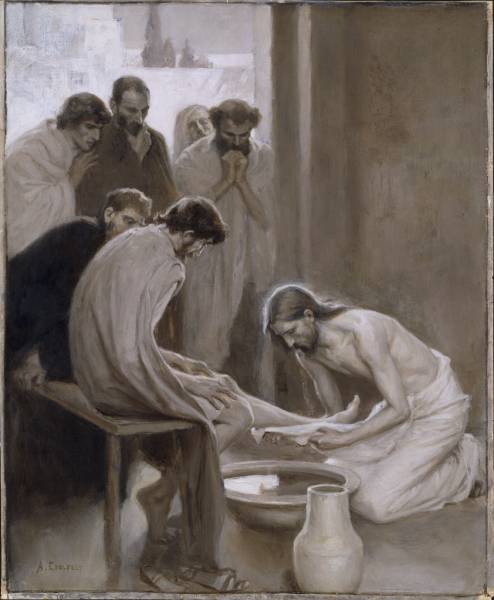
John 13:1-17
Aspects of Naturalism were evident in Albert Edelfelt's work throughout much of his life, even when working with historical and religious themes. In Europe, the religious genre came under the humanizing influence of Ernest Renan's book The Life of Jesus published in 1863. Edelfelt's unconventional Christ and Mary Magdalene, a Finnish Legend, set on the forested shoreline of a Finnish lake, shows Jesus dressed in peasant shoes plaited from strips of birch-bark, confronted by a pleading Magdalene in ethnic dress. Most consistently, however, religiosity permeated rural genre works, underscoring the piety of the indigenous peoples, as artists turned increasingly to depicting the supposed authenticity of the lives of the common folk.
Found in: Luke, Luke 8, 19th century
1 Soon afterwards, he went about through cities and villages, preaching and bringing the good news of God’s Kingdom. With him were the twelve,
2 and certain women who had been healed of evil spirits and infirmities: Mary who was called Magdalene, from whom seven demons had gone out;
3 and Joanna, the wife of Chuzas, Herod’s steward; Susanna; and many others; who served them from their possessions.
Luke 8:1-3 · World English Bible

1854 - 1905
Porvoo, Finland
Edelfelt was born 1854 in Porvoo, son of Swedish-speaking Finns Carl Albert Edelfelt (1818–1869), an architect, and Alexandra Edelfelt, née Brandt (1833–1901). His father died when he was still young, and his mother had to raise him and his younger siblings alone compounded by financial difficulties. He was very close with his mother throughout his life.