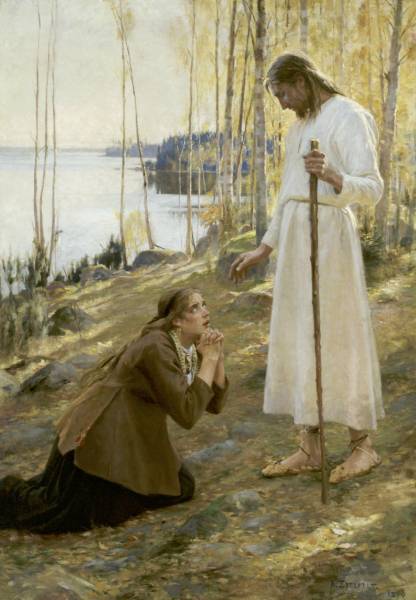
Christ and Mary Magdalene
(1890)
Albert Edelfelt
(Porvoo, 1854 - 1905)
Luke 8:1-3
Albert Edelfelt's "Jesus Washing the Feet of his Disciples" is a thought-provoking artwork that captures a significant biblical event. However, while the subject matter is compelling, the execution of the painting leaves much to be desired.
One of the main issues with this artwork is the use of grisaille, a monochromatic painting technique that lacks the vibrancy and depth of color found in traditional oil paintings. The absence of color diminishes the emotional impact that such a profound and intimate scene should evoke. Instead of being drawn into the emotional intensity of the moment, the viewer is left feeling disconnected and emotionally distant from the narrative.
Furthermore, the composition of the painting is somewhat cluttered and lacks a clear focal point. The positioning of the disciples and Jesus seems disorganized, with no visual hierarchy to guide the viewer's eye. As a result, the viewer struggles to identify the main subject of the painting, making it challenging to fully engage with the artwork.
Additionally, the level of detail in the painting is lacking. The faces of the disciples and Jesus appear somewhat flat and lack expression, making it difficult to grasp the emotions that should accompany such a significant event. The lack of attention to detail in the clothing and surroundings further diminishes the overall impact of the artwork.
The use of light and shadow, a crucial element in creating depth and dimension in a painting, is underutilized in this artwork. The lack of contrast and shading contributes to the flat and two-dimensional appearance of the figures, preventing them from coming to life and captivating the viewer.
While the subject matter of "Jesus Washing the Feet of his Disciples" is undeniably powerful, the artistic execution falls short of doing justice to the emotional and spiritual depth of the scene. The use of grisaille, cluttered composition, lack of detail, and insufficient use of light and shadow detract from the overall impact of the painting and hinder the viewer's ability to fully connect with the narrative.
In conclusion, Albert Edelfelt's "Jesus Washing the Feet of his Disciples" is an artwork with a meaningful subject, but its execution leaves much to be desired. The use of grisaille and the lack of attention to detail and composition hinder the painting's ability to evoke a profound emotional response from the viewer. As a result, the artwork falls short of conveying the depth and significance of the biblical event it seeks to portray.
Found in: John, John 13, 19th century
1 Now before the feast of the Passover, Jesus, knowing that his time had come that he would depart from this world to the Father, having loved his own who were in the world, he loved them to the end.
2 During supper, the devil having already put into the heart of Judas Iscariot, Simon’s son, to betray him,
3 Jesus, knowing that the Father had given all things into his hands, and that he came from God, and was going to God,
4 arose from supper, and laid aside his outer garments. He took a towel, and wrapped a towel around his waist.
5 Then he poured water into the basin, and began to wash the disciples’ feet, and to wipe them with the towel that was wrapped around him.
6 Then he came to Simon Peter. He said to him, “Lord, do you wash my feet?”
7 Jesus answered him, “You don’t know what I am doing now, but you will understand later.”
8 Peter said to him, “You will never wash my feet!” Jesus answered him, “If I don’t wash you, you have no part with me.”
9 Simon Peter said to him, “Lord, not my feet only, but also my hands and my head!”
10 Jesus said to him, “Someone who has bathed only needs to have his feet washed, but is completely clean. You are clean, but not all of you.”
11 For he knew him who would betray him, therefore he said, “You are not all clean.”
12 So when he had washed their feet, put his outer garment back on, and sat down again, he said to them, “Do you know what I have done to you?
13 You call me, ‘Teacher’ and ‘Lord.’ You say so correctly, for so I am.
14 If I then, the Lord and the Teacher, have washed your feet, you also ought to wash one another’s feet.
15 For I have given you an example, that you also should do as I have done to you.
16 Most certainly I tell you, a servant is not greater than his lord, neither one who is sent greater than he who sent him.
17 If you know these things, blessed are you if you do them.
John 13:1-17 · World English Bible

1854 - 1905
Porvoo, Finland
Edelfelt was born 1854 in Porvoo, son of Swedish-speaking Finns Carl Albert Edelfelt (1818–1869), an architect, and Alexandra Edelfelt, née Brandt (1833–1901). His father died when he was still young, and his mother had to raise him and his younger siblings alone compounded by financial difficulties. He was very close with his mother throughout his life.