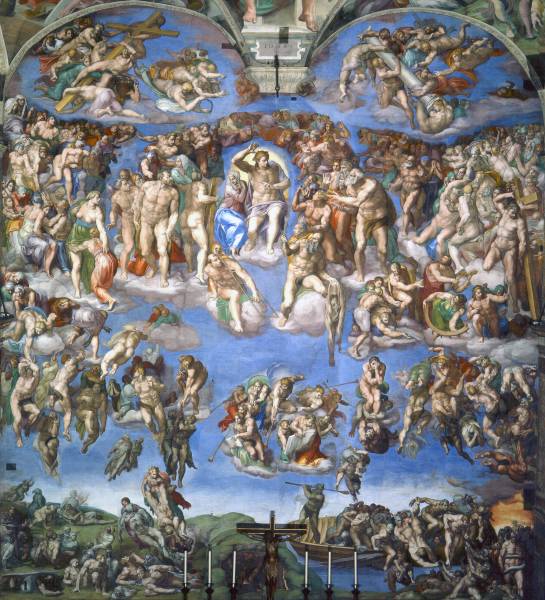
The Last Judgment
(1536)
Michelangelo
(Florence, Italy, 1475 - 1564)
Matthew 25:31-46
When this painting was first exhibited in 1856 at the Royal Academy the response was mixed. Viewers appreciated the vivid and detailed depiction of the area of “Oosdoom” (Kharbet Usdum) by the Dead Sea—an inaccessible and inhospitable place of which no photographs yet existed—and the courage and endurance of the artist in exposing himself to multiple hazards there in order to paint the work ‘from life’.
There was much less appreciation of the typological symbolism employed. This was set out in very full programme notes presenting the Azazel (scapegoat) of the Day of Atonement ritual in Leviticus 16 as a type of Christ, with the text on the frame clearly linking the two figures via the ‘suffering servant’ of Isaiah 53.
Hunt’s goat, like Isaiah’s suffering servant, is full of pathos, cut off from the land of the living, spent, and near to death, thus evoking a Christ who ‘was despised and rejected’. He bears away the people’s sins signified by his scarlet headband (Isaiah 1:18), a symbol Hunt would apply directly to the figure of Christ in a later painting, The Shadow of Death. The outcome is atonement and new life, hinted at by the olive branch in the left foreground.
Yet neither public nor critics found the symbolism persuasive, and Hunt himself reflected in hindsight, ‘I had over-counted on the picture’s intelligibility’ (Hunt 1905: 108; Bronkhust 2006). It was certainly unprecedented in its iconography. More importantly, the New Testament does not exploit this Christological type, and the history of textual commentators attempting to do so has been fraught with theological problems (Lyonnet & Sabourin 1970).
Recent biblical scholarship has instead begun to explore the way Christ and the scapegoat figure appear as a pair in the Gospel narratives. In this vein, some have noted connections between the scapegoat and Barabbas evident in Matthew 27:16ff (Moscicke 2018). Others (e.g. Anstis: 2012) have pursued a more intriguing possibility offered by the events earlier in that chapter where Judas, doomed to carry blame throughout history, is dismissed from the Temple to face his demons alone in the social wilderness.
Found in: Leviticus, Leviticus 16, 19th century
1 Yahweh spoke to Moses, after the death of the two sons of Aaron, when they came near before Yahweh, and died;
2 and Yahweh said to Moses, “Tell Aaron your brother, not to come at all times into the Most Holy Place within the veil, before the mercy seat which is on the ark; lest he die: for I will appear in the cloud on the mercy seat.
3 “Aaron shall come into the sanctuary with a young bull for a sin offering, and a ram for a burnt offering.
4 He shall put on the holy linen coat. He shall have the linen breeches on his body, and shall put on the linen sash, and he shall be clothed with the linen turban. They are the holy garments. He shall bathe his body in water, and put them on.
5 He shall take from the congregation of the children of Israel two male goats for a sin offering, and one ram for a burnt offering.
6 “Aaron shall offer the bull of the sin offering, which is for himself, and make atonement for himself and for his house.
7 He shall take the two goats, and set them before Yahweh at the door of the Tent of Meeting.
8 Aaron shall cast lots for the two goats; one lot for Yahweh, and the other lot for the scapegoat.
9 Aaron shall present the goat on which the lot fell for Yahweh, and offer him for a sin offering.
10 But the goat on which the lot fell for the scapegoat shall be presented alive before Yahweh, to make atonement for him, to send him away as the scapegoat into the wilderness.
Leviticus 16:1-10 · World English Bible
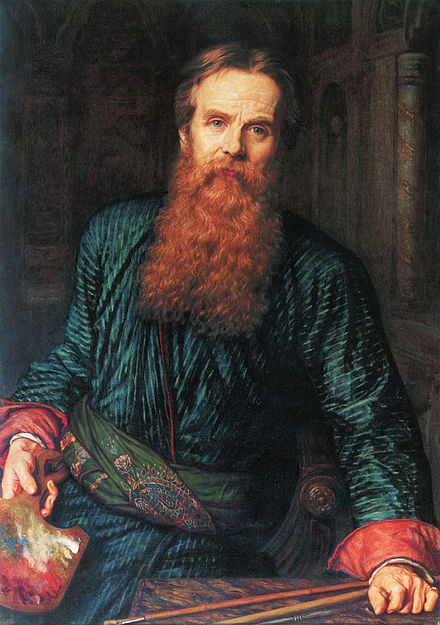
1827 - 1910
London, England
William Holman Hunt OM (2 April 1827 – 7 September 1910) was an English painter and one of the founders of the Pre-Raphaelite Brotherhood. His paintings were notable for their great attention to detail, vivid colour, and elaborate symbolism. These features were influenced by the writings of John Ruskin and Thomas Carlyle, according to whom the world itself should be read as a system of visual signs. For Hunt it was the duty of the artist to reveal the correspondence…