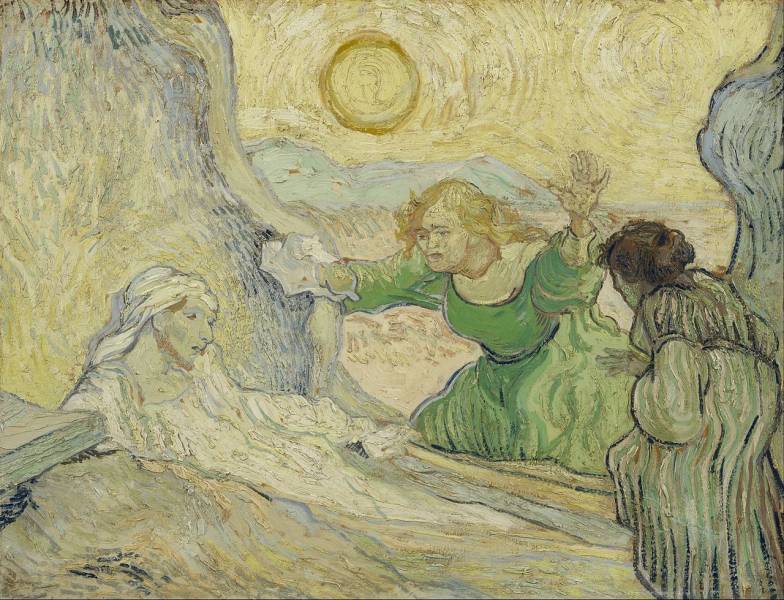
The Raising of Lazarus
(1890)
Vincent Van Gogh
(Zundert, 1853 - 1890)
John 11
On May 8, 1889, exhausted, ill, and out of control, Vincent Van Gogh committed himself to St. Paul's psychiatric asylum in Saint-Rémy-de-Provence, a small hamlet in the south of France. A former monastery, the sanitarium was located in an area of cornfields, vineyards and olive trees. There Van Gogh was allowed two small adjoining cells with barred windows. One room he used as his bedroom, and the other was his tiny studio. While there, Van Gogh not only painted the surrounding area and the interior of the asylum, he also copied paintings and drawings by other artists, making those paintings his own through modifications he made to the painting's composition, the colors and, of course, the brush strokes.
One of the artists whose works Van Gogh copied and modified was the Dutch Gold Age painter Rembrandt van Rijn. The Good Samaritan by Rembrandt drew Van Gogh's attention: in which a Samaritan man hoists a wounded man with a bandaged head onto a horse to be taken to an inn for recovery.
When Van Gogh was admitted to the sanitarium in St Remy de Provence, he had become so difficult, so sick that the townspeople of Arles, where he had been living and painting had given him the name "the red-headed madman." After a psychotic break during the visit of fellow artist Paul Gauguin, Van Gogh was all but put out of the town. With the help of a couple of people, he eventually made his way to the sanitarium in St Remy de Provence where he copied and modified Delacroix's painting of The Good Samaritan.
If viewers were to see the two paintings - Rembrandt's and Van Gogh's side by side - the first thing that would strike you is the light in Van Gogh's painting and the darkness in Rembrandt's. Though not sharing the bright colors of his paintings in Arles, Van Gogh's painting of The Good Samaritan, is well lit which means we can make out things more clearly in the painting.
Found in: Luke, Luke 10, 19th century, Good Samaritan
25 Behold, a certain lawyer stood up and tested him, saying, “Teacher, what shall I do to inherit eternal life?”
26 He said to him, “What is written in the law? How do you read it?”
27 He answered, “You shall love the Lord your God with all your heart, with all your soul, with all your strength, and with all your mind; and your neighbor as yourself.”
28 He said to him, “You have answered correctly. Do this, and you will live.”
29 But he, desiring to justify himself, asked Jesus, “Who is my neighbor?”
30 Jesus answered, “A certain man was going down from Jerusalem to Jericho, and he fell among robbers, who both stripped him and beat him, and departed, leaving him half dead.
31 By chance a certain priest was going down that way. When he saw him, he passed by on the other side.
32 In the same way a Levite also, when he came to the place, and saw him, passed by on the other side.
33 But a certain Samaritan, as he traveled, came where he was. When he saw him, he was moved with compassion,
34 came to him, and bound up his wounds, pouring on oil and wine. He set him on his own animal, and brought him to an inn, and took care of him.
35 On the next day, when he departed, he took out two denarii, and gave them to the host, and said to him, ‘Take care of him. Whatever you spend beyond that, I will repay you when I return.’
36 Now which of these three do you think seemed to be a neighbor to him who fell among the robbers?”
37 He said, “He who showed mercy on him.” Then Jesus said to him, “Go and do likewise.”
Luke 10:25-37 · World English Bible

1853 - 1890
Zundert, Netherlands
Vincent Willem van Gogh (30 March 1853 – 29 July 1890) was a Dutch post-impressionist painter who is among the most famous and influential figures in the history of Western art. In just over a decade he created about 2,100 artworks, including around 860 oil paintings, most of them in the last two years of his life. They include landscapes, still lifes, portraits and self-portraits, and are characterised by bold colours and dramatic, impulsive and expressive brushwork that contributed to…