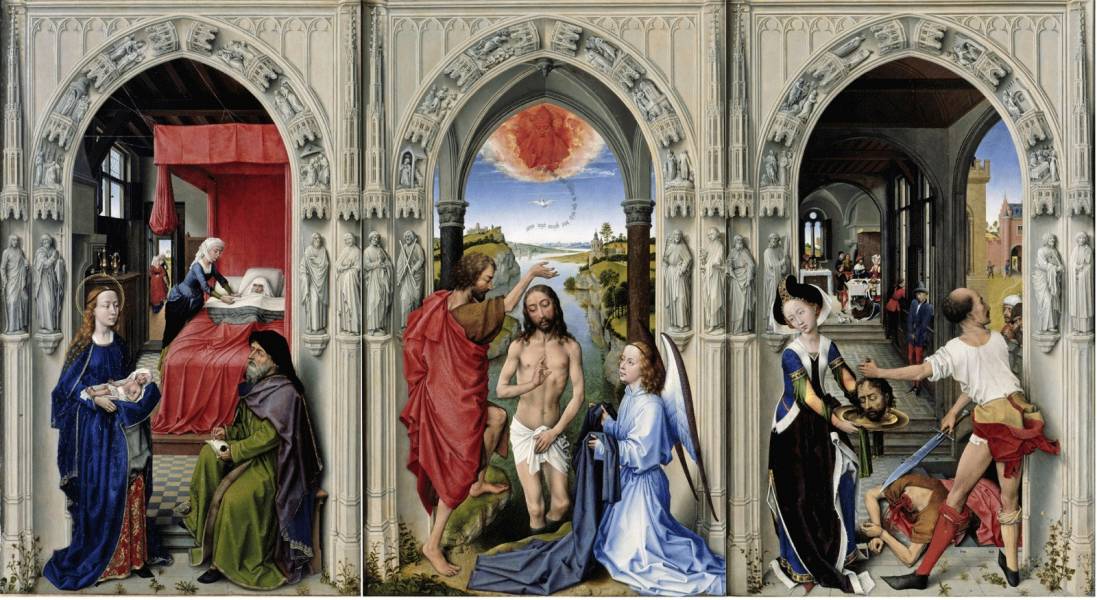
John the Baptist
(c1450)
Rogier Van der Weyden
(1399 - 1564)
John 1:29-34
It is believed - but without absolute certainty - that this Entombment is the centre of a polyptych which was acquired by Leonello d'Este, Duke of Ferrara, for the Study at Belfiore, when the painter went in pilgrimage to Rome in 1449, the year before the Jubilee. It is however more probable that this work - which is also mentioned as being in the Medicean Villa at Careggi - was done in 1449-50 at Florence, because it derives its compositive formula from the Deposition by Fra Angelico which can be seen in the predella of the altarpiece of St Mark in the Alte Pinakothek, Munich.
This painting, in a Renaissance frame decorated with pilasters, adorned the altar of the private chapel of the Medici villa in Careggi, near Florence. Cosimo de' Medici (1389 -1464) had built this country residence around the middle of the century, and there are good reasons to suppose that the Medici family, who must have owned Rogier's small panel of the Madonna (Städelsches Kunstinstitut, Frankfurt), also commissioned the larger painting.
The work closely follows the Entombment of Christ which was part of an altarpiece by Fra Angelico, painted around 1440 for the Florentine monastery church of San Marco. Its influence is evident in the display of the dead man, shown almost standing, with Mary and John holding his arms one on each side, and more particularly in the hill with the tomb in the rock, which runs entirely counter to Northern European tradition. Fra Angelico's altarpiece, to which the picture of the Entombment, much imitated in Florence, also belonged, was itself an important donation by the Medici family.
It is improbable that Rogier van der Weyden saw Fra Angelico's work by chance on his Italian journey, and then reworked it for his own Medici altarpiece - particularly as we do not know whether he passed through Florence at all on his way to Rome.
The model was more probably prescribed for him by his patrons when the work was commissioned. Very likely they sent the master a sketch of the work they had donated, telling him to follow it. Such clear guidelines from Florence would also explain why the painting was executed in almost square format, unusual for Netherlandish works but common in Italy and suitable for the architectural Renaissance setting.
The patrons who commissioned the work will have been as much struck by the fine, realistic detail of the painting of the Lamentation as by the intense emotion of the faces. These qualities, and the slight asymmetry that suited late Gothic taste, distinguish the picture in significant respects from the work of Fra Angelico. A two-dimensionality at least matching that of the St John Altarpiece (Staatliche Museen, Berlin), and not at all in line with the artistic ideals of the Renaissance, is particularly noticeable in the Magdalene kneeling at the front, her limbs compressed into the same plane. The painting can thus be associated with Rogier's late works coming after the St. Columba Altarpiece (Alte Pinakothek, Munich).
Found in: Mark, Mark 15, 15th century, Entombment
42 When evening had now come, because it was the Preparation Day, that is, the day before the Sabbath,
43 Joseph of Arimathaea, a prominent council member who also himself was looking for God’s Kingdom, came. He boldly went in to Pilate, and asked for Jesus’ body.
44 Pilate marveled if he were already dead; and summoning the centurion, he asked him whether he had been dead long.
45 When he found out from the centurion, he granted the body to Joseph.
46 He bought a linen cloth, and taking him down, wound him in the linen cloth, and laid him in a tomb which had been cut out of a rock. He rolled a stone against the door of the tomb.
47 Mary Magdalene and Mary, the mother of Joses, saw where he was laid.
Mark 15:42-47 · World English Bible

1399 - 1564
Netherland
Rogier van der Weyden or Roger de la Pasture (1399 or 1400 – 18 June 1464) was an Early Netherlandish painter whose surviving works consist mainly of religious triptychs, altarpieces and commissioned single and diptych portraits. He was highly successful and internationally famous in his lifetime; his paintings were exported – or taken – to Italy and Spain, and he received commissions from, amongst others, Philip the Good, Netherlandish nobility, and foreign princes. By the latter half of the 15th…