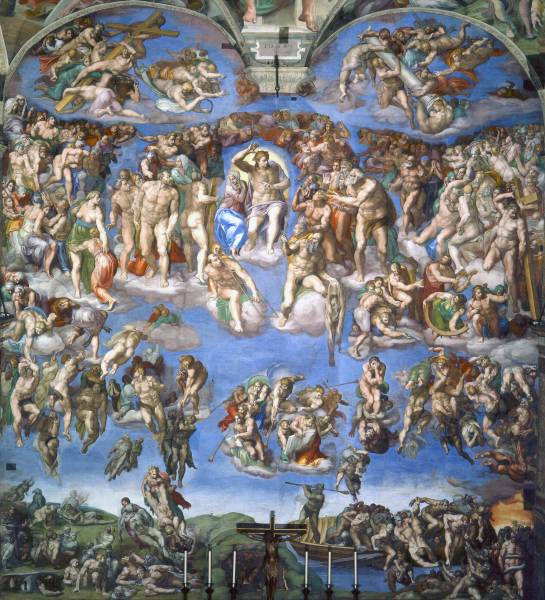
The Last Judgment
(1536)
Michelangelo
(Florence, Italy, 1475 - 1564)
Matthew 25:31-46
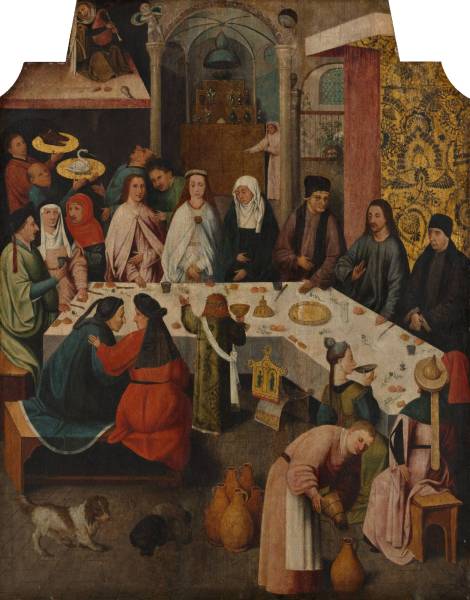
"The Marriage at Cana" by Quentin Varin is a grand and ambitious work of art that seeks to depict a significant biblical event from the Gospel of John. Created between 1618 and 1620, this colossal oil on canvas painting measures an impressive 259cm x 310cm, presenting the artist with a vast canvas to convey the scene in great detail.
Upon initial observation, the painting showcases a lavish banquet hall filled with a multitude of characters. The artist's attempt to capture the grandeur of the wedding feast is evident through the opulent setting and the meticulously rendered clothing and decorations of the guests. However, despite the meticulous attention to detail, the composition appears somewhat overcrowded and lacking a clear focal point. The plethora of figures and the busy background distract from the central narrative, making it difficult for the viewer to connect with the main characters and the essence of the moment.
While the artwork's large scale is meant to emphasize the significance of the event, it also presents certain challenges in terms of visual unity and coherence. The execution of such a monumental work demands a high level of technical expertise, and while Quentin Varin demonstrates skill in portraying individual elements, the overall unity of the composition falls short of its potential. The various characters and elements seem to compete for attention, leading to a sense of visual confusion.
The use of color and lighting in the painting is commendable, creating a warm and vibrant atmosphere that befits a joyous occasion. However, the lighting and shadows are not consistently applied throughout the work, resulting in inconsistencies in the depiction of volume and perspective. This lack of uniformity detracts from the overall realism and visual impact of the painting.
Furthermore, the portrayal of some of the figures appears stiff and lacking in natural grace, detracting from the emotional depth that should be conveyed in a scene of celebration. The facial expressions of the characters, especially the central figures, seem somewhat static and unconvincing, failing to communicate the joy and excitement that should accompany a wedding celebration.
While "The Marriage at Cana" attempts to depict a significant biblical moment with grandeur and attention to detail, it falls short in terms of visual coherence and emotional depth. The painting's crowded composition and inconsistent lighting diminish the impact of the scene, making it difficult for the viewer to fully engage with the narrative. While Quentin Varin's ambitious undertaking deserves recognition for its attempt at capturing a monumental event, it ultimately lacks the finesse and unity needed to fully convey the essence of the story.
Found in: John, John 2, 17th century, Marriage at Cana
1 The third day, there was a marriage in Cana of Galilee. Jesus’ mother was there.
2 Jesus also was invited, with his disciples, to the marriage.
3 When the wine ran out, Jesus’ mother said to him, “They have no wine.”
4 Jesus said to her, “Woman, what does that have to do with you and me? My hour has not yet come.”
5 His mother said to the servants, “Whatever he says to you, do it.”
6 Now there were six water pots of stone set there after the Jews’ way of purifying, containing two or three metretes apiece.
7 Jesus said to them, “Fill the water pots with water.” They filled them up to the brim.
8 He said to them, “Now draw some out, and take it to the ruler of the feast.” So they took it.
9 When the ruler of the feast tasted the water now become wine, and didn’t know where it came from (but the servants who had drawn the water knew), the ruler of the feast called the bridegroom,
10 and said to him, “Everyone serves the good wine first, and when the guests have drunk freely, then that which is worse. You have kept the good wine until now!”
11 This beginning of his signs Jesus did in Cana of Galilee, and revealed his glory; and his disciples believed in him.
12 After this, he went down to Capernaum, he, and his mother, his brothers, and his disciples; and they stayed there a few days.
John 2:1-12 · World English Bible
1584 - 1626
Beauvais, France
Quentin Varin (1584 in Beauvais – 1626 in Paris), was a French Baroque painter, who was the teacher of Nicolas Poussin. He is known for religious works.