John Linnell
(London, 1792 - 1882)
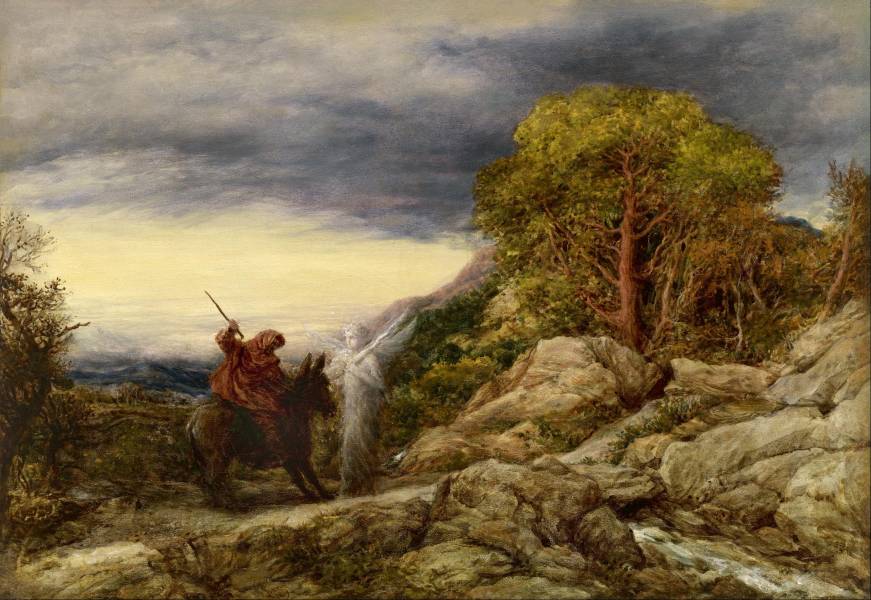
Numbers 22:21-41
This artwork, created by the British artist John Linnell (c. 1792-1882), draws inspiration from the renowned Biblical narratives of the Great Flood, often referred to as the Deluge, and the story of Noah's Ark. Presented in the Book of Genesis, this tale recounts a global flood unleashed by divine forces that persisted for forty days before gradually receding. According to the narrative, the sole sanctuary amidst the torrential deluge was Noah's Ark. Consequently, only Noah's family and the fortunate animals they sheltered on their vessel survived this ancient cataclysm. Genesis articulates this account:
"For forty days the flood kept coming on the earth, and as the waters increased they lifted the ark high above the earth. The waters rose and increased greatly on the earth, and the ark floated on the surface of the water. They rose greatly on the earth, and all the high mountains under the entire heavens were covered. The waters rose and covered the mountains to a depth of more than fifteen cubits. Every living thing that moved on land perished—birds, livestock, wild animals, all the creatures that swarm over the earth, and all mankind. Everything on dry land that had the breath of life in its nostrils died. Every living thing on the face of the earth was wiped out; people and animals and the creatures that move along the ground and the birds were wiped from the earth. Only Noah was left, and those with him in the ark" (Genesis 7: 17-23, NIV translation).
John Linnell (c. 1792-1882) did not solely rely on the ancient religious text for his creative impetus. Instead, he drew inspiration from the English countryside and is believed to have turned to the verses of John Milton's "Paradise Lost" (c. 1608-1674) to shape his visualization of the flood. Milton's verses read:
"The one just man alive; by his command
Shall build a wondrous ark, as thou beheld'st,
To save himself and household from amidst
A world devote to universal wrack.
No sooner he with them of man and beast
Select for life shall in the ark be lodged,
And sheltered round, but all the cataracts
Of heav'n set open on the earth shall pour
Rain day and night, all fountains of the deep
Broke up, shall have the ocean to usurp
Beyond all bounds, till inundation rise
Above the highest hills: then shall this mount
Of Paradise by might of waves be moved
Out of his place…
…
And the clear sun on his wide wat'ry glass
Gazed hot, and of the fresh wave largely drew…
(John Milton, Paradise Lost, Book 11, lines 818-845)
Following the narrative laid out by John Milton, the painting depicts the tempests of the Great Deluge gradually gathering momentum as animals find their way to the safety of Noah's Ark, visible in the painting's background on the right side. Linnell seems to translate Milton's description of the scorching sun into warm hues that dominate the artwork's vivid sunset. A hint of Milton's contemplative and reflective portrayal of water can be observed in John Linnell's rendering of the rising sea on the painting's horizon. In the foreground of the scene, Noah and his family gaze out over the landscape, the clouds, and the surging waters, absorbing the juxtaposed ominous and breathtaking sights before eventually seeking refuge on the ship.
Found in: Genesis, Genesis 7, 19th century
1 Yahweh said to Noah, “Come with all of your household into the ship, for I have seen your righteousness before me in this generation.
2 You shall take seven pairs of every clean animal with you, the male and his female. Of the animals that are not clean, take two, the male and his female.
3 Also of the birds of the sky, seven and seven, male and female, to keep seed alive on the surface of all the earth.
4 In seven days, I will cause it to rain on the earth for forty days and forty nights. I will destroy every living thing that I have made from the surface of the ground.”
5 Noah did everything that Yahweh commanded him.
6 Noah was six hundred years old when the flood of waters came on the earth.
7 Noah went into the ship with his sons, his wife, and his sons’ wives, because of the floodwaters.
8 Clean animals, unclean animals, birds, and everything that creeps on the ground
9 went by pairs to Noah into the ship, male and female, as God commanded Noah.
10 After the seven days, the floodwaters came on the earth.
11 In the six hundredth year of Noah’s life, in the second month, on the seventeenth day of the month, on the same day all the fountains of the great deep burst open, and the sky’s windows opened.
12 It rained on the earth forty days and forty nights.
13 In the same day Noah, and Shem, Ham, and Japheth—the sons of Noah—and Noah’s wife and the three wives of his sons with them, entered into the ship—
14 they, and every animal after its kind, all the livestock after their kind, every creeping thing that creeps on the earth after its kind, and every bird after its kind, every bird of every sort.
15 Pairs from all flesh with the breath of life in them went into the ship to Noah.
16 Those who went in, went in male and female of all flesh, as God commanded him; then Yahweh shut him in.
Genesis 7:1-16 · World English Bible

1792 - 1882
London, England
John Linnell was born on the 16th of June in 1792 in Bloomsbury, London, where his father worked as a carver and gilder. From an early age, he was exposed to the artistic world, selling portraits he drew in chalk and pencil by the age of ten. His initial art mentor was the American artist Benjamin West, and he spent a year residing in the household of the painter John Varley. It was there that he encountered fellow pupils like…