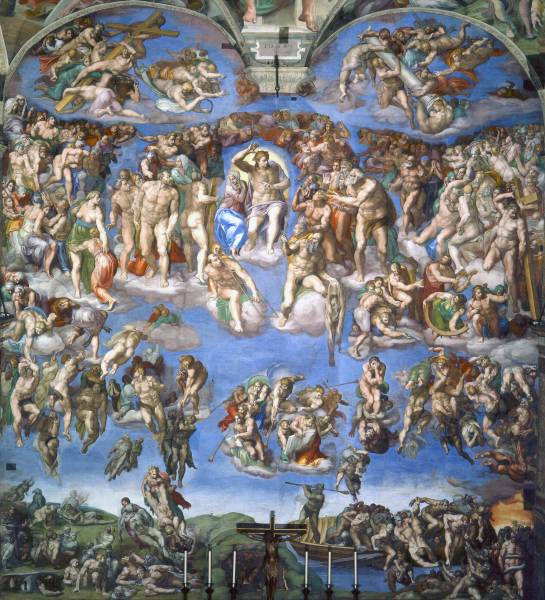
The Last Judgment
(1536)
Michelangelo
(Florence, Italy, 1475 - 1564)
Matthew 25:31-46
Seventeenth-century artists often made remarkable use of the contrast between foreground and background. A small image in the background provided the key to the meaning of the principal scene. Among those who employed this device were Pieter Aertsen and Joachim Beuckelaer. An early example is found in this painting by Jacob Cornelisz van Oostsanen, Saul and the Witch of Endor, in which several episodes from the biblical story are depicted in a simultaneous narrative, while the clue to the scene is hidden in the distance.
In order to unravel this puzzling picture one has to be familiar with the Old Testament story found in the first book of Samuel, especially chapters 28 and 31, which relates that Saul, the first king of the people of Israel, was counseled by the priest Samuel for many years. Eventually, though, Saul rejected him and began acting in defiance of God's commands, whereupon God charged Samuel with the task of finding a new king for Israel. The choice fell on David, but Saul refused to accept him. He was confronted with mounting difficulties, one of which was a disastrous war with the Philistines. Just before the decisive battle, Saul decided to consult a fortune-teller to seek the advice of the dead Samuel.
On the far left, Saul and several of his men arrive to consult the witch, with the tents of Saul's army in the background. The sorceress, half naked and seated in a magic circle, summons a witches' sabbath. This foreground scene does not come from the Bible, although the latter does refer to the witch's magical arts. Witches flying through the skies on a ram, like the one in the right background, were a symbol of the devil in the late middle ages, and it was with their help that the witch could harness secret forces. Through the gateway in the centre one sees Samuel emerging from his grave, rebuking Saul for disturbing the repose of the dead. In the distance is the real key to the meaning of the picture: the battle that Saul lost, after which he committed suicide by falling on his sword. Saul's godless desire to know the future, which led him to disturb the dead, proved fatal.
Found in: 1 Samuel, 1 Samuel 28, 16th century, Saul
1 In those days, the Philistines gathered their armies together for warfare, to fight with Israel. Achish said to David, “Know assuredly that you will go out with me in the army, you and your men.”
2 David said to Achish, “Therefore you will know what your servant can do.” Achish said to David, “Therefore I will make you my bodyguard forever.”
3 Now Samuel was dead, and all Israel had mourned for him, and buried him in Ramah, even in his own city. Saul had sent away those who had familiar spirits and the wizards out of the land.
4 The Philistines gathered themselves together, and came and encamped in Shunem; and Saul gathered all Israel together, and they encamped in Gilboa.
5 When Saul saw the army of the Philistines, he was afraid, and his heart trembled greatly.
6 When Saul inquired of Yahweh, Yahweh didn’t answer him by dreams, by Urim, or by prophets.
7 Then Saul said to his servants, “Seek for me a woman who has a familiar spirit, that I may go to her, and inquire of her.” His servants said to him, “Behold, there is a woman who has a familiar spirit at Endor.”
8 Saul disguised himself and put on other clothing, and went, he and two men with him, and they came to the woman by night. Then he said, “Please consult for me by the familiar spirit, and bring me up whomever I shall name to you.”
9 The woman said to him, “Behold, you know what Saul has done, how he has cut off those who have familiar spirits, and the wizards, out of the land. Why then do you lay a snare for my life, to cause me to die?”
10 Saul swore to her by Yahweh, saying, “As Yahweh lives, no punishment will happen to you for this thing.”
11 Then the woman said, “Whom shall I bring up to you?” He said, “Bring Samuel up for me.”
12 When the woman saw Samuel, she cried with a loud voice; and the woman spoke to Saul, saying, “Why have you deceived me? For you are Saul!”
13 The king said to her, “Don’t be afraid! What do you see?” The woman said to Saul, “I see a god coming up out of the earth.”
14 He said to her, “What does he look like?” She said, “An old man comes up. He is covered with a robe.” Saul perceived that it was Samuel, and he bowed with his face to the ground, and showed respect.
15 Samuel said to Saul, “Why have you disturbed me, to bring me up?” Saul answered, “I am very distressed; for the Philistines make war against me, and God has departed from me, and answers me no more, by prophets, or by dreams. Therefore I have called you, that you may make known to me what I shall do.”
16 Samuel said, “Why then do you ask me, since Yahweh has departed from you and has become your adversary?
17 Yahweh has done to you as he spoke by me. Yahweh has torn the kingdom out of your hand, and given it to your neighbor, even to David.
18 Because you didn’t obey Yahweh’s voice, and didn’t execute his fierce wrath on Amalek, therefore Yahweh has done this thing to you today.
19 Moreover Yahweh will deliver Israel also with you into the hand of the Philistines; and tomorrow you and your sons will be with me. Yahweh will deliver the army of Israel also into the hand of the Philistines.”
20 Then Saul fell immediately his full length on the earth, and was terrified, because of Samuel’s words. There was no strength in him; for he had eaten no bread all day long or all night long.
21 The woman came to Saul, and saw that he was very troubled, and said to him, “Behold, your servant has listened to your voice, and I have put my life in my hand, and have listened to your words which you spoke to me.
22 Now therefore, please listen also to the voice of your servant, and let me set a morsel of bread before you. Eat, that you may have strength, when you go on your way.”
23 But he refused, and said, “I will not eat.” But his servants, together with the woman, constrained him; and he listened to their voice. So he arose from the earth and sat on the bed.
24 The woman had a fattened calf in the house. She hurried and killed it; and she took flour, and kneaded it, and baked unleavened bread of it.
25 She brought it before Saul, and before his servants; and they ate. Then they rose up, and went away that night.
1 Samuel 28 · World English Bible

1470 - 1533
Oostzaan, Netherland
Jacob Cornelisz van Oostsanen (before 1470 – 1533) was a Northern Netherlandish designer of woodcuts and painter. He was one of the first important artists working in Amsterdam, at a time when it was a flourishing provincial town.