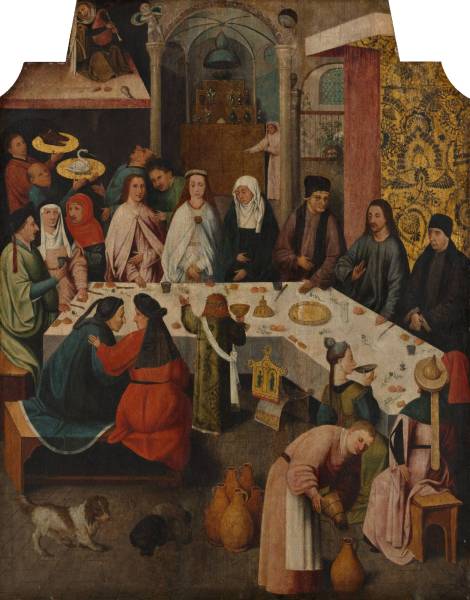
The Wedding at Cana
(c1490)
Hieronymus Bosch
(Brabant, Netherland, 1450 - 1516)
John 2:1-11
Critique of "The Carrying of the Cross" (Escorial) by Hieronymus Bosch:
Hieronymus Bosch's "The Carrying of the Cross" is an oil-on-panel painting created around 1498, inspired by the biblical passage from John 19:17-27. This artwork portrays a crucial moment from the Passion of Christ, depicting Jesus carrying the cross on his way to Golgotha, where he would be crucified.
1. Composition and Narrative: Bosch's composition skillfully captures the chaotic and emotionally charged atmosphere of the scene. The central focus is on Jesus, who is depicted straining under the weight of the cross, surrounded by a tumultuous crowd. The chaotic arrangement of figures and the sense of movement create a sense of urgency and desperation, reflecting the gravity of the event.
2. Symbolism and Allegory: As is characteristic of Bosch's works, "The Carrying of the Cross" is laden with symbolism and allegorical elements. The painting goes beyond a straightforward depiction of the biblical narrative and delves into themes of human sinfulness, redemption, and divine suffering. The presence of fantastical and grotesque creatures in the crowd may represent the dark forces that surrounded Jesus during his crucifixion.
3. Emotional Expression: Bosch's attention to emotional expression is evident in the faces and body language of the figures. The anguish and sorrow of Jesus are palpable, while the expressions of the crowd range from curiosity to callousness, adding depth and complexity to the narrative.
4. Size and Medium: With dimensions of 94cm ✕ 150cm, the painting is of significant size, allowing for intricate details and expressive figures. The use of oil on panel was a common medium during this period, allowing for rich colors and meticulous brushwork.
5. Sense of Mystery: Bosch's work is renowned for its enigmatic and mysterious quality, and "The Carrying of the Cross" is no exception. The surreal elements, unconventional representations, and dreamlike quality invite interpretation and contemplation, encouraging viewers to engage with the painting on multiple levels.
6. Context and Influence: Bosch was a leading artist of the Northern Renaissance, and his works were deeply influenced by his religious beliefs and the socio-cultural context of his time. His unique artistic style and innovative approach to religious subjects made him an influential figure in art history.
In conclusion, "The Carrying of the Cross" (Escorial) by Hieronymus Bosch is a captivating and emotionally charged depiction of a pivotal moment in the Passion of Christ. Through its composition, symbolism, and emotional expression, the painting draws viewers into the profound significance of the crucifixion. Bosch's use of allegory and enigmatic elements adds depth and complexity to the narrative, making the artwork a timeless and thought-provoking masterpiece. As a product of the Northern Renaissance, the painting showcases Bosch's unique artistic vision and enduring impact on the world of art.
Found in: John, John 19, 15th century, Carrying of the cross
17 He went out, bearing his cross, to the place called “The Place of a Skull”, which is called in Hebrew, “Golgotha”,
18 where they crucified him, and with him two others, on either side one, and Jesus in the middle.
19 Pilate wrote a title also, and put it on the cross. There was written, “JESUS OF NAZARETH, THE KING OF THE JEWS.”
20 Therefore many of the Jews read this title, for the place where Jesus was crucified was near the city; and it was written in Hebrew, in Latin, and in Greek.
21 The chief priests of the Jews therefore said to Pilate, “Don’t write, ‘The King of the Jews,’ but, ‘he said, “I am King of the Jews.”’”
22 Pilate answered, “What I have written, I have written.”
23 Then the soldiers, when they had crucified Jesus, took his garments and made four parts, to every soldier a part; and also the coat. Now the coat was without seam, woven from the top throughout.
24 Then they said to one another, “Let’s not tear it, but cast lots for it to decide whose it will be,” that the Scripture might be fulfilled, which says, “They parted my garments among them. For my cloak they cast lots.” Therefore the soldiers did these things.
25 But there were standing by the cross of Jesus his mother, and his mother’s sister, Mary the wife of Clopas, and Mary Magdalene.
26 Therefore when Jesus saw his mother, and the disciple whom he loved standing there, he said to his mother, “Woman, behold, your son!”
27 Then he said to the disciple, “Behold, your mother!” From that hour, the disciple took her to his own home.
John 19:17-27 · World English Bible

1450 - 1516
Brabant, Netherland
Hieronymus Bosch born Jheronimus van Aken (c. 1450 – 9 August 1516) was a Dutch/Netherlandish painter and draughtsman from Brabant. He is one of the most notable representatives of the Early Netherlandish painting school. His work contains fantastic illustrations of religious concepts and narratives. Within his lifetime his work was collected in the Netherlands, Austria, and Spain, and widely copied, especially his macabre and nightmarish depictions of hell.