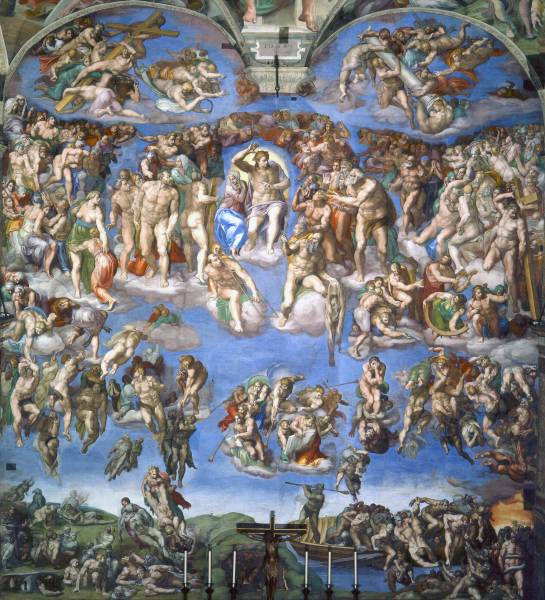
The Last Judgment
(1536)
Michelangelo
(Florence, Italy, 1475 - 1564)
Matthew 25:31-46
"Hagar and Ishmael in the Desert" by François-Joseph Navez is a compelling artwork that beautifully portrays the poignant biblical narrative from Genesis 16:1-16. Created in 1820, this oil on canvas painting showcases Navez's skillful technique and his ability to capture profound emotions and human connections.
The painting depicts the moment when Hagar, the handmaiden of Sarah, and her son Ishmael are cast out into the desert by Abraham at the insistence of Sarah. The composition is emotionally charged, and the artist skillfully conveys the feelings of abandonment, sorrow, and uncertainty that Hagar and Ishmael must have experienced in this challenging situation.
The use of oil on canvas allows Navez to create a rich and detailed scene, with intricate brushwork that brings life and depth to the characters and the landscape. The colors are harmoniously blended, reflecting the desolate yet serene atmosphere of the desert. The artist's attention to small details, such as the folds of the garments and the expressions on Hagar and Ishmael's faces, adds to the overall realism and emotional impact of the painting.
Navez's portrayal of the bond between mother and child is particularly poignant. Hagar's protective gesture towards Ishmael and the way he clings to her in distress evoke a powerful sense of maternal love and vulnerability. This emotional connection between the figures humanizes the biblical story and makes it relatable to viewers on a deeper level.
In "Hagar and Ishmael in the Desert," François-Joseph Navez successfully captures the essence of this biblical narrative through his artistry and emotive storytelling. The painting serves as a visual reflection of the universal themes of human suffering, resilience, and the strength of the mother-child bond. It is a testament to Navez's skill as an artist and his ability to convey complex emotions and narratives through his brushstrokes.
In conclusion, "Hagar and Ishmael in the Desert" by François-Joseph Navez is a remarkable artwork that brings to life the emotional depth of the biblical story from Genesis. Navez's mastery of oil painting allows for a rich and detailed portrayal of the characters and their surroundings. The painting's ability to evoke deep emotions and its portrayal of the mother-child bond make it a truly captivating and thought-provoking masterpiece that continues to resonate with viewers to this day.
Found in: Genesis, Genesis 16, 19th century
1 Now Sarai, Abram’s wife, bore him no children. She had a servant, an Egyptian, whose name was Hagar.
2 Sarai said to Abram, “See now, Yahweh has restrained me from bearing. Please go in to my servant. It may be that I will obtain children by her.” Abram listened to the voice of Sarai.
3 Sarai, Abram’s wife, took Hagar the Egyptian, her servant, after Abram had lived ten years in the land of Canaan, and gave her to Abram her husband to be his wife.
4 He went in to Hagar, and she conceived. When she saw that she had conceived, her mistress was despised in her eyes.
5 Sarai said to Abram, “This wrong is your fault. I gave my servant into your bosom, and when she saw that she had conceived, I was despised in her eyes. Yahweh judge between me and you.”
6 But Abram said to Sarai, “Behold, your maid is in your hand. Do to her whatever is good in your eyes.” Sarai dealt harshly with her, and she fled from her face.
7 Yahweh’s angel found her by a fountain of water in the wilderness, by the fountain on the way to Shur.
8 He said, “Hagar, Sarai’s servant, where did you come from? Where are you going?” She said, “I am fleeing from the face of my mistress Sarai.”
9 Yahweh’s angel said to her, “Return to your mistress, and submit yourself under her hands.”
10 Yahweh’s angel said to her, “I will greatly multiply your offspring, that they will not be counted for multitude.”
11 Yahweh’s angel said to her, “Behold, you are with child, and will bear a son. You shall call his name Ishmael, because Yahweh has heard your affliction.
12 He will be like a wild donkey among men. His hand will be against every man, and every man’s hand against him. He will live opposite all of his brothers.”
13 She called the name of Yahweh who spoke to her, “You are a God who sees,” for she said, “Have I even stayed alive after seeing him?”
14 Therefore the well was called Beer Lahai Roi. Behold, it is between Kadesh and Bered.
15 Hagar bore a son for Abram. Abram called the name of his son, whom Hagar bore, Ishmael.
16 Abram was eighty-six years old when Hagar bore Ishmael to Abram.
Genesis 16:1-16 · World English Bible

1787 - 1869
Brussels, Belgium
François-Joseph Navez (Charleroi, 16 November 1787 – Brussels, 12 October 1869) was a Belgian neo-classical painter. He was a pupil of Jacques-Louis David, he spent five years in Italy between 1817 and 1822. Between 1835 and 1862 he was the director of the Académie Royale des Beaux-Arts in Brussels.