The Adoration of the Magi (1480)
(c1480)
Filippino Lippi
(Prato, 1457 - 1504)
Matthew 2:1-12
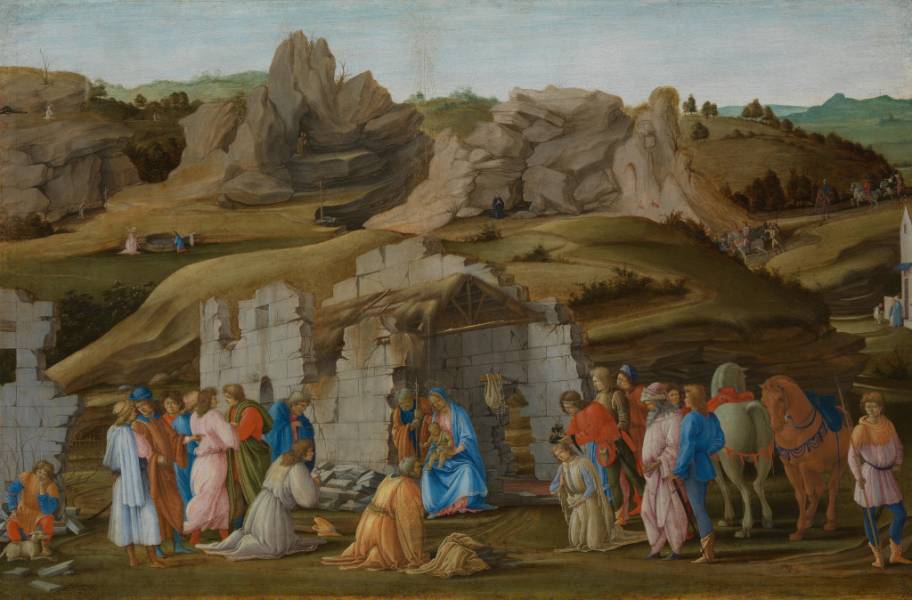
The Adoration of the Magi is a painting by the Italian Renaissance painter Filippino Lippi. It is signed and dated at 1496. It is housed in the Uffizi of Florence.
The panel was painted for the Convent of San Donato in Scopeto, in substitution of the one commissioned in 1481 to Leonardo da Vinci, who left it unfinished. In 1529 it was acquired by Cardinal Carlo de' Medici and in 1666 it became part of the Uffizi collection.
Filippino Lippi followed Leonardo's setting, in particular in the central part of the work. Much of its inspiration was clearly derived from Botticelli's Adoration of the Magi, also in the Uffizi: this is evident in the disposition of the characters on the two sides, with the Holy Family portrayed in the centre under. Similarly to Botticelli's work, Filippino also portrayed numerous members of the Medici cadet line, who had adhered to the Savonarolian Republic in the period in which the work was executed. On the left, kneeling and holding with a quadrant, is Pierfrancesco de' Medici, who had died 20 years before. Behind him, standing, are his two sons Giovanni, holding a goblet, and Lorenzo, from whom a page is removing a crown.
The general style is that of Filippino's late career, characterized by a greater care to details and by a nervous rhythm in the forms, influenced by the knowledge of foreign painting schools (as also in the landscape of the background).
Found in: Matthew, Matthew 2, 15th century, Adoration of the Magi
1 Now when Jesus was born in Bethlehem of Judea in the days of King Herod, behold, wise men from the east came to Jerusalem, saying,
2 “Where is he who is born King of the Jews? For we saw his star in the east, and have come to worship him.”
3 When King Herod heard it, he was troubled, and all Jerusalem with him.
4 Gathering together all the chief priests and scribes of the people, he asked them where the Christ would be born.
5 They said to him, “In Bethlehem of Judea, for this is written through the prophet,
6 ‘You Bethlehem, land of Judah, are in no way least among the princes of Judah: for out of you shall come a governor, who shall shepherd my people, Israel.’”
7 Then Herod secretly called the wise men, and learned from them exactly what time the star appeared.
8 He sent them to Bethlehem, and said, “Go and search diligently for the young child. When you have found him, bring me word, so that I also may come and worship him.”
9 They, having heard the king, went their way; and behold, the star, which they saw in the east, went before them, until it came and stood over where the young child was.
10 When they saw the star, they rejoiced with exceedingly great joy.
11 They came into the house and saw the young child with Mary, his mother, and they fell down and worshiped him. Opening their treasures, they offered to him gifts: gold, frankincense, and myrrh.
12 Being warned in a dream that they shouldn’t return to Herod, they went back to their own country another way.
Matthew 2:1-12 · World English Bible

1457 - 1504
Prato, Italy
Filippino Lippi (April 1457 – April 1504) was an Italian painter working in Florence, Italy during the later years of the Early Renaissance and first few years of the High Renaissance.