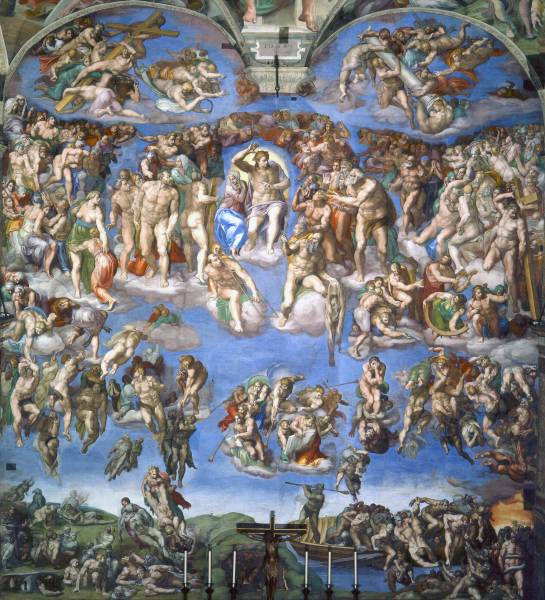
The Last Judgment
(1536)
Michelangelo
(Florence, Italy, 1475 - 1564)
Matthew 25:31-46
This painting is closely related to the Queen Esther that the prominent English academic painter Edwin Long exhibited at London’s Royal Academy in 1879. On 13 April 1878, Alfred Taddy Thomson, a squatting pioneer who had left Australia to return to live in London and was acting as the National Gallery of Victoria’s adviser there, had visited Long’s studio. Here, seeing in progress the painting that would be shown at the Royal Academy the following year, Thomson commissioned for the Melbourne collection a second version of the same subject.
Since Long began this version immediately, and thus worked on both paintings simultaneously – advancing their separate progresses together, neck and neck – the Melbourne version cannot be considered a pure copy. As Long himself wrote in 1879 to the Times, where comment had been made about the two Queen Esther pictures:
The two paintings are not nearly so identical as your correspondent supposes. The replica is of a different proportion, and the attendant figures are painted from different models. Esther herself is also painted from life, and, as a necessary sequence, varied in expression.
The artist has drawn his subject matter from the Old Testament book of Esther. As the wife of the Persian king Xerxes, Esther was forbidden to appear before him without being expressly summoned. Her relative Mordecai, who was an official at the court of Xerxes, had learned, however, of a plot by another official, Haman, to massacre all the Jews in the kingdom. At Mordecai’s insistence, Esther placed her life at risk by visiting the king, before whom she pleaded successfully for her people. Long depicts the final moments of the queen’s preparations before her audience with Xerxes.
Long was concerned with making both versions of Queen Esther archaeologically correct. His wall inscriptions, for example, are based on cuneiform tablets. And, as Alfred Taddy Thomson wrote back to Melbourne in 1878, ‘The colours of the hangings and the pavement are taken from the 1st Book of Esther v 6, the most ancient of architectural descriptions extant’. Verse 6 of the first chapter of the book of Esther does indeed describe how in Xerxes’ palace there were:
white, green, and blue, hangings, fastened with cords of fine linen and purple to silver rings and pillars of marble: the beds were of gold and silver, upon a pavement of red, and blue, and white, and black, marble.
The elaborate frame that protects Queen Esther was also carefully designed by Long himself, to complement the archaeological accuracy of his painting, incorporating motifs taken from the ornamentation of the bases of columns at the ancient Persian city of Persepolis.
Text by Dr Ted Gott from 19th century painting and sculpture in the international collections of the National Gallery of Victoria, National Gallery of Victoria, Melbourne, 2003, p. 70.
Found in: Esther, Esther 2, 19th century
5 There was a certain Jew in the citadel of Susa, whose name was Mordecai, the son of Jair, the son of Shimei, the son of Kish, a Benjamite,
6 who had been carried away from Jerusalem with the captives who had been carried away with Jeconiah king of Judah, whom Nebuchadnezzar the king of Babylon had carried away.
7 He brought up Hadassah, that is, Esther, his uncle’s daughter; for she had neither father nor mother. The maiden was fair and beautiful; and when her father and mother were dead, Mordecai took her for his own daughter.
Esther 2:5-7 · World English Bible

1829 - 1891
Bath, England
Long was born in Bath, Somerset, the son of James Long, a hairdresser, (from Kelston in Somerset), and was educated at Dr. Viner's School in Bath. Adopting the profession of a painter, Long came to London and studied in the British Museum. He was subsequently a pupil in the school of James Mathews Leigh in Newman Street London, and practised first as a portrait artist painting Charles Greville, Lord Ebury and others.