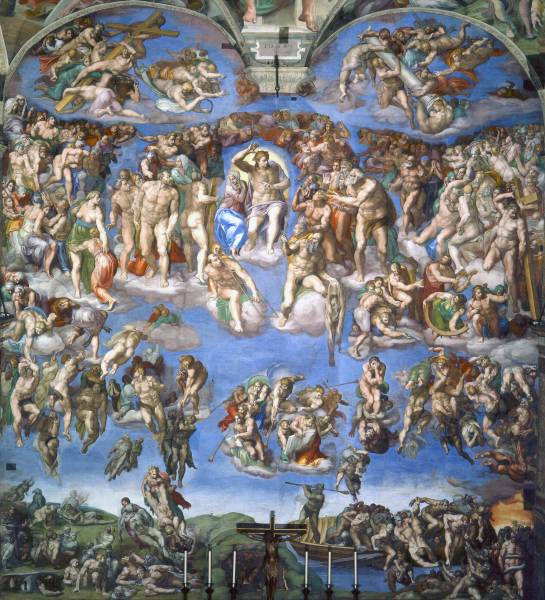
The Last Judgment
(1536)
Michelangelo
(Florence, Italy, 1475 - 1564)
Matthew 25:31-46
Jonah is one of Ryder’s most densely painted canvases. He reworked this image so many times that the paint layers are still soft to the touch after more than a century. Ryder chose a Biblical tale of damnation, terror, and salvation that suited his poetic temperament and his manner of working. He was a thoughtful and literate painter who often found himself waiting for inspiration to strike. When the moment came, Ryder gave himself over to the act of painting, stopping only to gather his energy and courage. We imagine his brush sweeping and turning through the thick paint, much as Jonah struggled in the ocean’s pitching waves. American artists a generation later were inspired by Ryder’s mythic themes and vigorous painting. His example helped them to create a new art for the American century. The abstract expressionist Jackson Pollock once said, “The only American master who interests me is Ryder.”
Found in: Jonah, Jonah 1, 19th century, Jonah
1 Now Yahweh’s word came to Jonah the son of Amittai, saying,
2 “Arise, go to Nineveh, that great city, and preach against it, for their wickedness has come up before me.”
3 But Jonah rose up to flee to Tarshish from the presence of Yahweh. He went down to Joppa, and found a ship going to Tarshish; so he paid its fare, and went down into it, to go with them to Tarshish from the presence of Yahweh.
4 But Yahweh sent out a great wind on the sea, and there was a mighty storm on the sea, so that the ship was likely to break up.
5 Then the mariners were afraid, and every man cried to his god. They threw the cargo that was in the ship into the sea to lighten the ship. But Jonah had gone down into the innermost parts of the ship, and he was laying down, and was fast asleep.
6 So the ship master came to him, and said to him, “What do you mean, sleeper? Arise, call on your God! Maybe your God will notice us, so that we won’t perish.”
7 They all said to each other, “Come, let us cast lots, that we may know who is responsible for this evil that is on us.” So they cast lots, and the lot fell on Jonah.
8 Then they asked him, “Tell us, please, for whose cause this evil is on us. What is your occupation? Where do you come from? What is your country? Of what people are you?”
9 He said to them, “I am a Hebrew, and I fear Yahweh, the God of heaven, who has made the sea and the dry land.”
10 Then the men were exceedingly afraid, and said to him, “What have you done?” For the men knew that he was fleeing from the presence of Yahweh, because he had told them.
11 Then they said to him, “What shall we do to you, that the sea may be calm to us?” For the sea grew more and more stormy.
12 He said to them, “Take me up, and throw me into the sea. Then the sea will be calm for you; for I know that because of me this great storm is on you.”
13 Nevertheless the men rowed hard to get them back to the land; but they could not, for the sea grew more and more stormy against them.
14 Therefore they cried to Yahweh, and said, “We beg you, Yahweh, we beg you, don’t let us die for this man’s life, and don’t lay on us innocent blood; for you, Yahweh, have done as it pleased you.”
15 So they took up Jonah, and threw him into the sea; and the sea ceased its raging.
16 Then the men feared Yahweh exceedingly; and they offered a sacrifice to Yahweh, and made vows.
17 Yahweh prepared a great fish to swallow up Jonah, and Jonah was in the belly of the fish three days and three nights.
Jonah 1 · World English Bible

1847 - 1917
New Bedford Massachusetts, USA
Albert Pinkham Ryder was an American painter best known for his poetic and moody allegorical works and seascapes, as well as his eccentric personality. While his art shared an emphasis on subtle variations of colour with tonalist works of the time, it was unique for accentuating form in a way that some art historians regard as modernist.