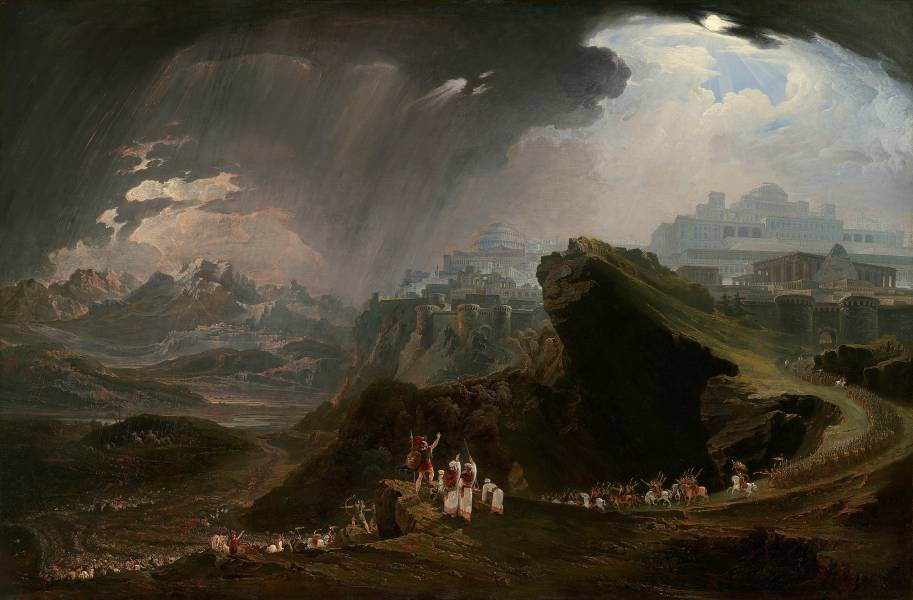
John Martin
(Northumberland, 1789 - 1854)
Joshua: 10:1-15
In this portrayal from the Old Testament, we witness the scene where Methuselah, the venerable figure with a white beard, rests on an elevated ledge, encircled by Noah's family. Methuselah has guided Noah to unfurl a prophetic scroll, which, owing to the alignment of the sun, moon, and comet in the sky above, foretells the impending cataclysmic flood ordained by God. A pair of circling ravens heightens the ominous atmosphere, while revellers from the antediluvian era continue their oblivious dance in the middle ground, unaware of the impending devastation. Martin had previously created a small mezzotint of the same theme to accompany John Galt's "The Ouranoulogos or The Celestial Vision" in 1833.
Emerging from humble beginnings in Newcastle-Upon-Tyne, where he initially worked as a heraldic painter for a coach builder, John Martin transitioned to London, where he carved out a prosperous career as a painter, illustrator, engraver, and engineer. By the time of this painting, he had firmly established his reputation, having first exhibited at the Royal Academy in 1811 and gaining immense popularity with the public for his paintings.
It is likely that Prince Albert's appreciation for Martin's work was influenced by his uncle Leopold I, the King of the Belgians, who had engaged Martin as a Historical Landscape Painter during his short marriage to Princess Charlotte (1816-17). This connection continued when Leopold moved to Brussels in 1831: the Belgian government acquired Martin's "The Fall of Nineveh" in 1833, he became a member of the Belgian Academy, and later was inducted into the Order of Leopold.
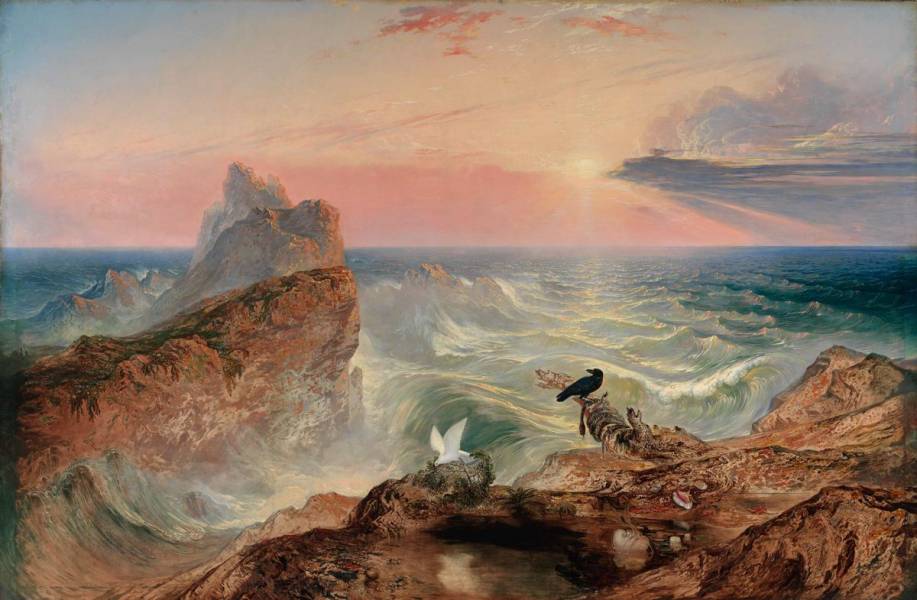
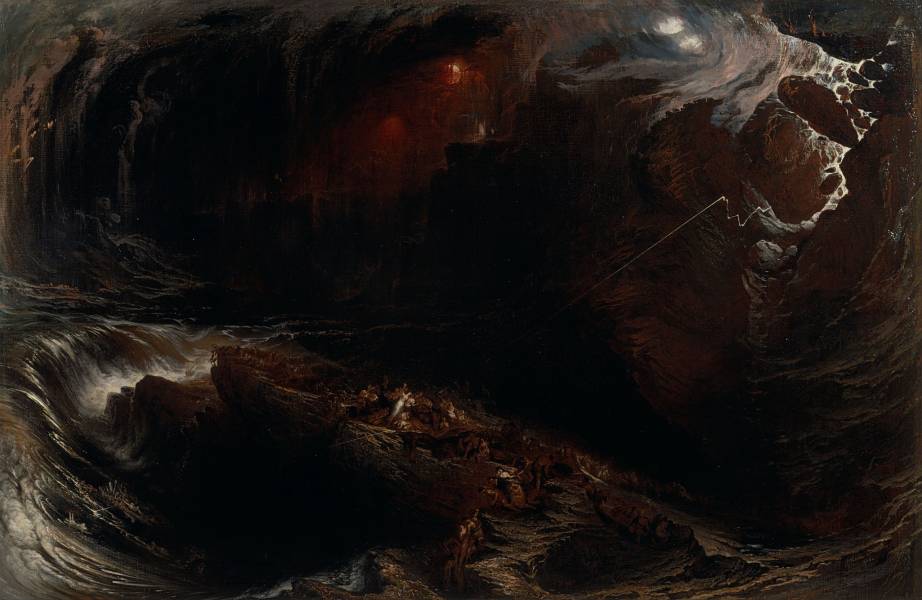
Prince Albert's initial visit to Martin's studio took place in 1839, preceding his marriage. He made several subsequent visits after he permanently settled in England in February of the following year. Leopold, the artist's son, recollected that John Martin greatly valued the Prince's insights into art history: 'The enlightened criticisms of the Prince deeply impressed him as being judicious, thoughtful, and kind, revealing a truly refined and extensive knowledge of art' (Balston 1947, p.202-3). According to Leopold, it was Prince Albert who, upon viewing Martin's "The Deluge" (New Haven, Yale Center for British Art) during one of these visits, proposed the idea of a trilogy depicting the flood story. This trilogy would comprise "The Eve of the Deluge" as a prelude and "The Assuagement of the Waters" (San Francisco Museum of Fine Arts) depicting the aftermath. The Duchess of Sutherland, who served as the Mistress of the Robes to Queen Victoria, commissioned "The Assuagement of the Waters." "The Eve of the Deluge" was initially displayed in Prince Albert's Dressing Room at Buckingham Palace, and the mezzotint reproduction, issued two years after the painting, was dedicated to the Prince.
This painting encapsulates the early Romantic inclination for the sublime and the visionary. Martin's works were marked by rich imagination and frequently utilized dramatic perspectives to underscore humanity's insignificance within the vast expanse of nature. It's possible that he personally observed the Great Comet of 1811-12 and the return of Halley's Comet in 1835. During this era, the biblical flood theme was contentious, given that contemporary geological and paleontological discoveries were challenging the notion that the Earth was as young as suggested by a literal reading of the Old Testament. Martin supplemented the trio of paintings with an eight-page pamphlet that delved into a plethora of esoteric literary influences and extensively quoted passages from Byron's "sublime poem," "Heaven and Earth."
Found in: Genesis, Genesis 7, 19th century
1 Yahweh said to Noah, “Come with all of your household into the ship, for I have seen your righteousness before me in this generation.
2 You shall take seven pairs of every clean animal with you, the male and his female. Of the animals that are not clean, take two, the male and his female.
3 Also of the birds of the sky, seven and seven, male and female, to keep seed alive on the surface of all the earth.
4 In seven days, I will cause it to rain on the earth for forty days and forty nights. I will destroy every living thing that I have made from the surface of the ground.”
5 Noah did everything that Yahweh commanded him.
6 Noah was six hundred years old when the flood of waters came on the earth.
7 Noah went into the ship with his sons, his wife, and his sons’ wives, because of the floodwaters.
8 Clean animals, unclean animals, birds, and everything that creeps on the ground
9 went by pairs to Noah into the ship, male and female, as God commanded Noah.
10 After the seven days, the floodwaters came on the earth.
11 In the six hundredth year of Noah’s life, in the second month, on the seventeenth day of the month, on the same day all the fountains of the great deep burst open, and the sky’s windows opened.
12 It rained on the earth forty days and forty nights.
13 In the same day Noah, and Shem, Ham, and Japheth—the sons of Noah—and Noah’s wife and the three wives of his sons with them, entered into the ship—
14 they, and every animal after its kind, all the livestock after their kind, every creeping thing that creeps on the earth after its kind, and every bird after its kind, every bird of every sort.
15 Pairs from all flesh with the breath of life in them went into the ship to Noah.
16 Those who went in, went in male and female of all flesh, as God commanded him; then Yahweh shut him in.
Genesis 7:1-16 · World English Bible

1789 - 1854
Northumberland, England
John Martin (19 July 1789 – 17 February 1854) was an English Romantic painter, engraver and illustrator. He was celebrated for his typically vast and melodramatic paintings of religious subjects and fantastic compositions, populated with minute figures placed in imposing landscapes. Martin's paintings, and the prints made from them, enjoyed great success with the general public—in 1821 Thomas Lawrence referred to him as "the most popular painter of his day"—but were lambasted by John Ruskin and other critics.