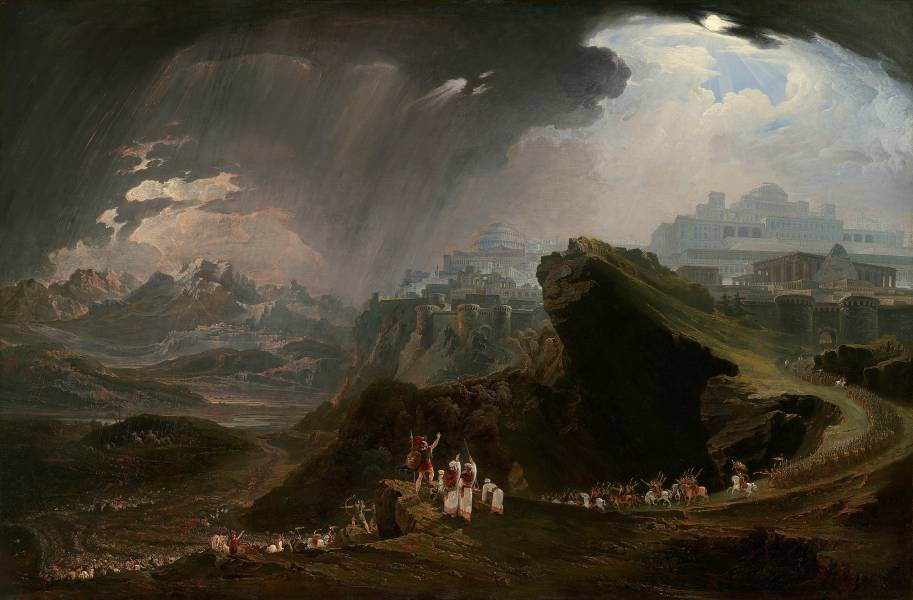
John Martin
(Northumberland, 1789 - 1854)
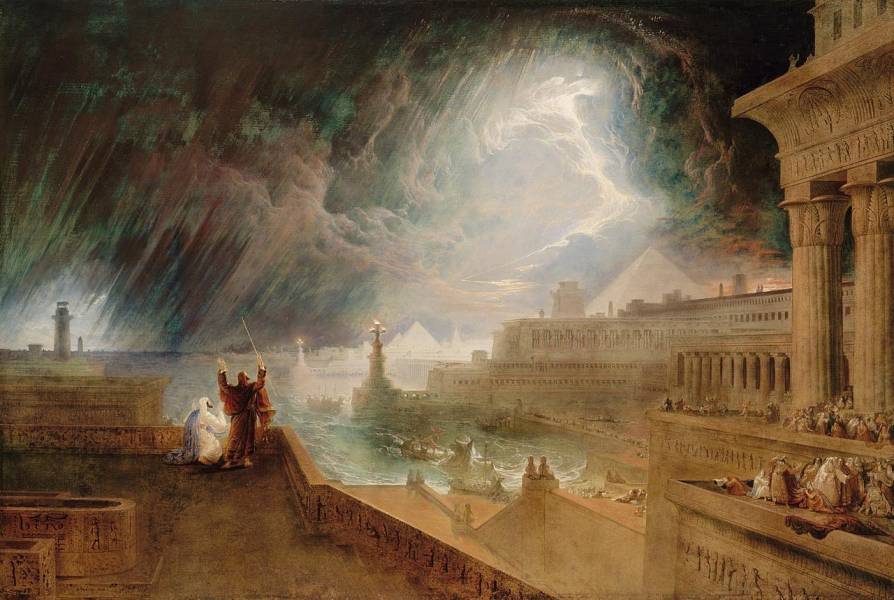
Joshua: 10:1-15
After Queen Victoria's Coronation on June 28, 1838, a flurry of prominent artists aimed to capture the event on canvas. Among them was John Martin, who approached the task with a unique twist. Instead of merely focusing on the central event, he aimed to encompass the entire congregation in intricate portrait detail. This clever approach involved inviting attendees to sit for portraits, while those who declined had their images gleaned from existing portraits. The strategy paid off as visits to his studio led to the viewing and purchase of artworks from his collection. Additionally, smaller preparatory portrait images were acquired once the Coronation painting was completed. This tactic proved an excellent way for Martin to raise his profile within the aristocracy.
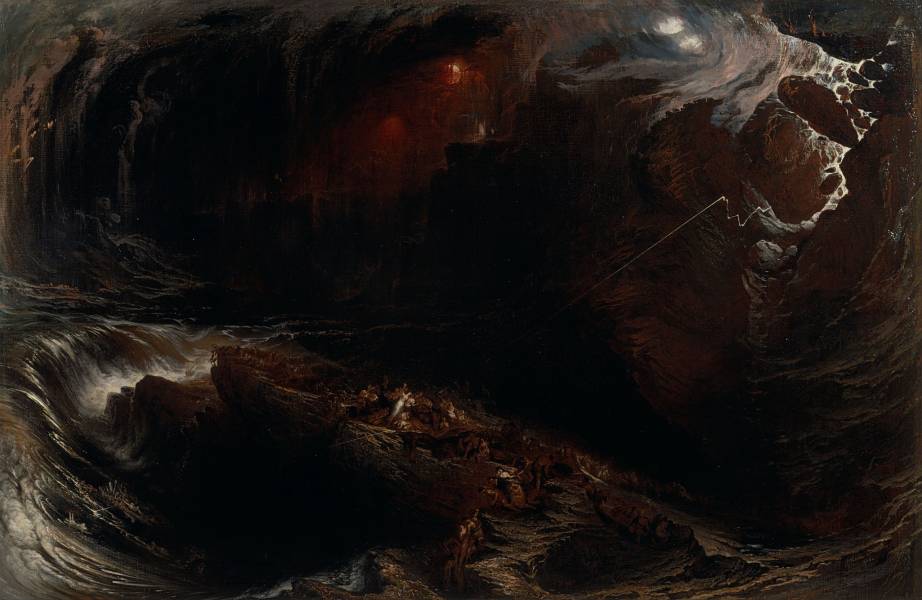
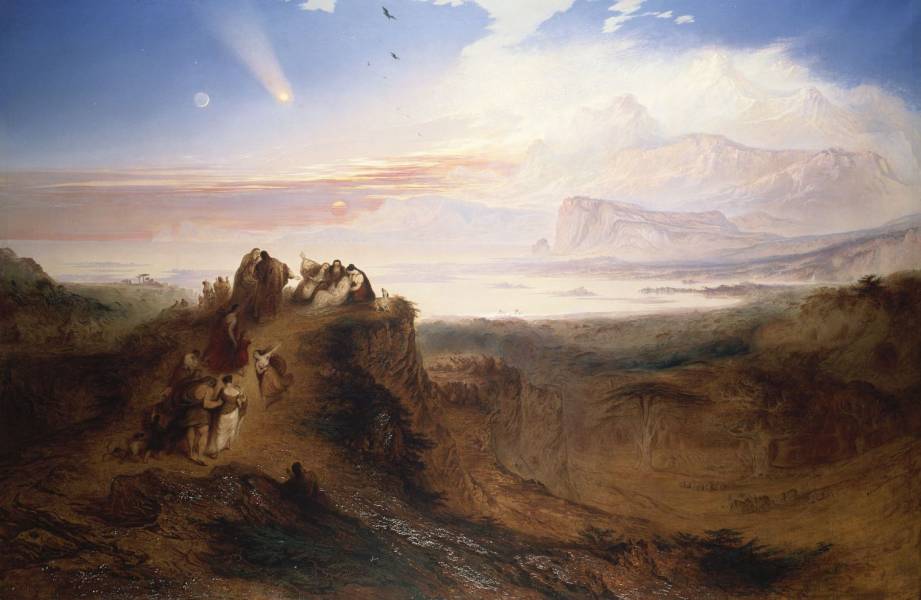
Prince Albert's visit to view the Coronation painting resulted in the commission of a painting from a proposed trilogy that expanded upon Martin's earlier work, "The Deluge – The Eve of the Flood." Not to be outdone, Harriet, 2nd Duchess of Sutherland, swiftly commissioned the third in the series, "The Assuaging of the Waters." Correspondence between the Duchess and John Martin followed, ensuring that the subject matter aligned with the Duchess's taste for decor in her residence. Unlike Martin's original portrayal of corpses and aquatic creatures, the revised version featured sea-shells and vegetation, aligning with the Duchess's preferences.
Described by his biographer William Feaver, "The Assuaging of the Waters" depicts "a few relics of the antediluvian world preserved, like trinkets, on the slowly surfacing peaks of Mount Ararat." However, Feaver was unaware that Harriet had edited the original, darker composition.
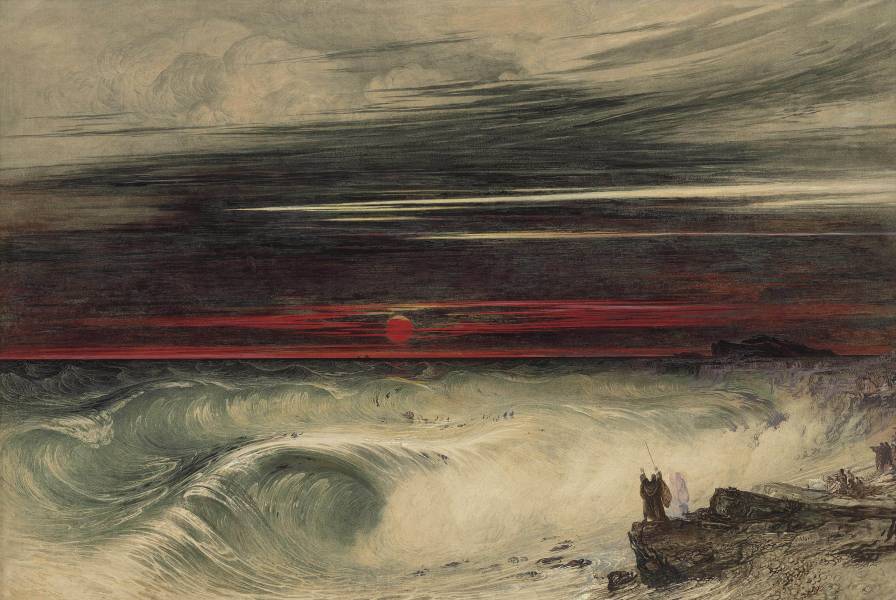
The initial version of "The Deluge" was painted in 1826 and exhibited at the British Institution. Martin included a quote from Byron's poem "Heaven and Earth" in the accompanying pamphlet. Despite its exhibition, the painting remained unsold until Martin's mezzotint reproduction in 1828 led to successful sales. He then painted a second version in 1834, which won a Gold Medal at the Paris Salon in 1835. The notion of a trilogy on this subject had long been brewing in Martin's mind; a watercolor titled "The Assuaging of the Waters" was displayed in 1838. Feaver's notes suggest that the oil version of "The Eve of the Deluge" was likely started before Prince Albert's visit in 1840.
Martin's distinctive style, featuring towering cliffs and scenes of calamity, became his trademark early on. Raised in Haydon Bridge, Tyneside, an area characterized by imposing cliffs, wild moorland, and ruins like Hadrian's Wall, Martin's childhood memories of catastrophic floods influenced his paintings' sublime and picturesque landscapes. According to Feaver, Martin, the artist of floods, apocalyptic visions, and disordered time scales, was ideally formed by his upbringing.
The trilogy's pieces are now held by The Royal Collection ("The Eve of the Deluge"), the Yale Center for British Art ("The Deluge"), and the Fine Arts Museum of San Francisco ("The Assuaging of the Waters"). The Tate Gallery owns "The Coronation." The trilogy hadn't been publicly exhibited together until 1997 when the Yale Center for British Art curated an exhibition titled "John Martin: Visions of the Biblical Flood."
Found in: Genesis, Genesis 8, 19th century
1 God remembered Noah, all the animals, and all the livestock that were with him in the ship; and God made a wind to pass over the earth. The waters subsided.
2 The deep’s fountains and the sky’s windows were also stopped, and the rain from the sky was restrained.
3 The waters continually receded from the earth. After the end of one hundred fifty days the waters decreased.
4 The ship rested in the seventh month, on the seventeenth day of the month, on Ararat’s mountains.
5 The waters receded continually until the tenth month. In the tenth month, on the first day of the month, the tops of the mountains were visible.
6 At the end of forty days, Noah opened the window of the ship which he had made,
7 and he sent out a raven. It went back and forth, until the waters were dried up from the earth.
8 He himself sent out a dove to see if the waters were abated from the surface of the ground,
9 but the dove found no place to rest her foot, and she returned into the ship to him, for the waters were on the surface of the whole earth. He put out his hand, and took her, and brought her to him into the ship.
10 He waited yet another seven days; and again he sent the dove out of the ship.
11 The dove came back to him at evening and, behold, in her mouth was a freshly plucked olive leaf. So Noah knew that the waters were abated from the earth.
12 He waited yet another seven days, and sent out the dove; and she didn’t return to him anymore.
13 In the six hundred first year, in the first month, the first day of the month, the waters were dried up from the earth. Noah removed the covering of the ship, and looked. He saw that the surface of the ground was dried.
14 In the second month, on the twenty-seventh day of the month, the earth was dry.
Genesis 8:1-14 · World English Bible

1789 - 1854
Northumberland, England
John Martin (19 July 1789 – 17 February 1854) was an English Romantic painter, engraver and illustrator. He was celebrated for his typically vast and melodramatic paintings of religious subjects and fantastic compositions, populated with minute figures placed in imposing landscapes. Martin's paintings, and the prints made from them, enjoyed great success with the general public—in 1821 Thomas Lawrence referred to him as "the most popular painter of his day"—but were lambasted by John Ruskin and other critics.