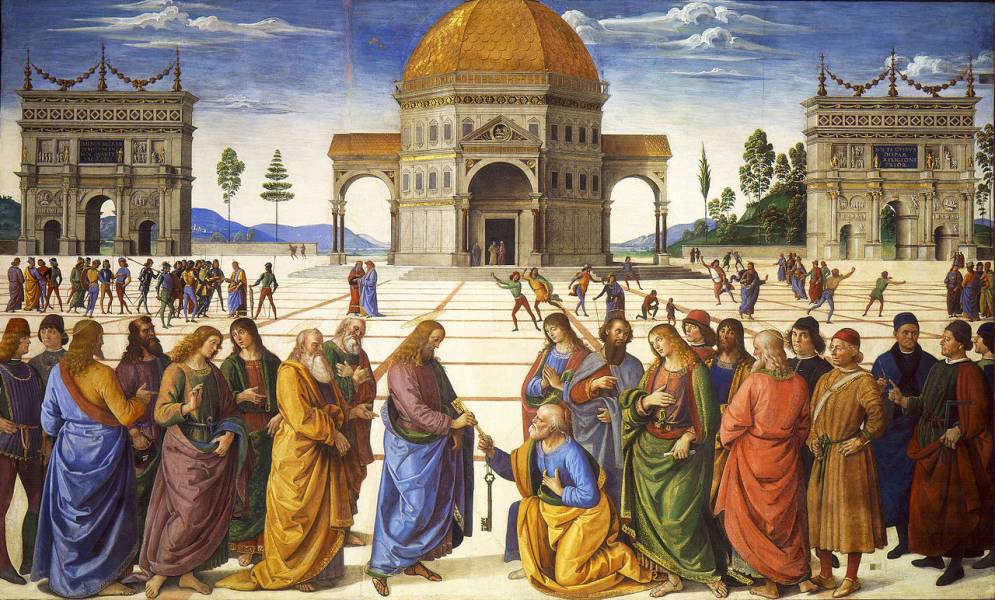
Pietro Perugino
(Città della Pieve, 1446 - 1523)
Matthew 16:13-20
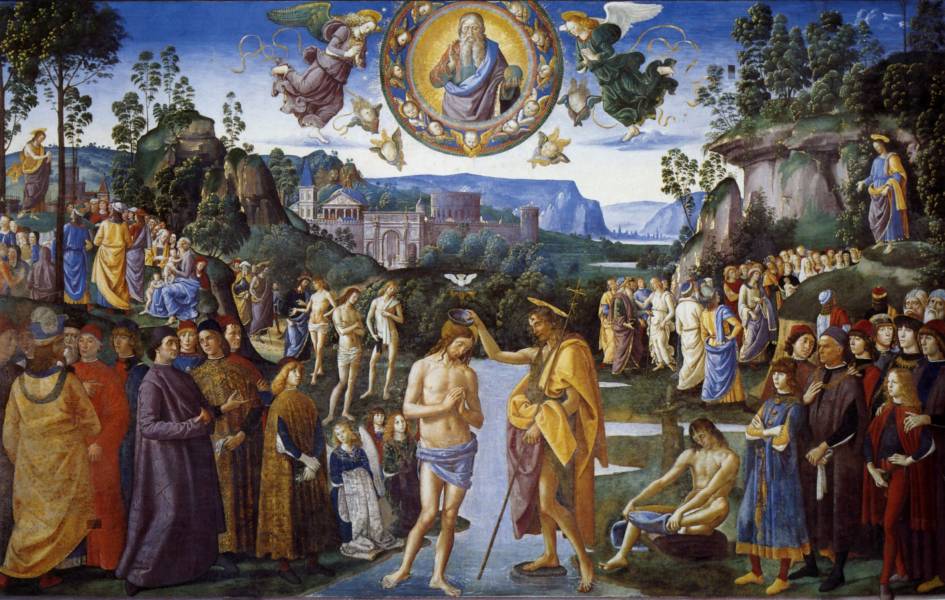
Moses Leaving for Egypt is a fresco by the Italian Renaissance painter Pietro Perugino and his workshop, executed around 1482 and located in the Sistine Chapel, Rome. It depicts a journey by the prophet Moses.
The commission of the work originated in 1480, when Perugino was decorating a chapel in the Old St. Peter's Basilica in Rome. Pope Sixtus IV was pleased by his work, and decided to commission him also the decoration of the new Chapel he had built in the Vatican Palace. Due to the size of the work, Perugino was later joined by a group of painters from Florence, including Botticelli, Ghirlandaio and others.
Perugino's assistants in the Sistine Chapel included Pinturicchio. Some figures in the fresco were traditionally attributed to him, but this has been disputed by 20th-century art historians.[1] They were painted by Andrea d'Assisi, Rocco Zoppo or, less likely, Lo Spagna or Bartolomeo della Gatta, other Perugino's collaborators of the time.
Found in: Exodus, Exodus 4, 15th century, Moses, Sistine Chapel
18 Moses went and returned to Jethro his father-in-law, and said to him, “Please let me go and return to my brothers who are in Egypt, and see whether they are still alive.” Jethro said to Moses, “Go in peace.”
19 Yahweh said to Moses in Midian, “Go, return into Egypt; for all the men who sought your life are dead.”
20 Moses took his wife and his sons, and set them on a donkey, and he returned to the land of Egypt. Moses took God’s rod in his hand.
21 Yahweh said to Moses, “When you go back into Egypt, see that you do before Pharaoh all the wonders which I have put in your hand, but I will harden his heart and he will not let the people go.
22 You shall tell Pharaoh, ‘Yahweh says, Israel is my son, my firstborn,
23 and I have said to you, “Let my son go, that he may serve me”; and you have refused to let him go. Behold, I will kill your son, your firstborn.’”
24 On the way at a lodging place, Yahweh met Moses and wanted to kill him.
25 Then Zipporah took a flint, and cut off the foreskin of her son, and cast it at his feet; and she said, “Surely you are a bridegroom of blood to me.”
26 So he let him alone. Then she said, “You are a bridegroom of blood,” because of the circumcision.
27 Yahweh said to Aaron, “Go into the wilderness to meet Moses.” He went, and met him on God’s mountain, and kissed him.
28 Moses told Aaron all Yahweh’s words with which he had sent him, and all the signs with which he had instructed him.
29 Moses and Aaron went and gathered together all the elders of the children of Israel.
30 Aaron spoke all the words which Yahweh had spoken to Moses, and did the signs in the sight of the people.
31 The people believed, and when they heard that Yahweh had visited the children of Israel, and that he had seen their affliction, then they bowed their heads and worshiped.
Exodus 4:18-31 · World English Bible

1446 - 1523
Città della Pieve, Italy
Pietro Perugino (c. 1446/1452 – 1523), born Pietro Vannucci, was an Italian Renaissance painter of the Umbrian school, who developed some of the qualities that found classic expression in the High Renaissance. Raphael was his most famous pupil.