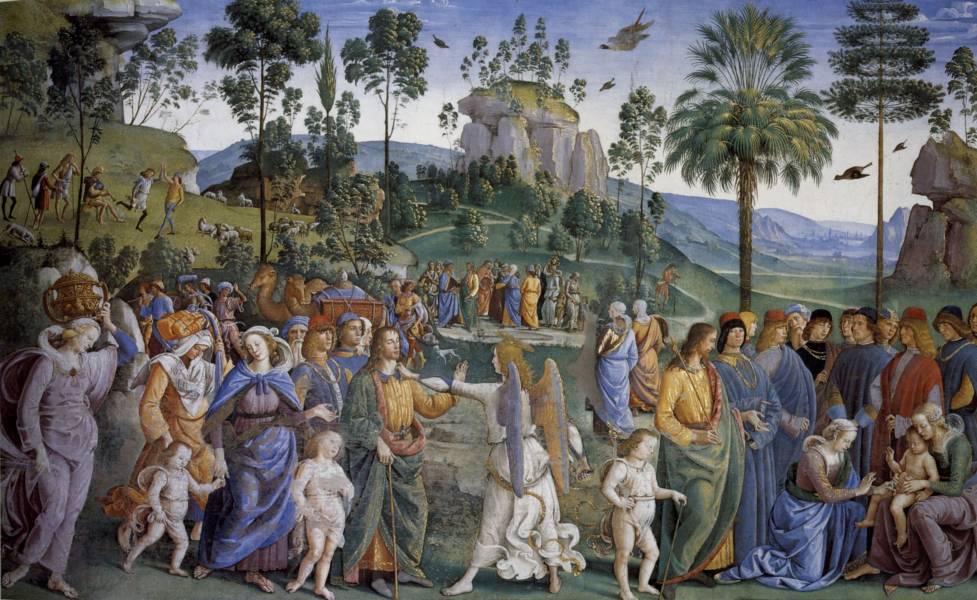
Moses' Journey into Egypt
(c1482)
Pietro Perugino
(Città della Pieve, 1446 - 1523)
Exodus 4:18-31
The commission of the work originated in 1480, when Perugino was decorating a chapel in the Old St. Peter's Basilica in Rome. Pope Sixtus IV was pleased by his work, and decided to commission him also the decoration of the new Chapel he had built in the Vatican Palace. Due to the size of the work, Perugino was later joined by a group of painters from Florence, including Botticelli, Ghirlandaio and others.
While the work was still being created, a visit from Alfonso II of Naples resulted in his addition to the far left of the group of foreground figures. To balance out the image, an apostle was added above St. Peter.
The scene, part of the series of the Stories of Jesus on the chapel's northern wall, is a reference to Matthew 16 in which Jesus says he will give "the keys of the kingdom of heaven" to Saint Peter. These keys represent the power to forgive and to share the word of God thereby giving them the power to allow others into heaven. The main figures are organized in a frieze in two tightly compressed rows close to the surface of the picture and well below the horizon. The principal group, showing Christ handing the silver and gold keys to the kneeling St. Peter, is surrounded by the other Apostles, including Judas (fifth figure to the left of Christ), all with halos, together with portraits of contemporaries, including one said to be a self-portrait (fifth from the right edge). The flat, open square is divided by coloured stones into large foreshortened rectangles. In the center of the background is a temple resembling the ideal church of Leon Battista Alberti's On architecture; on either side are triumphal arches with inscriptions aligning Sixtus IV to Solomon, recalling the latter's porticoed temple. Scattered in the middle distance are two scenes from the life of Christ, including the Tribute Money on the left and the stoning of Christ on the right.
Found in: Matthew, Matthew 16, 15th century, Jesus, Peter, Sistine Chapel
13 Now when Jesus came into the parts of Caesarea Philippi, he asked his disciples, saying, “Who do men say that I, the Son of Man, am?”
14 They said, “Some say John the Baptizer, some, Elijah, and others, Jeremiah, or one of the prophets.”
15 He said to them, “But who do you say that I am?”
16 Simon Peter answered, “You are the Christ, the Son of the living God.”
17 Jesus answered him, “Blessed are you, Simon Bar Jonah, for flesh and blood has not revealed this to you, but my Father who is in heaven.
18 I also tell you that you are Peter, and on this rock I will build my assembly, and the gates of Hades will not prevail against it.
19 I will give to you the keys of the Kingdom of Heaven, and whatever you bind on earth will have been bound in heaven; and whatever you release on earth will have been released in heaven.”
20 Then he commanded the disciples that they should tell no one that he was Jesus the Christ.
Matthew 16:13-20 · World English Bible

1446 - 1523
Città della Pieve, Italy
Pietro Perugino (c. 1446/1452 – 1523), born Pietro Vannucci, was an Italian Renaissance painter of the Umbrian school, who developed some of the qualities that found classic expression in the High Renaissance. Raphael was his most famous pupil.