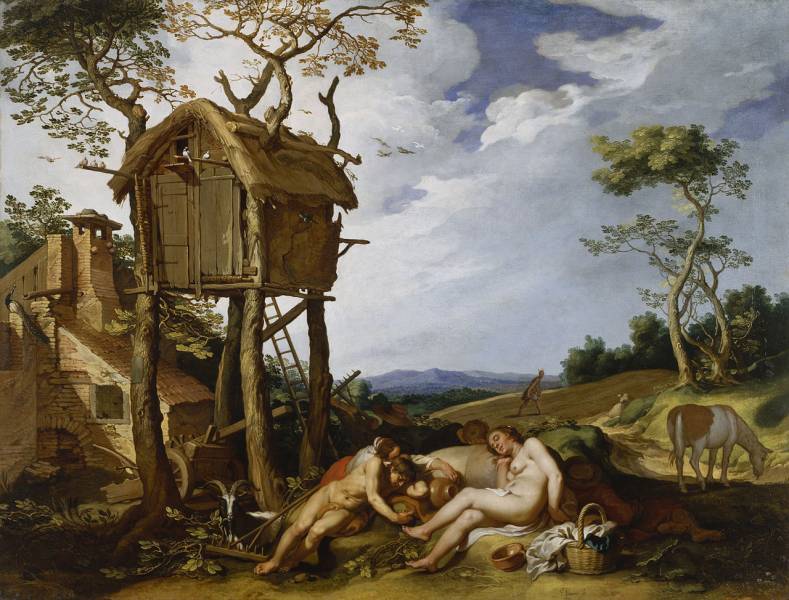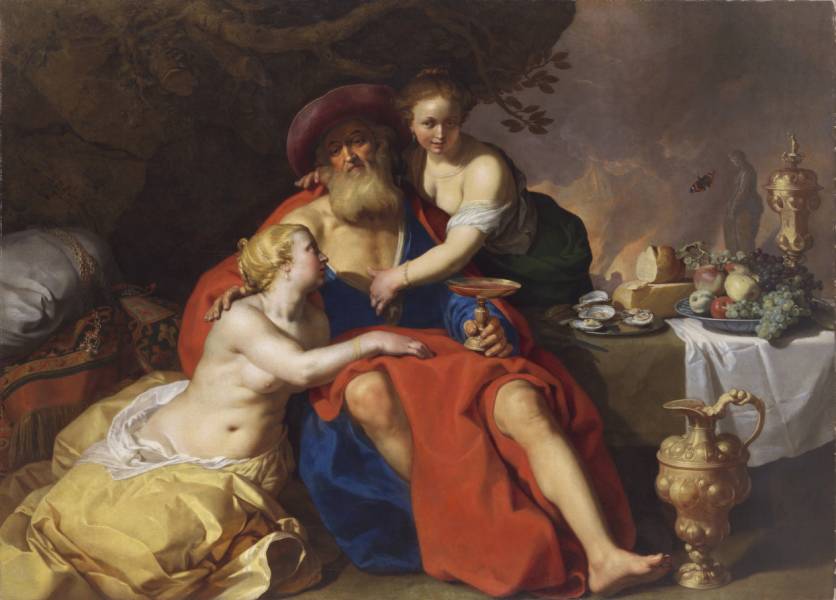
Lot and his daughters
(1624)
Abraham Bloemaert
(Gorinchem, 1566 - 1651)
Genesis 19:30-38
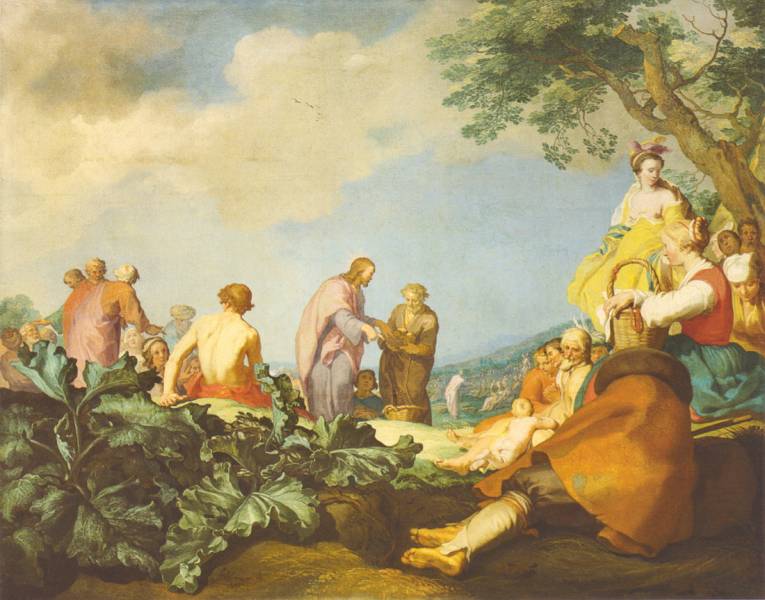
"The Feeding of the Multitude" is a captivating oil on canvas painting by the renowned Dutch artist, Abraham Bloemaert, created in 1593. This evocative masterpiece weaves together artistic brilliance and biblical storytelling, capturing a profound moment of compassion and abundance from the Gospel of John.
Bloemaert's artistic finesse is evident in the skillful use of color and composition. The scene unfolds with a harmonious balance of hues, evoking a sense of serenity and divine presence. The radiant glow of golden light gently bathes the multitude of people gathered around, underscoring the miraculous nature of the event.
At the heart of the painting stands Jesus, depicted with grace and humility as he blesses the loaves and fish, the meager offerings transformed into an abundant feast. His compassionate gaze reflects the depth of his love for humanity, and his outstretched arms seem to embrace both the physical and spiritual hunger of the crowd.
The multitude is depicted in a mesmerizing array of postures and expressions, each person responding uniquely to the miracle before them. Some are in awe, their eyes fixed on Jesus, while others bow their heads in prayerful gratitude. The artist's attention to detail brings to life the diverse characters in the crowd, reminding viewers of the universal nature of Christ's message and the profound impact of his teachings.
The setting is also imbued with symbolism, as the lush green landscape and calm waters mirror the abundance and tranquility brought about by Christ's presence. The surrounding mountains add a touch of majesty and grandeur, reinforcing the divine significance of the moment.
Bloemaert's choice of oil on canvas as his medium allows for rich textures and intricate detailing. Each brushstroke contributes to the overall sense of realism, making the figures almost tangible in their humanity. The use of light and shadow further enhances the three-dimensional quality of the scene, drawing viewers into the very heart of the miraculous gathering.
"The Feeding of the Multitude" transcends its historical and biblical context to become a timeless testament to compassion, faith, and the power of divine intervention. Bloemaert's masterful depiction of this sacred event invites contemplation and reflection, encouraging viewers to consider the spiritual nourishment that lies at the core of human existence.
In this masterpiece, we witness not only a miraculous multiplication of loaves and fish but also the multiplication of hope, unity, and the transformative nature of faith. As we gaze upon Bloemaert's "The Feeding of the Multitude," we are invited to partake in the abundant feast of divine grace and compassion, a feast that continues to nourish the soul throughout the ages.
Found in: John, John 6, 16th century, Miracles by Jesus
1 After these things, Jesus went away to the other side of the sea of Galilee, which is also called the Sea of Tiberias.
2 A great multitude followed him, because they saw his signs which he did on those who were sick.
3 Jesus went up into the mountain, and he sat there with his disciples.
4 Now the Passover, the feast of the Jews, was at hand.
5 Jesus therefore lifting up his eyes, and seeing that a great multitude was coming to him, said to Philip, “Where are we to buy bread, that these may eat?”
6 This he said to test him, for he himself knew what he would do.
7 Philip answered him, “Two hundred denarii worth of bread is not sufficient for them, that everyone of them may receive a little.”
8 One of his disciples, Andrew, Simon Peter’s brother, said to him,
9 “There is a boy here who has five barley loaves and two fish, but what are these among so many?”
10 Jesus said, “Have the people sit down.” Now there was much grass in that place. So the men sat down, in number about five thousand.
11 Jesus took the loaves; and having given thanks, he distributed to the disciples, and the disciples to those who were sitting down; likewise also of the fish as much as they desired.
12 When they were filled, he said to his disciples, “Gather up the broken pieces which are left over, that nothing be lost.”
13 So they gathered them up, and filled twelve baskets with broken pieces from the five barley loaves, which were left over by those who had eaten.
14 When therefore the people saw the sign which Jesus did, they said, “This is truly the prophet who comes into the world.”
John 6:1-14 · World English Bible

1566 - 1651
Gorinchem, Netherlands
Bloemaert was born in Gorinchem, Habsburg Netherlands, the son of the architect Cornelis Bloemaert I, who moved his family to Utrecht in 1575, where Abraham was first a pupil of Gerrit Splinter (pupil of Frans Floris) and of Joos de Beer. From the age of 15 or 16, he then spent three years in Paris from 1581–1583, studying six weeks under a Jehan Bassot (possibly Jean Cousin the Younger) and then under a Maistre Herry. While in the School of…