The Abyss of Hell
(c1485)
Sandro Botticelli
(Florence, 1445 - 1510)
Revelation 20:11-15
The Temptations of Christ depicts three episodes from the gospels, in parallel with the painting on the opposite wall, also by Botticelli, showing the Trials of Moses. A frieze, similar to that beneath the other frescos, has the inscription TEMPTATIO IESU CHRISTI LATORIS EVANGELICAE LEGIS ("The Temptations of Christ, Bringer of the Evangelic Law").
The subject of the title takes place in three scenes in the upper section of the fresco. On the left, Jesus, who has been fasting, is tempted by the Devil, in the guise of a hermit, to turn stones into bread. In the second scene of temptation, at the upper centre of the picture, the Devil has carried Jesus to the top of the temple of Jerusalem, represented by the facade of the Chapel of Santa Maria in Traspontina of the Church of Santo Spirito in Sassia in Rome. The Devil tempts Jesus to challenge God's promise that he will be protected by angels, by throwing himself down. In the third temptation, to the upper right, the Devil has taken Jesus to a high mountain where he shows him the beauties of the Earth. The Devil promises Jesus power over this domain, if he will deny God and bow down to the Devil. Jesus sends the Devil away from him, while angels come to minister to him.
In the foreground, a man whom Jesus has healed of leprosy presents himself to the High Priest at the temple, so that he may be pronounced clean. The young man carries a basin of water, in which is a bough of hyssop. A woman brings two fowls for sacrifice and another woman brings cedar wood. These three ingredients were part of the ritual of cleansing of a leper. The high priest may symbolize Moses, who transmitted the Law, and the young man may symbolically represent Christ, who, according to the Gospels, was wounded and slain for the benefit of mankind, and healed through the Resurrection so that mankind might also be made spiritually clean, and receive salvation. In Christian symbolism, many stories, such as the healing of the leper, are perceived to prefigure the crucifixion and resurrection of Jesus, or other events in his life.
Found in: Matthew, Matthew 4, 15th century, Jesus, Sistine Chapel
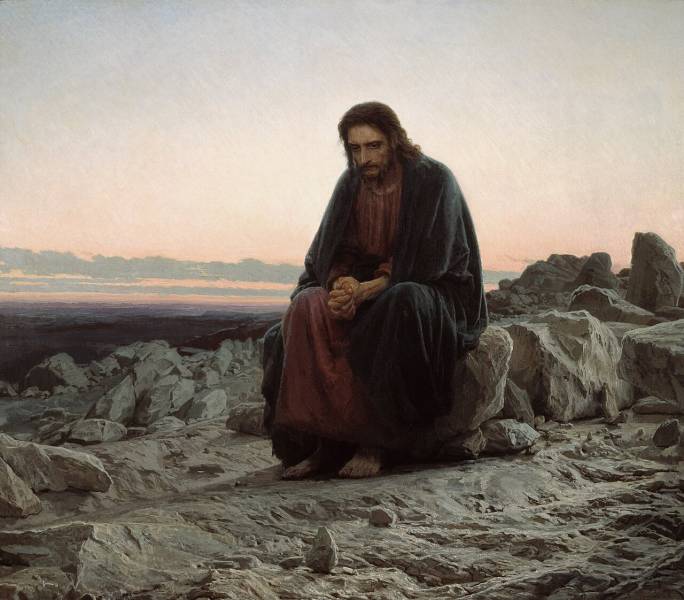
1 Then Jesus was led up by the Spirit into the wilderness to be tempted by the devil.
2 When he had fasted forty days and forty nights, he was hungry afterward.
3 The tempter came and said to him, “If you are the Son of God, command that these stones become bread.”
4 But he answered, “It is written, ‘Man shall not live by bread alone, but by every word that proceeds out of the mouth of God.’”
5 Then the devil took him into the holy city. He set him on the pinnacle of the temple,
6 and said to him, “If you are the Son of God, throw yourself down, for it is written, ‘He will put his angels in charge of you.’ and, ‘On their hands they will bear you up, so that you don’t dash your foot against a stone.’”
7 Jesus said to him, “Again, it is written, ‘You shall not test the Lord, your God.’”
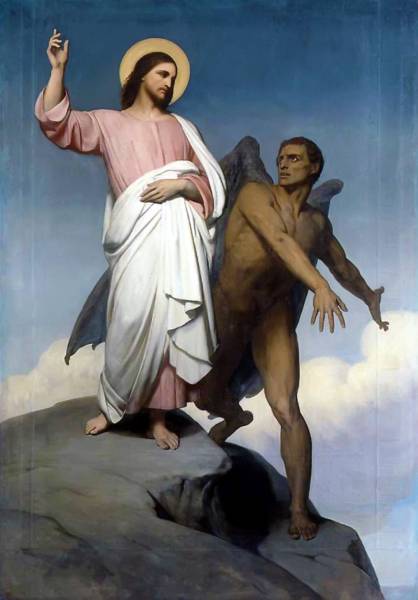
8 Again, the devil took him to an exceedingly high mountain, and showed him all the kingdoms of the world, and their glory.
9 He said to him, “I will give you all of these things, if you will fall down and worship me.”
10 Then Jesus said to him, “Get behind me, Satan! For it is written, ‘You shall worship the Lord your God, and you shall serve him only.’”
11 Then the devil left him, and behold, angels came and served him.
Matthew 4:1-11 · World English Bible

1445 - 1510
Florence, Italy
Alessandro di Mariano di Vanni Filipepi, known as Sandro Botticelli, was an Italian painter of the Early Renaissance. He belonged to the Florentine School under the patronage of Lorenzo de' Medici, a movement that Giorgio Vasari would characterize less than a hundred years later in his Vita of Botticelli as a "golden age". Botticelli's posthumous reputation suffered until the late 19th century; since then, his work has been seen to represent the linear grace of Early Renaissance painting.