Rembrandt Harmenszoon van Rijn
(Leiden, Netherland, 1606 - 1669)
Genesis 18:1-12
In this dynamic drawing, Rembrandt captures the dramatic climax of the biblical showdown on Mount Carmel, as described in 1 Kings 18. The prophet Elijah challenges the 450 priests of Baal, supported by King Ahab, to a contest: each side will prepare a sacrifice, and the true god will reveal himself by igniting it.
The priests of Baal spend the entire morning pleading with their deity to no avail. Elijah mocks their efforts, suggesting their god might be asleep. Then, in the late afternoon, Elijah prays to the Lord: “LORD God of Abraham, Isaac, and of Israel, let it be known this day that thou art God in Israel.” Instantly, fire consumes his offering.
Rembrandt illustrates this very moment—smoke rises from Elijah’s altar as the priests of Baal recoil in disbelief. Some Israelites drop to their knees in awe, and King Ahab watches from above at the upper right of the scene. The composition is charged with movement and reaction, highlighting the miracle and its immediate emotional impact.
Following this event, Elijah orders the execution of Baal’s prophets, sealing the triumph of Israel’s God in front of the assembled people.
This drawing reflects Rembrandt’s skill in conveying powerful biblical narratives with immediacy, emotion, and a masterful use of light and gesture.
Found in: 1 Kings, 1 Kings 18, 17th century
16 So Obadiah went to meet Ahab, and told him; and Ahab went to meet Elijah.
17 When Ahab saw Elijah, Ahab said to him, “Is that you, you troubler of Israel?”
18 He answered, “I have not troubled Israel; but you, and your father’s house, in that you have forsaken Yahweh’s commandments, and you have followed the Baals.
19 Now therefore send, and gather to me all Israel to Mount Carmel, and four hundred fifty of the prophets of Baal, and four hundred of the prophets of the Asherah, who eat at Jezebel’s table.”
20 So Ahab sent to all the children of Israel, and gathered the prophets together to Mount Carmel.
21 Elijah came near to all the people, and said, “How long will you waver between the two sides? If Yahweh is God, follow him; but if Baal, then follow him.” The people didn’t say a word.
22 Then Elijah said to the people, “I, even I only, am left as a prophet of Yahweh; but Baal’s prophets are four hundred fifty men.
23 Let them therefore give us two bulls; and let them choose one bull for themselves, and cut it in pieces, and lay it on the wood, and put no fire under; and I will dress the other bull, and lay it on the wood, and put no fire under it.
24 You call on the name of your god, and I will call on Yahweh’s name. The God who answers by fire, let him be God.” All the people answered, “What you say is good.”
25 Elijah said to the prophets of Baal, “Choose one bull for yourselves, and dress it first; for you are many; and call on the name of your god, but put no fire under it.”
26 They took the bull which was given them, and they dressed it, and called on the name of Baal from morning even until noon, saying, “Baal, hear us!” But there was no voice, and nobody answered. They leaped about the altar which was made.
27 At noon, Elijah mocked them, and said, “Cry aloud; for he is a god. Either he is deep in thought, or he has gone somewhere, or he is on a journey, or perhaps he sleeps and must be awakened.”
28 They cried aloud, and cut themselves in their way with knives and lances, until the blood gushed out on them.
29 When midday was past, they prophesied until the time of the evening offering; but there was no voice, no answer, and nobody paid attention.
30 Elijah said to all the people, “Come near to me!”; and all the people came near to him. He repaired Yahweh’s altar that had been thrown down.
31 Elijah took twelve stones, according to the number of the tribes of the sons of Jacob, to whom Yahweh’s word came, saying, “Israel shall be your name.”
32 With the stones he built an altar in Yahweh’s name. He made a trench around the altar, large enough to contain two seahs of seed.
33 He put the wood in order, and cut the bull in pieces, and laid it on the wood. He said, “Fill four jars with water, and pour it on the burnt offering, and on the wood.”
34 He said, “Do it a second time”; and they did it the second time. He said, “Do it a third time”; and they did it the third time.
35 The water ran around the altar; and he also filled the trench with water.
36 At the time of the evening offering, Elijah the prophet came near, and said, “Yahweh, the God of Abraham, of Isaac, and of Israel, let it be known today that you are God in Israel, and that I am your servant, and that I have done all these things at your word.
37 Hear me, Yahweh, hear me, that this people may know that you, Yahweh, are God, and that you have turned their heart back again.”
38 Then Yahweh’s fire fell, and consumed the burnt offering, the wood, the stones, and the dust, and licked up the water that was in the trench.
39 When all the people saw it, they fell on their faces. They said, “Yahweh, he is God! Yahweh, he is God!”
40 Elijah said to them, “Seize the prophets of Baal! Don’t let one of them escape!” They seized them; and Elijah brought them down to the brook Kishon, and killed them there.
1 Kings 18:16-40 · World English Bible
1606 - 1669
Leiden, Netherland
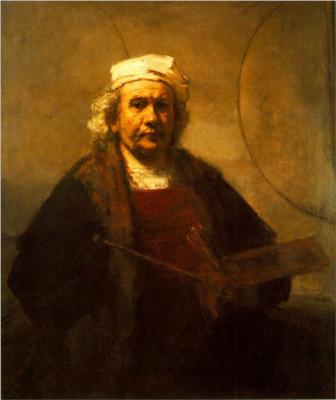
Rembrandt Harmenszoon van Rijn (15 July 1606– 4 October 1669) was a Dutch draughtsman, painter and printmaker. An innovative and prolific master in three media,he is generally considered one of the greatest visual artists in the history of art and the most important in Dutch art history.Unlike most Dutch masters of the 17th century, Rembrandt's works depict a wide range of style and subject matter, from portraits and self-portraits to landscapes, genre scenes, allegorical and historical scenes, biblical and mythological…