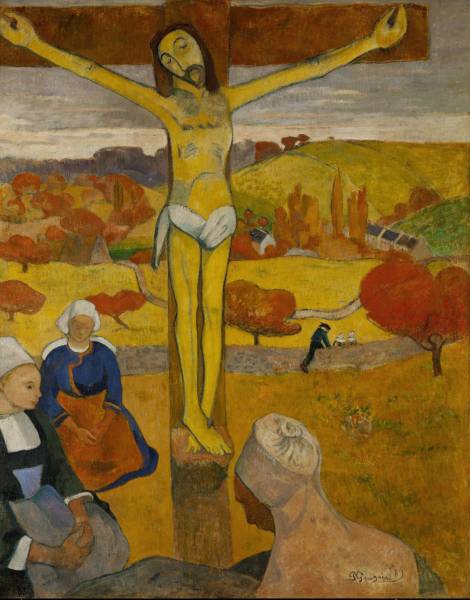
The Yellow Christ
(1889)
Paul Gauguin
(Paris, 1848 - 1903)
John 19:16-27
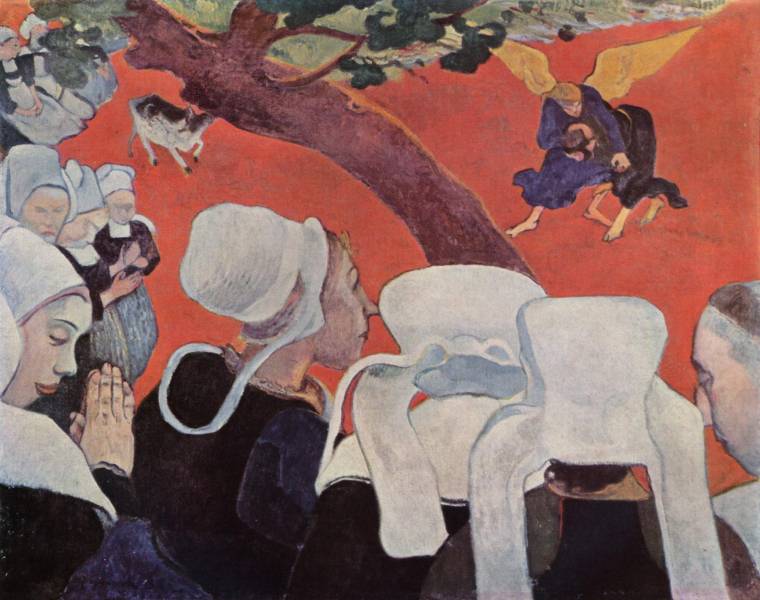
The Green Christ (in French: Le Christ vert) is a painting executed by Paul Gauguin in autumn 1889 in Pont-Aven, Brittany, France. Together with The Yellow Christ, it is considered to be one of the key-works of Symbolism in painting. It depicts a Breton woman at the foot of a calvary, or sculpture of Christ's crucifixion. Calvaries are common in town squares in Brittany. The woman appears to be hiding from a pair of figures in the distant background; the green christ providing her cover from the figures.
Topographically, the site depicted is the Atlantic coast at Le Pouldu. But the calvary depicted is an amalgam of calvaires from different site; the cross is based upon that in the centre of Névez, a community close to Pont-Aven and several miles from the coast, and the figure of Christ is based upon the calvaire at Briec - also some distance from the sea.
Found in: John, John 19, 19th century, Crucifixion
16 So then he delivered him to them to be crucified. So they took Jesus and led him away.
17 He went out, bearing his cross, to the place called “The Place of a Skull”, which is called in Hebrew, “Golgotha”,
18 where they crucified him, and with him two others, on either side one, and Jesus in the middle.
19 Pilate wrote a title also, and put it on the cross. There was written, “JESUS OF NAZARETH, THE KING OF THE JEWS.”
20 Therefore many of the Jews read this title, for the place where Jesus was crucified was near the city; and it was written in Hebrew, in Latin, and in Greek.
21 The chief priests of the Jews therefore said to Pilate, “Don’t write, ‘The King of the Jews,’ but, ‘he said, “I am King of the Jews.”’”
22 Pilate answered, “What I have written, I have written.”
23 Then the soldiers, when they had crucified Jesus, took his garments and made four parts, to every soldier a part; and also the coat. Now the coat was without seam, woven from the top throughout.
24 Then they said to one another, “Let’s not tear it, but cast lots for it to decide whose it will be,” that the Scripture might be fulfilled, which says, “They parted my garments among them. For my cloak they cast lots.” Therefore the soldiers did these things.
25 But there were standing by the cross of Jesus his mother, and his mother’s sister, Mary the wife of Clopas, and Mary Magdalene.
26 Therefore when Jesus saw his mother, and the disciple whom he loved standing there, he said to his mother, “Woman, behold, your son!”
27 Then he said to the disciple, “Behold, your mother!” From that hour, the disciple took her to his own home.
John 19:16-27 · World English Bible
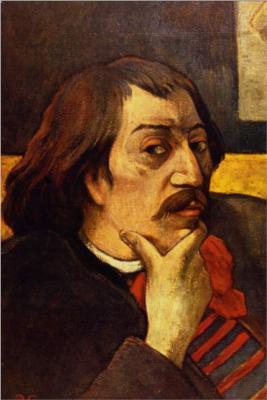
1848 - 1903
Paris, France
Eugène Henri Paul Gauguin was a French post-Impressionist artist. Unappreciated until after his death, Gauguin is now recognized for his experimental use of colour and Synthetist style that were distinctly different from Impressionism. Toward the end of his life, he spent ten years in French Polynesia, and most of his paintings from this time depict people or landscapes from that region.