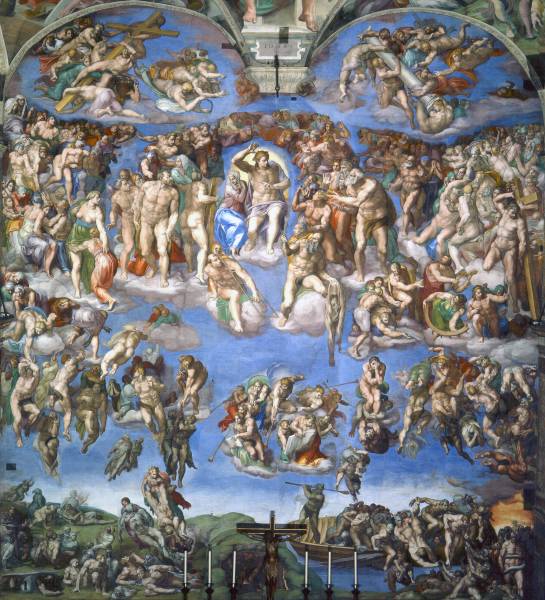
The Last Judgment
(1536)
Michelangelo
(Florence, Italy, 1475 - 1564)
Matthew 25:31-46
Mattia Preti's "Pilate Washing His Hands" is a masterful depiction of a pivotal moment in the Passion of Christ, as described in Matthew 27:24. The scene shows Pontius Pilate, the Roman governor of Judea, washing his hands in a symbolic gesture of innocence, declaring himself blameless for the fate of Jesus. This dramatic moment marks a turning point in the narrative, as Pilate's refusal to intervene ultimately seals Jesus' fate. Preti's painting captures the tension and drama of this scene, conveying the complexity of Pilate's character and the weight of his decision.
The artistic composition of "Pilate Washing His Hands" is characterized by Preti's signature use of chiaroscuro, a strong contrast between light and dark that creates a sense of depth and volume. The painting's central figure, Pilate, is bathed in a warm, golden light, while the surrounding figures are cast in shadow, creating a sense of drama and highlighting the emotional intensity of the moment. The symbolism in the painting is also noteworthy, with the act of handwashing serving as a powerful metaphor for Pilate's attempt to cleanse himself of responsibility. The figure of Pilate, meanwhile, is depicted with a sense of psychological complexity, his expression conveying a mix of emotions, from guilt to indifference.
The significance of "Pilate Washing His Hands" extends beyond its artistic merits, as it offers a window into the cultural and historical context of 17th-century Europe. Painted in 1663, the work reflects the artistic and intellectual currents of the time, including the influence of Caravaggio and the emerging Baroque style. As a major work by a prominent artist, "Pilate Washing His Hands" is also a testament to Preti's skill and versatility, demonstrating his ability to craft compelling and emotionally resonant scenes that continue to captivate audiences today.
As a work of biblical art, "Pilate Washing His Hands" offers a powerful interpretation of a pivotal moment in the Christian narrative, one that continues to resonate with audiences today. Preti's masterful use of light, composition, and symbolism brings the scene to life, inviting the viewer to reflect on the complexities of human nature and the consequences of our actions. As a masterpiece of 17th-century art, "Pilate Washing His Hands" remains a compelling and thought-provoking work, one that rewards close observation and contemplation.
Found in: Matthew, Matthew 27, 17th century
24 So when Pilate saw that nothing was being gained, but rather that a disturbance was starting, he took water, and washed his hands before the multitude, saying, “I am innocent of the blood of this righteous person. You see to it.”
Matthew 27:24 · World English Bible
1613 - 1699
Taverna, Italy
Mattia Preti (1613-1699), known as "Il Cavalier Calabrese" (the Calabrian Knight), stands among the most accomplished masters of Italian Baroque painting. Born in the small Calabrian town of Taverna, Preti's artistic journey began with early training under Giovanni Battista Caracciolo, a follower of Caravaggio, which profoundly influenced his dramatic use of light and shadow throughout his career. By 1630, he had joined his painter brother Gregorio in Rome, where he immersed himself in the techniques of Caravaggio's school while also…