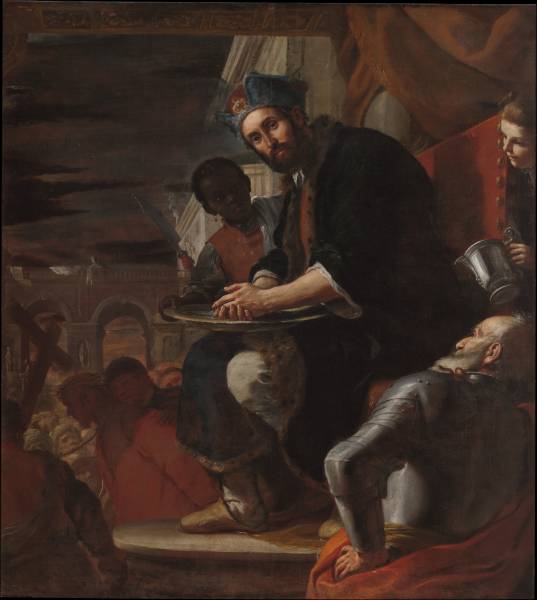
Pilate Washing His Hands
(1663)
Mattia Preti
(Taverna, 1613 - 1699)
Matthew 27:24
1613 - 1699
Taverna, Italy
Mattia Preti (1613-1699), known as "Il Cavalier Calabrese" (the Calabrian Knight), stands among the most accomplished masters of Italian Baroque painting. Born in the small Calabrian town of Taverna, Preti's artistic journey began with early training under Giovanni Battista Caracciolo, a follower of Caravaggio, which profoundly influenced his dramatic use of light and shadow throughout his career. By 1630, he had joined his painter brother Gregorio in Rome, where he immersed himself in the techniques of Caravaggio's school while also studying the works of Guercino, Rubens, and Guido Reni.
Preti's mature style combined Caravaggesque chiaroscuro with the dynamic energy of the high Baroque, creating powerfully emotional religious narratives. His mastery of large-scale compositions became evident in his fresco cycles for Roman churches including Sant'Andrea della Valle and San Carlo ai Catinari. During his Neapolitan period (1653-1660), he created one of his most ambitious projects: a series of monumental ex-voto frescoes on the city's seven gates, depicting saints and the Virgin delivering the people from plague. Though these works are now lost, surviving sketches reveal his bold vision of divine intervention in human suffering.
In 1660, Preti was appointed Knight of Grace in the Order of St. John, leading to his relocation to Malta, where he would spend his final decades and create his masterpiece. His transformation of St. John's Co-Cathedral in Valletta through an extensive cycle depicting the life and martyrdom of St. John the Baptist (1661-1666) represents one of the finest achievements of Baroque religious art. These paintings, with their theatrical lighting and emotional intensity, demonstrate Preti's ability to make biblical narratives immediate and compelling for contemporary viewers.
Preti's legacy extends far beyond Malta's shores, with his works held in major museums throughout Europe. His paintings exemplify the late Baroque synthesis of Caravaggesque naturalism with decorative grandeur, influencing subsequent generations of religious painters. Today, he is commemorated in Valletta's Mattia Preti Square, and his remains rest in the very cathedral he so magnificently adorned, ensuring his continued presence in the sacred space he transformed through his artistic vision.
1 artwork found