Cosimo Rosselli
(Florence, 1439 - 1507)
Exodus 32
On 27 October 1480 Rosselli, together with other Florentine painters, left for Rome, where he had been called as part of the reconciliation project between Lorenzo de' Medici, the de facto ruler of Florence, and Pope Sixtus IV. The Florentines started to work in the Sistine Chapel as early as the Spring of 1481, along with Pietro Perugino, who was already there.
The theme of the decoration was a parallel between the stories of Moses and those of Christ, as a sign of continuity between the Old and the New Testament, as well as between the divine law of the Tables and the message of Jesus, who had chosen Peter (the first alleged bishop of Rome) as his successor: This would finally result in a legitimation of the latter's successors, the popes of Rome.
Due to the commission's size, the artists brought with them numerous assistants. Rosselli brought his son-in-law Piero di Cosimo. According to the Renaissance art historian Giorgio Vasari, Rosselli was considered one of the less gifted among the painters at the Sistine Chapel, and his paintings in the chapel were the subject of the other artists' irony. However, his sheer adoption of brilliant colors granted him the appreciation of the pope, who apparently, was not considered an art expert.
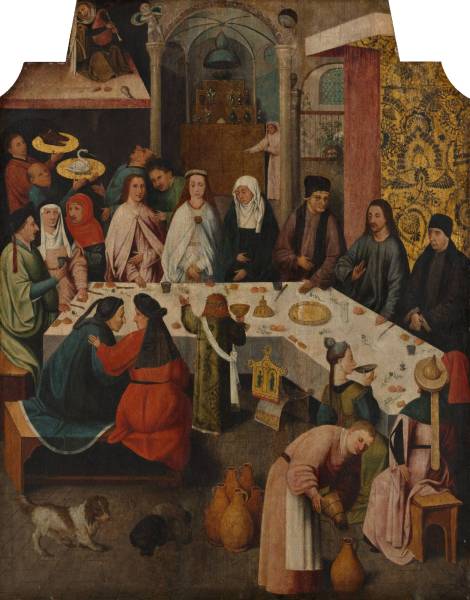
Found in: Matthew, Matthew 26, 15th century, Last Supper
17 Now on the first day of unleavened bread, the disciples came to Jesus, saying to him, “Where do you want us to prepare for you to eat the Passover?”
18 He said, “Go into the city to a certain person, and tell him, ‘The Teacher says, “My time is at hand. I will keep the Passover at your house with my disciples.”’”
19 The disciples did as Jesus commanded them, and they prepared the Passover.
20 Now when evening had come, he was reclining at the table with the twelve disciples.
21 As they were eating, he said, “Most certainly I tell you that one of you will betray me.”
22 They were exceedingly sorrowful, and each began to ask him, “It isn’t me, is it, Lord?”
23 He answered, “He who dipped his hand with me in the dish, the same will betray me.
24 The Son of Man goes, even as it is written of him, but woe to that man through whom the Son of Man is betrayed! It would be better for that man if he had not been born.”
25 Judas, who betrayed him, answered, “It isn’t me, is it, Rabbi?” He said to him, “You said it.”
26 As they were eating, Jesus took bread, gave thanks for it, and broke it. He gave to the disciples, and said, “Take, eat; this is my body.”
27 He took the cup, gave thanks, and gave to them, saying, “All of you drink it,
28 for this is my blood of the new covenant, which is poured out for many for the remission of sins.
29 But I tell you that I will not drink of this fruit of the vine from now on, until that day when I drink it anew with you in my Father’s Kingdom.”
30 When they had sung a hymn, they went out to the Mount of Olives.
Matthew 26:17-30 · World English Bible
1439 - 1507
Florence, Italy
Cosimo Rosselli (1439–1507) was an Italian painter of the Quattrocento, active mainly in his birthplace of Florence, but also Lucca earlier in his career, and from 1480 in the Sistine Chapel in Rome, where he painted some of the large fresco panels on the side walls. Despite being roughly the same age (slightly older in each case) as Sandro Botticelli, Pietro Perugino and Domenico Ghirlandaio, the other leading Florentine painters, all regarded as greater talents, Rosselli was still able to…